
Ads of Real Estate: 12 Examples That Convert in 2026

- Real estate ads on Meta, TikTok, and YouTube Shorts are now the primary buyer touchpoint, with a typical buyer scrolling for 6 to 8 months before contacting an agent.
- The ads of real estate that actually convert share 5 traits: a 3 second hook, local specificity, the agent on camera, a single CTA, and hardcoded captions.
- Solo agents need 4 to 8 short form ads per week to stay top of feed, which collapses the DIY filming model for anyone running listings full time.
- 12 ad formats break down into 4 buckets: listing-led, agent-led, neighborhood-led, and social proof. The article maps each to its goal, length, and platform.
- Production paths in 2026 fall into 3 buckets, with cost ranging from $0 (DIY phone) to $1,500-$3,000 per month (videographer) to $39-$499 per month for AI video tools.
- Argil sits in the AI video bucket and removes the daily filming bottleneck for solo agents who need their own face on camera 4 to 8 times a week. Pricing starts at $39 per month for the Classic plan, verified at argil.ai/pricing in May 2026.
Ads of Real Estate: 12 Examples That Convert in 2026
Why real estate ads are a daily cadence game now
Meta, TikTok, Instagram, and YouTube Shorts are still where many home buyers gather signals before reaching out, but 2026 NAR (National Association of Realtors) reporting shows the bigger story is that buyers are taking longer overall and relying heavily on agents.
That timeline reshapes the math on cadence. Showing up in feed every other day for 6 months is what wins the listing appointment, while posting once a week gets the agent forgotten by the algorithm and the buyer on the same schedule. Buffer's 2024 social media benchmarks report puts the short form video hook window at 3 seconds, which means the first frame either earns the next 30 or it does not. Source: Buffer State of Social 2024.
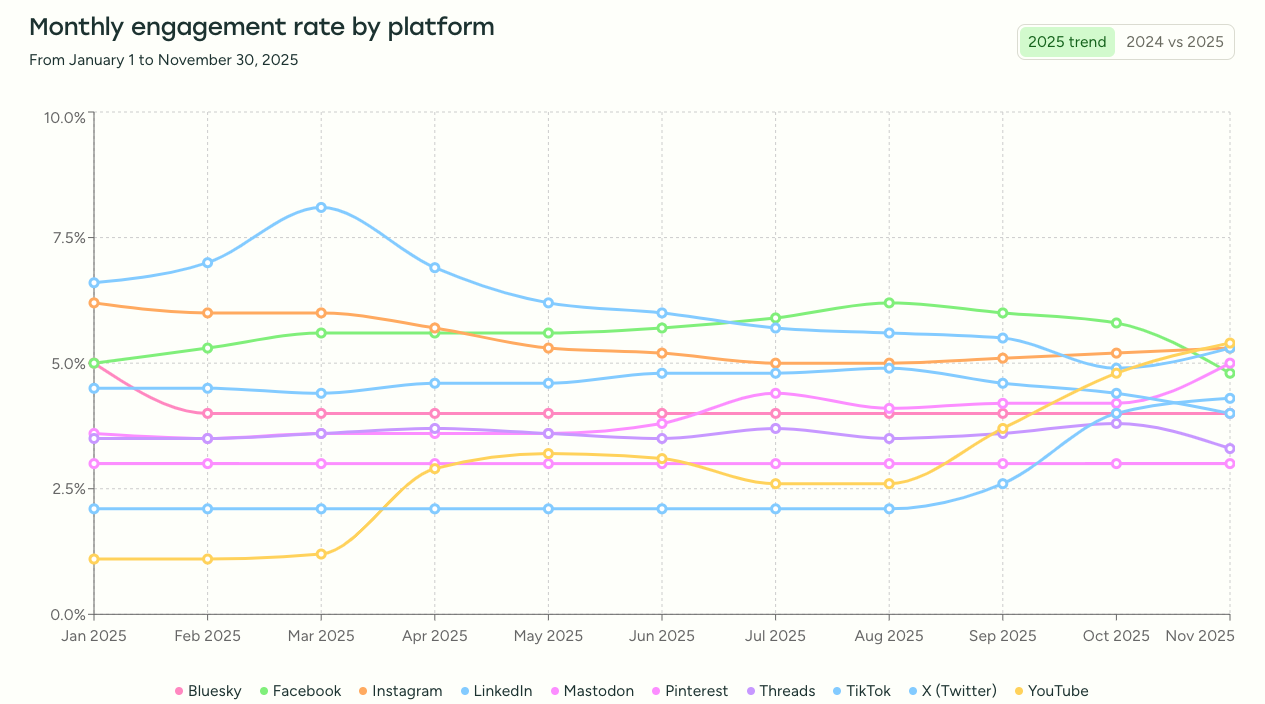
Image source: Buffer
3 to 5 short form ads per week is the realistic baseline for staying on the algorithm's radar. Teams that treat that number as a system instead of a finish line dominate local feed.
This guide breaks down 12 specific ads of real estate worth stealing, organized by hook, format, distribution, and what makes each one work. The final third covers how solo agents are producing this volume in 2026 without filming daily.
What separates a real estate ad that converts
Before walking through the 12 examples, lock 5 traits that show up in every converting ad. Miss any and the creative reads as filler regardless of how it is produced.
The 3 second hook rule
The first frame must visually communicate the property, the neighborhood, or the agent's face. Logo intros, slow drone establishing shots, and music builds all push the hook past the scroll threshold. Cut the first 5 seconds of every ad in your drafts folder and rewrite from the hook.
The local specificity test
The ad must name a neighborhood, school district, price band, or buyer persona in the opening 5 seconds. Generic 'find your dream home' framing does not convert because it does not signal who the ad is for. The buyer scrolling at 9pm needs to recognize themselves in the first sentence.
The agent on camera trust signal
Ads with the agent's face in the first 2 seconds outperform faceless property b-roll on watch through and save rate. Buyers want to know who they would actually be working with before they care about the listing itself. Even a 2 second cutaway to the agent's face inside an otherwise property-led ad lifts both metrics.
The single CTA rule
One action per ad. DM for the address, comment HOME for the guide, click for the showing slot. Multiple CTAs collapse conversion because the viewer hesitates, and the algorithm reads hesitation as a signal to bury the next post.
Captions on by default
Over 85% of feed video is watched muted, per Meta's creative guidance for advertisers. Hardcoded captions are required, not optional. Auto-captions count, but only if you confirm they are accurate before publishing. Source: Meta Business creative guide.
12 ads of real estate worth stealing
Each format below is in active rotation by top producing agents in 2026. Steal the structure, plug in your own neighborhood and listing details, and post the result this week. Length, hook, and distribution channel are called out for every one.
1. Solo agent talking head listing intro
The selfie listing video is the highest yield format for any agent comfortable on camera. The agent walks the property, phone vertical, narrating standout features as they move room to room.
- Format: 30 to 45 seconds, vertical 9:16, agent walking and talking.
- Hook: I just listed this 3-bed in [neighborhood] for [price] and here is the one thing the photos do not show you.
- Distribution: Reels, TikTok, LinkedIn.
- Why it works: Combines agent face, neighborhood specificity, price anchor, and a curiosity hook in the opening 4 seconds. The unpolished walking version outperforms the produced version because it reads as on the ground.
- Watch-out: Reading from a teleprompter is the kill switch. Memorize the hook, improvise the body.
2. Drone exterior plus voice over walkthrough
When the property has scale, lot size, or a view, the drone reveal opens with stakes the phone cannot capture. Tight interior cuts under voice over keep the narrative moving once the buyer is hooked.
- Format: 60 to 90 seconds, drone pull back opener, then interior cuts under voice over.
- Hook: This 1-acre lot is the largest in [neighborhood], and the inside lives even bigger.
- Distribution: Reels, YouTube Shorts, listing landing page.
- Why it works: Drone establishes scale instantly. Voice over keeps the narrative tight without requiring blocking. Interior cuts maintain pace while the voice does the storytelling work.
- Watch-out: Drone footage is the budget barrier. Invest in a Mavic and FAA Part 107 certification, or build a relationship with one local drone operator.
3. Day in the life agent ad
The day in the life ad is a personal brand asset disguised as content. It builds trust by showing the unglamorous parts of the work, including the early mornings and the cancelled appointments.
- Format: 45 to 60 second compilation of the agent's actual day, vertical, mostly self-shot.
- Hook: A day as a [city] real estate agent in 2026.
- Distribution: TikTok, Reels, Instagram Stories.
- Why it works: Builds trust by showing the work, not just the wins. Pulls in younger buyers and recruits at the same time.
- Watch-out: Glamorizing the day kills credibility. Show the parking ticket, the missed showing, the cold coffee. The grittier, the more it converts.
4. Neighborhood guide ad
The neighborhood guide pulls in buyers who are 4 to 6 months out from purchasing. It is the highest ROI format for buyer side lead gen because most agents are too focused on listings to film it.
- Format: 60 to 90 seconds, agent walking the neighborhood (not a house), pointing out coffee shops, parks, schools, and commute landmarks.
- Hook: If you are thinking of moving to [neighborhood], here are the 5 things nobody tells you.
- Distribution: YouTube (long version), Reels (cut down), TikTok.
- Why it works: Ranks the agent as the local expert before they pitch a listing. Captures top of funnel buyers competitors are ignoring. The 5-things framing creates list payoff that holds attention through the full runtime.
- Watch-out: Stick to public sidewalks and exterior shots until you have permission agreements with the businesses you feature.
5. Just listed teaser
The 15 second teaser is built for speed and shareability. Big text on screen does the work voice over cannot in that runtime, the cuts are fast, and there is no dialog. The format is designed to be re-shared in agent group chats and saved by buyers who want to come back later.
- Format: 15 to 20 second hype clip, fast cuts, music, big text overlays. Vertical 9:16.
- Hook: JUST LISTED [neighborhood] [bed/bath] [price] on screen in the first frame.
- Distribution: Reels, Stories, agent group chats, Facebook listing groups.
- Why it works: Pure speed. The text overlay does the work voice over cannot in 15 seconds, and the sub-30 second runtime hits Reels' completion sweet spot.
- Watch-out: Pair every teaser with a longer walkthrough posted 24 hours later. The teaser earns the save, the walkthrough earns the showing request.
6. Just sold social proof ad
The just sold ad is social proof at its purest. Buyers and sellers both consume it, which makes it the most efficient credentialing asset on a one-shoot basis.
- Format: 20 to 30 second before and after of the listing process, with optional 5 second client reaction clip.
- Hook: Listed for [X], sold for [Y], in [Z] days.
- Distribution: Reels, LinkedIn, agent landing page.
- Why it works: Compresses the value proposition into 1 sentence and 30 seconds. Sellers see the result. Buyers see how fast inventory moves. Both consume it without feeling pitched.
- Watch-out: Do not run more than 1 just sold per week. Higher cadence reads as bragging, and the algorithm starts treating the account as a self-promotion node.
7. Market update Q&A
The market update positions the agent as the data source for the local market. It earns saves at higher rates than any listing-led format because the data is portable.
- Format: 30 to 60 second talking head answering 1 specific market question with the data point on screen.
- Hook: [City] buyers are asking me this every week, so here is the answer.
- Distribution: Reels, TikTok, LinkedIn, email newsletter.
- Why it works: Pulls in fence sitters watching rates and inventory. The 1 question per ad structure makes the takeaway portable across feeds.
- Watch-out: Source the data (MLS, local board, Redfin, Zillow) and put the source on screen. Unsourced numbers kill the trust signal.
8. First time buyer guide ad
The first time buyer ad educates the most anxious buyer cohort, and anxious buyers convert faster than confident ones. Build a series of 6 to 8 and pin them to the profile.
- Format: 45 to 75 seconds, agent breaking down 1 first time buyer concept (closing costs, earnest money, contingencies, appraisal gaps).
- Hook: If you are buying your first home in [city], here is the one thing nobody explains until it is too late.
- Distribution: TikTok, Reels, YouTube Shorts.
- Why it works: The 1 concept per ad structure makes each one binge-able in a series. Compounds as evergreen lead gen because the topics do not date.
- Watch-out: Pin the series to the profile in priority order: closing costs, earnest money, contingencies, appraisal gaps.
9. Before and after staging reveal
The before and after staging reveal has the highest watch through rate of any real estate format because the payoff is instant and visual. It doubles as a pitch asset for seller listing appointments.
- Format: 20 to 30 second split screen or wipe transition between empty or dated room and staged room.
- Hook: Visual contrast in the first frame, no voice over needed.
- Distribution: Reels, TikTok, Pinterest.
- Why it works: Highest watch through rate of any real estate format. Doubles as a seller pitch asset because you can show prospects the staging delta on a previous listing during the appointment.
- Watch-out: Get the staging release in writing before you film. Some stagers retain rights and will not allow social distribution without a license.
10. Broker recruitment ad
Most teams ignore recruitment ads, which leaves the field wide open for any team running them with intent. The format pulls in agents who are unhappy at their current brokerage.
- Format: 45 to 60 second talking head from the team lead, framed around why agents are joining.
- Hook: We added 12 agents in Q1 and here is what they all said about why they left their old brokerage.
- Distribution: LinkedIn (primary), Reels, Facebook.
- Why it works: LinkedIn rewards talking head with insight better than any other channel for recruitment, and most agents who would consider switching brokerages actually scroll there during commute hours.
- Watch-out: Pair with a no-pitch CTA: book a 15 minute brokerage comparison. Pitching upfront kills the inbound.
11. Client video testimonial
The testimonial is the only format where the agent does not speak, which is exactly why it converts. Buyers trust other buyers more than they trust agents.
- Format: 30 to 60 second clip of an actual client describing the experience. Filmed at the closing table on phone vertical.
- Hook: The client's first sentence about why they chose this agent.
- Distribution: Reels, listing landing page, email follow ups.
- Why it works: Buyers trust other buyers more than they trust agents, and closing-table testimonials read as real where studio testimonials read as paid.
- Watch-out: Capture testimonials at the closing table. Asking the client to record one later from home almost never happens.
12. Holiday or seasonal touchpoint
The seasonal touchpoint keeps the agent top of mind during low intent months. It is a soft compounding asset, not a direct response play, and it earns referrals on a 6 to 12 month lag.
- Format: 20 to 30 second light touch seasonal ad (4th of July, Thanksgiving, market year in review). Warm, personal, no listing pitch.
- Hook: A warm personal opening, no listing pitch attached.
- Distribution: Stories, Reels, email.
- Why it works: Reads as a person, not a brand, which is the entire point. Soft compounding effect on referrals.
- Watch-out: Do not slap a CTA on these. The CTA-free version earns more replies than the version with a booking link.
How to choose the right real estate ad format for your goal
12 formats is too many to run all at once. Pick 4 to 5 based on the goal, then layer the rest as the system gets faster.
Map the goal to the format
The goal of the ad sets the format. Pick the goal first, then walk down to the format that serves it.
- Buyer lead gen: neighborhood guide, first time buyer guide.
- Seller lead gen: just sold, before and after staging.
- Brand building: day in the life, market update.
- Recruitment: broker recruitment talking head.
- Speed plays: just listed teaser, holiday or seasonal.
Allocate the cadence across the week
A healthy week is 1 listing related ad, 2 educational ads (neighborhood or buyer guide), 1 personal brand ad, and 1 social proof ad. Running 5 listing ads in a row reads as inventory dump, even if the listings are good.
Match the channel to the format
TikTok rewards faster cuts and rougher production. LinkedIn rewards longer talking head with insight. Reels accept either. YouTube Shorts rewards search-friendly titles even at 60 second runtime.
Where solo agents get stuck producing this volume of ads of real estate
The bottleneck is rarely the formats themselves. It is producing 4 to 8 of them per week with the agent on camera, every week, without setting up a tripod every morning. Walk through the 3 production paths agents are choosing in 2026 honestly, then pick.
Path 1: DIY phone production
Cost is $0, assuming the agent has a phone. Time cost is 6 to 10 hours per week once filming and editing are factored in. Output quality is inconsistent because lighting and energy fluctuate by day.
DIY phone fits agents who genuinely enjoy filming and have block time. It does not fit full time agents juggling showings, listing appointments, and admin. The math breaks the moment the agent has 2 active listings.
Path 2: Hire a part time videographer
Cost runs $1,500 to $3,000 per month for a part time freelancer producing 4 to 8 videos. Higher in major metros. Time cost is still 2 to 4 hours per week because the agent has to BE on camera in every shoot.
Videographer fits agents who want consistent quality and have the budget. The catch: even with a videographer on retainer, daily output is impossible because the videographer is bottlenecked by their own schedule. Production gets outsourced, but the agent still has to be on camera for every shoot, which keeps the daily ceiling firmly in place.
Path 3: AI video tools
Cost runs $39 to $499 per month depending on the plan. Argil's Classic plan is $39 per month for 1,600 credits and 100+ avatars, Pro is $149 per month for 6,000 credits, and Scale is $499 per month for 18,000 credits. Time cost is 30 to 60 minutes per week to script and generate 4 to 8 videos. Pricing verified at argil.ai/pricing in May 2026.
How it works: the agent records 1 training video of themselves, 2 minutes long. Argil builds an AI clone trained on the agent's actual voice and face. The agent then writes a script, or pastes an existing newsletter or market update, and Argil generates a fully edited short form video with captions, b-rolls, and transitions built in. The real estate agents using AI for UGC content guide walks through the full workflow with examples.
Path 3 fits agents who need 4 to 8 videos a week with their own face on camera and cannot film daily. It does not fit listing walkthroughs (the property still needs phone footage) or any ad where physical movement through a space is the point. Pair the AI clone for talking head ads with phone footage for listing walkthroughs and you cover the whole content week.
The trust objection answered honestly
AI cloned video does not read as fake when the agent on screen is the actual agent and the script is in their voice. The clone removes the daily camera friction without touching the credibility. The 'looks fake' problem comes from stock avatars reading LLM scripts, which is a different product category. For a deeper read on which AI tools fit real estate, the top AI avatar tools for real estate video walkthroughs guide breaks down the field.
FAQ on ads of real estate
How many ads of real estate should a solo agent post per week?
3 to 5 short form ads per week is the realistic floor for staying top of feed. Less than that and the algorithm forgets the account. More than 5 works only if the agent has a system (template plus AI video) to avoid quality drop. Start at 3, then add 1 per week as the system gets faster.
What is the best length for a real estate ad on Meta and TikTok?
15 to 30 seconds for top of funnel attention (just listed, just sold, before and after). 45 to 90 seconds for educational and trust building (neighborhood guides, buyer education, market updates). The hook stays in the first 3 seconds regardless of length. TikTok now favors 60 second plus videos in the algorithm, so the longer formats are no longer at a disadvantage on that platform.
Do I need to be on camera for ads of real estate to convert?
Yes for ads where the agent is the differentiator: personal brand, market commentary, buyer education. No for ads where the property is the differentiator: just listed teasers, before and after staging, drone exteriors. Most converting agents are on camera for at least 60% of their content. AI video tools let agents stay on camera daily without filming daily, which closes the cadence gap for everyone else.
How much does it cost to produce ads of real estate consistently?
DIY phone is free but consumes 6 to 10 hours per week. Part time videographer runs $1,500 to $3,000 per month and is bottlenecked by scheduling. AI video tools run $39 to $499 per month (Argil's Classic at $39, Pro at $149, Scale at $499 verified May 2026 at argil.ai/pricing). Solo agents are increasingly defaulting to a phone plus AI hybrid because it covers both the listing walkthroughs and the talking head cadence inside the same week.
What is the single biggest mistake agents make with ads of real estate?
Front loading the ad with logo intros, slow music builds, or generic 'find your dream home' framing. Buyers scroll past anything that does not name a neighborhood, price, or specific buyer persona in the first 3 seconds. The fix is brutal: cut the first 5 seconds of every ad in your drafts folder and rewrite the hook from scratch.
Should I run paid ads or rely on organic for real estate video?
Organic first. The same ad that performs organically is the one worth boosting. Agents who skip the organic test and put dollars behind untested creative burn budget. Once a video clears 5,000 organic views or generates 2 plus DMs in 48 hours, push $20 to $100 behind it for local geo targeting. Everything below that threshold gets cut, not boosted.
Related articles
- Top AI avatar tools for real estate video walkthroughs
- How real estate agents are using AI to create viral UGC videos in 2026
- Best real estate marketing agencies in 2026
The agents who win local feed in 2026 will be the ones who built a 4 to 8 ads per week system that still ships in week 26 without burning the agent out by Wednesday.