12 Best Corporate Video Production Companies in 2026 (and When AI Beats Them)
Compare the 12 best corporate video production companies in 2026 with verified prices, project tiers, and when AI video tools now beat traditional vendors.

Article Highlights
- Corporate video production runs $5K to $200K per project
- Per finished minute pricing sits at $1,000 to $10,000
- 12 vendor profiles cover boutique, mid market, premium tiers
- AI video tools now own internal comms and exec content
- Hybrid stack beats single vendor for 2026 video budgets
- Argil fits the recurring exec and founder video slot
12 Best Corporate Video Production Companies in 2026 (and When AI Beats Them)
Most teams shopping for corporate video production in 2026 are sending the recurring exec and training work to agencies that should never have priced it. Hero brand films, customer testimonials, and launch ads still belong in a studio. The weekly founder update and the 40 training videos used to live there too, and now they don't.
This guide covers the 12 best corporate video production companies operating in 2026, with verified price ranges and project specialties. Then it covers when traditional production stops penciling out, and which AI video tools have taken that work over. Read it before you sign anything.
Context on why this matters: 91% of businesses now use video as part of their marketing strategy, up from 86% in 2024 (Wyzowl Video Marketing Statistics 2026). 80% of B2B teams say LinkedIn is their primary distribution channel for video, beating YouTube (Wistia State of Video 2026). Demand is climbing while budgets are not, which is why allocation matters more than vendor pick.
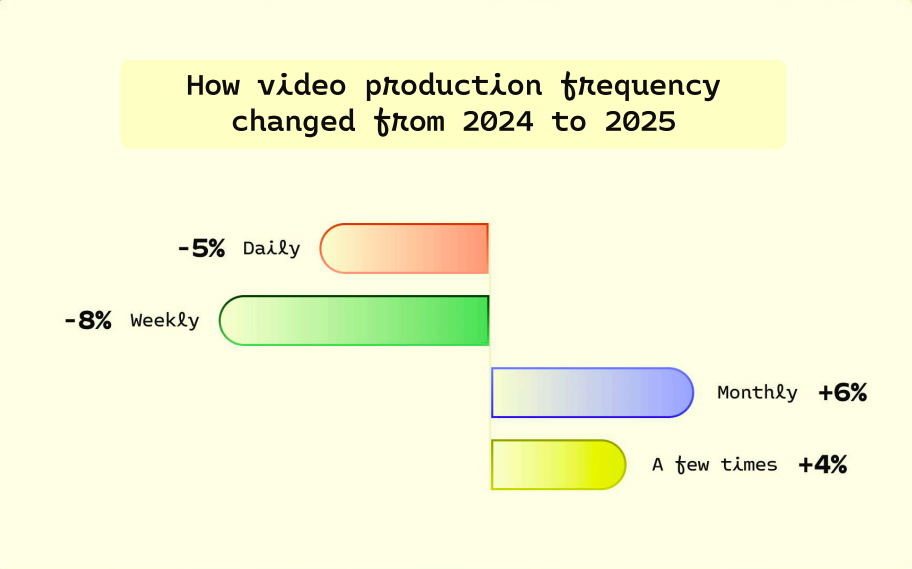
Monthly production is now the most common pace, and teams are moving toward a more sustainable rhythm. Image source: Wista State of Video Report 2026
What corporate video production actually costs in 2026
Pricing in this category breaks into three tiers, and almost every quote you receive will sit inside one of them.
Boutique studios run roughly $5,000 to $25,000 per project, typically a single-day shoot in talking-head format with stock footage and one round of edits. Mid-market agencies run $25,000 to $100,000 for multi-day shoots, multiple locations, custom motion graphics, and multilingual deliverables. Premium agencies that produce Super Bowl spots sit at $100,000 and up.
On a per finished minute basis, the industry rule of thumb in 2026 is $1,000 to $10,000 per minute. Basic talking-head sits at the low end, live-action with a professional presenter falls between $1,000 and $3,000 per minute, and custom 2D animation can hit $7,000 to $20,000 per minute.
What drives corporate video production costs up
- On-site crew, location permits, and travel for multi-day shoots.
- Talent fees for professional actors, voiceover artists, or named hosts.
- Custom animation and motion graphics built from scratch.
- Multi-language deliverables, each requiring its own voiceover, captions, and review cycle.
What drives corporate video production costs down
- Studio shoots over location shoots.
- Single-talent setups, especially talking-head formats.
- Internal-only usage, which removes broadcast and licensing fees.
- Pre-built templates or modular animation libraries instead of custom assets.
Hidden costs most buyers miss
Three line items get bolted on after the contract is signed: usage rights for talent and music if the video lives beyond a year or moves to paid media, additional language versions quoted separately from the base shoot, and edits beyond the contracted round count charged hourly. Read your contract before you greenlight.

Watch for extra charges: usage rights, extra languages, and edits beyond the agreed rounds.
How we ranked these 12 corporate video production companies
We weighted five criteria for buyers who actually need to write a check: industry reputation (years in market and named clients), specialty fit across brand films, training, and internal comms, cost transparency (do they publish pricing or force a discovery call), turnaround from kickoff to delivered file, and scalability across one-offs and ongoing programs.
All 12 are real, currently operating studios. We grouped them into boutique, mid-market, and premium tiers to make the budget-conscious shortlist easier.
The 12 best corporate video production companies in 2026
1. Sandwich Video
Best for: B2B SaaS launch films and brand-defining hero videos.
Strengths: Long history of Silicon Valley launch films, with Slack, Notion, and Robinhood among their historical clients. Handles strategy and production in-house, so you don't pay an agency to brief a separate production company.
Cost: around $100,000 per video for a typical launch film, per their TechCrunch profile, with current pricing trending higher for premium hero work.
Limitation: Wrong vendor for ongoing internal comms volume. They build films, not pipelines.
2. Demo Duck
Best for: Explainer videos and brand stories with a strong narrative spine.
Strengths: Animation and live-action hybrid with a strong scriptwriting culture and clean process documentation.
Cost: animated videos typically run $20,000 to $25,000, live-action explainers $35,000 to $50,000+. Most projects do not start under $20,000.
Limitation: Smaller team means tight project queues during busy quarters.
3. Yum Yum Videos
Best for: Animated explainer videos for SaaS and complex products.
Strengths: Scriptwriting-led process. Clear pricing tiers published on their site.
Cost: typically $7,000 to $15,000 per animated explainer.
Limitation: Limited live-action capability. If your script needs real people on camera, route elsewhere.
4. Vidico
Best for: Tech and SaaS brand video, especially companies wanting predictable monthly volume.
Strengths: Distributed production model keeps costs lower than coast-based agencies. Subscription pricing model for ongoing programs.
Cost: subscription pricing starts around $3,999/month for four 15-second videos. Project-based work runs $10,000 to $60,000.
Limitation: Less suited to non-tech verticals where category vocabulary matters.
5. Lemonlight
Best for: Mid-market brands needing nationwide US production at a transparent price.
Strengths: Nationwide crew network. Predetermined pricing tiers, which is rare in this category.
Cost: animated videos start at $3,500, scripted videos at $8,000. Doc-style and curated stock builds sit between.
Limitation: Production quality can vary project-to-project depending on which crew picks up your job.
6. Sparkhouse
Best for: Brand films and corporate video for Orange County and West Coast brands.
Strengths: Per-project fixed-fee structure agreed before filming. Strategic brief work baked in.
Cost: most projects fall between $10,000 and $50,000, with bigger campaigns running into six figures.
Limitation: Less project-flexibility for one-off small budgets.
7. Indigo Productions
Best for: Enterprise events, training, and brand films in the New York metro.
Strengths: Established 1990, with live-action and virtual events as the specialty and a deep bench for multi-camera shoots.
Cost: typically $20,000 to $100,000 per project, weighted toward NYC pricing.
Limitation: NYC-centric pricing means your budget needs the geography premium baked in.
8. Casual Films
Best for: Global enterprise programs needing multi-country production.
Strengths: Production presence across multiple regions. Multilingual deliverables built into the workflow.
Cost: typically $25,000 to $150,000 per program, depending on country count and scope.
Limitation: Overhead of a global operator means smaller projects get less senior attention.
9. Skeleton Productions
Best for: B2B brand video in the UK and Europe.
Strengths: Strategic narrative chops. B2B-native team that understands long sales cycles.
Cost: roughly £15,000 to £60,000 per project.
Limitation: Smaller US footprint, so cross-Atlantic projects need a partner.
10. Wistia Studio
Best for: Marketing video paired with hosting and analytics.
Strengths: Integrated production-to-distribution stack. Knows how the videos perform once they ship.
Cost: production starts around $10,000, bundled with Wistia hosting subscriptions.
Limitation: Stack lock-in. Best for teams already on Wistia, not a tool-agnostic vendor pick.
11. Moonb
Best for: Subscription-style video production for SaaS brands and content programs.
Strengths: Monthly retainer model that delivers predictable output. Strong design and motion bench.
Cost: retainer plans typically run $5,000 to $15,000 per month for ongoing video output.
Limitation: Less suited to one-off hero films where the brief demands a senior director on set.
12. Local boutique studios
Best for: City-specific or industry-specific work where local crew, locations, or vertical knowledge matters.
Strengths: Senior creative attention on small teams and faster decision-making than agencies, often with the best price-to-quality ratio for a single project.
Cost: highly variable, often $5,000 to $30,000.
Limitation: Scales poorly past a couple of projects per year. No bench for multi-deliverable rollouts.
Side-by-side comparison of the 12 corporate video production companies
Sorted by entry price low to high. Useful for the budget-conscious shortlist.
- Lemonlight: Mid-market US production. Price: $3,500 to $40,000+. Turnaround: 4 to 8 weeks. Engagement: Project-based.
- Vidico (subscription): Tech and SaaS brand video. Price: $3,999/month. Turnaround: Continuous. Engagement: Retainer.
- Local boutique studios: City or vertical-specific work. Price: $5,000 to $30,000. Turnaround: 3 to 8 weeks. Engagement: Project-based.
- Yum Yum Videos: Animated explainers for SaaS. Price: $7,000 to $15,000. Turnaround: 4 to 8 weeks. Engagement: Project-based.
- Moonb: Ongoing video programs. Price: $5,000 to $15,000/month. Turnaround: Continuous. Engagement: Retainer.
- Wistia Studio: Marketing video plus hosting. Price: Starts at $10,000. Turnaround: 4 to 8 weeks. Engagement: Project-based.
- Sparkhouse: Brand films, West Coast. Price: $10,000 to $50,000. Turnaround: 6 to 12 weeks. Engagement: Project-based.
- Skeleton Productions: B2B brand video, UK/Europe. Price: £15,000 to £60,000. Turnaround: 6 to 12 weeks. Engagement: Project-based.
- Demo Duck: Explainers and brand stories. Price: $20,000 to $50,000+. Turnaround: 6 to 8 weeks. Engagement: Project-based.
- Indigo Productions: Enterprise NYC production. Price: $20,000 to $100,000. Turnaround: 8 to 16 weeks. Engagement: Project-based.
- Casual Films: Global enterprise programs. Price: $25,000 to $150,000. Turnaround: 8 to 20 weeks. Engagement: Both.
- Sandwich Video: Premium SaaS launch films. Price: $100,000+. Turnaround: 12 to 24 weeks. Engagement: Project-based.
When traditional corporate video production stops making sense
Not every corporate video needs a $50,000 shoot. Internal training, exec thought-leadership, recurring product updates, and onboarding videos no longer fit a traditional production schedule. Three forces shifted the math in 2026.
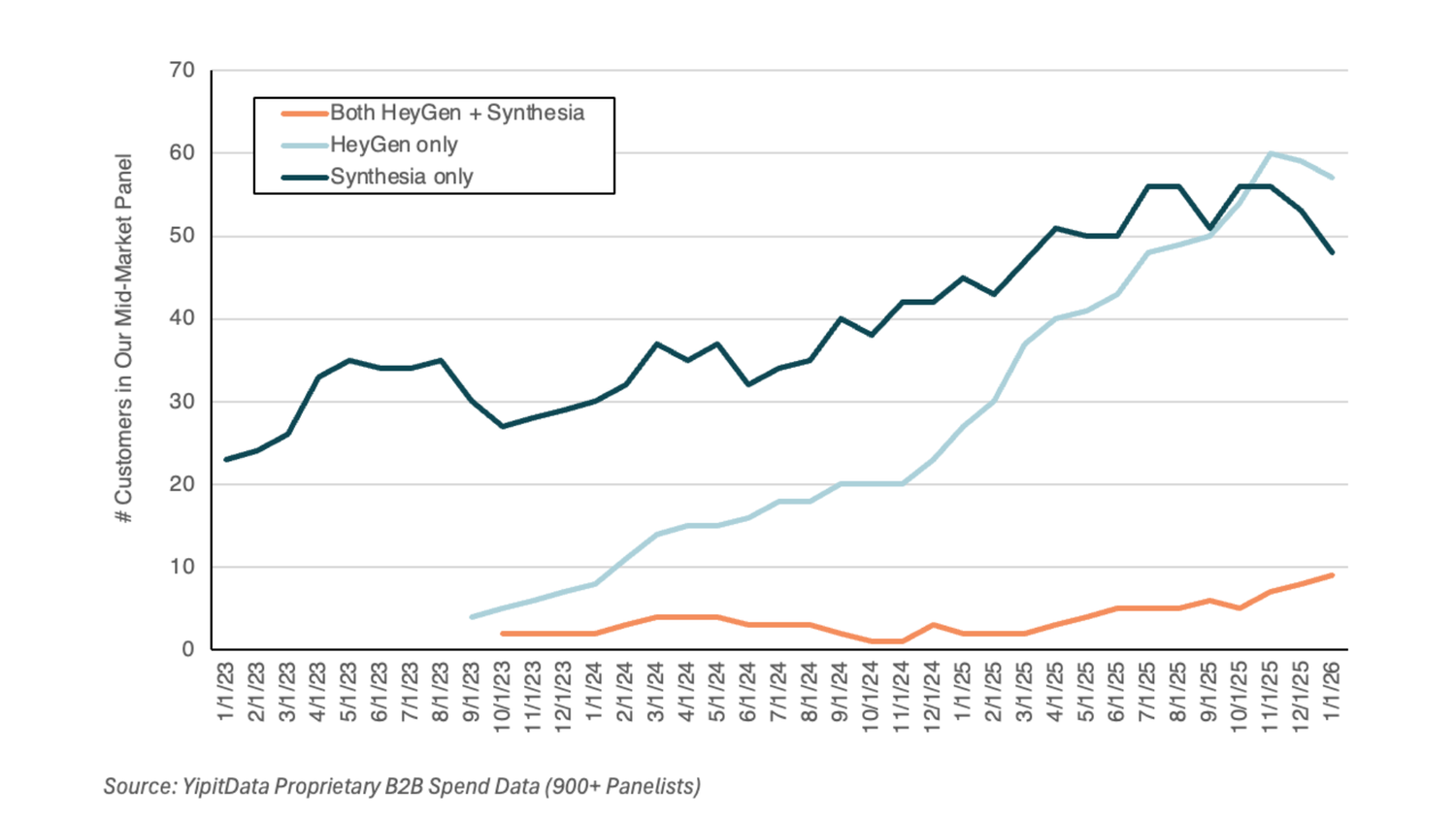
AI tools have cut video production costs by 91% and reduced a 60-second video from 13 days to 27 minutes. Image source: YipiData
Cost. Run the math on 12 monthly internal-comms videos at $5,000 each and you are at $60,000 a year. The same content produced by an in-house AI clone runs in the low four figures, all in. According to YipitData, AI tools have cut production costs by 91%, from $4,500 per minute to roughly $400, while shrinking 60-second video production from 13 days to 27 minutes.
Speed. Traditional production runs 2 to 8 weeks per video, and internal comms and exec thought-leadership lose most of their value at that latency. A founder LinkedIn post about a launch is dead 48 hours after the launch.
Iteration. Most traditional contracts cap edits at 2 to 3 rounds. AI generation regenerates from a script edit in minutes, which makes the difference for high-iteration formats like sales-enablement video and weekly exec content.
What remains for traditional corporate video production is anything story-driven with high production values: hero brand films, customer testimonials, ad campaigns. That work still belongs in a studio, and everything else is up for re-bidding. For a deeper look at the talking-head specifically, see our guide to creating video content without being on camera.
AI video alternatives for the recurring corporate video use cases
The AI video category has matured into specialized lanes. Each lane handles a different slice of the corporate video production workload. The Wyzowl 2026 data shows nearly half of all marketers have folded AI video generation into their regular workflows, up from roughly 18% in 2023.
Argil: AI clone video for executives, founders, and creators
Train an AI clone on a 2-minute video of yourself, then generate fully-edited videos from scripts or existing content. Best fit: executive thought-leadership, weekly product updates, founder-led marketing video. Works best when an expert with domain taste runs it. Plans start at $39/month for the Classic tier with 1,600 credits per month. Pro is $149/month, Scale is $499/month, and Enterprise is custom. The full pipeline is built in: scripts in, fully edited videos out with captions, B-rolls, and transitions. Compare with how to fully clone yourself with Argil.
Synthesia and HeyGen: avatar libraries for training and L&D
Synthesia starts at $29/month for the Starter plan, with Creator at $89/month and Enterprise custom. HeyGen starts at $29/month for Creator, Pro around $94/month, and Business at $149/month plus seats. Both serve training, internal comms, and multilingual deliverables at scale. Synthesia serves over 60,000 businesses including more than 90% of the Fortune 100, per YipitData's 2026 AI video market report. Pair these with structured L&D programs where you need 50+ training videos per year. See how to make engaging training videos with AI for a full L&D walkthrough.
Captions and Descript: AI editing on top of footage you film
Useful when you still want a real shoot but want to cut post-production cost. Captions runs from $9.99/month Pro to $24.99/month Max with 500 credits, scaling up to $279.99/month for Scale 8x. Descript starts at $24/month Hobbyist, with Creator at $35/month and Business at $65/month. Both tools sit downstream of a traditional shoot, accelerating editing without replacing camera work.
OpusClip: repurposing layer for clip distribution
Turns long-form video into short clips automatically. Free tier with 60 credits, Starter at $15/month, Pro at $29/month monthly. Best paired with one of the above. A founder records a 30-minute podcast or all-hands, OpusClip cuts it into 20 short-form clips for LinkedIn, TikTok, and Shorts.
A typical 2026 corporate video stack combines a traditional vendor for the launch hero film, Argil for the founder's weekly update, HeyGen for the training catalog, and OpusClip for clip distribution layered on top. Different formats need different tools, which is why a single-vendor approach overspends. For a fuller comparison of the AI category, see our review of the best AI video generators for commercial use.
Recommendation by corporate video use case
- Hero brand film, ad campaign, customer testimonial, recruitment film: Traditional vendor (Sandwich for premium, Demo Duck or Vidico for mid-market, Lemonlight for transparent budget).
- Executive thought-leadership, weekly founder updates, recurring marketing video: Argil for AI clone video, paired with OpusClip for clip distribution.
- Internal training and L&D at volume: Synthesia or HeyGen for avatar-based delivery, optionally paired with a traditional vendor for one or two flagship modules.
- Sales-enablement video at scale: Argil or HeyGen, often combined with a sales-platform integration for personalized outbound video.
- Recurring multilingual product announcements: Argil or HeyGen for fast multilingual generation, with a traditional vendor for the launch hero film.
- Internal communications (all-hands, CEO updates, policy rollouts): Argil for executive-led messages, HeyGen or Synthesia for company-wide announcements.
- Animated SaaS explainer: Yum Yum Videos, Demo Duck, or a boutique animation studio.
The 2026 verdict on corporate video production
Traditional corporate video production is still the right answer for high-stakes, narrative, hero work. It is no longer the right answer for recurring volume.
The 2026 stack is hybrid: a traditional vendor for the one or two films that have to look like a movie, AI video tools for everything else. Evaluating one vendor for both is how budgets blow up on the wrong work.
The new buyer skill is allocation. Decide which 2 or 3 videos this year truly need a film crew, send those to one of the 12 vendors above weighted to your budget tier, and move the rest into AI tools: internal comms, the founder series, the training catalog. Run the comparison at year end and the budget split will show whether the allocation worked.
Corporate video production FAQ
How much does corporate video production cost in 2026?
Most projects fall between $5,000 and $100,000, with hero films exceeding that. On a per finished minute basis, expect $1,000 to $10,000. The biggest cost drivers are crew size, location count, custom animation, and multilingual deliverables.
How long does a corporate video production project take?
Boutique projects run 4 to 8 weeks from kickoff to delivered file, mid-market work 6 to 12 weeks, and premium hero films 4 to 6 months. AI-generated video ships in minutes once the script is finalized.
Should I use a corporate video production company or AI video tools?
Use both. Traditional vendors handle the hero work: brand films, customer testimonials, ad campaigns. AI video tools handle the recurring lanes, including exec thought-leadership, training, internal comms, and weekly founder content. The hybrid stack is the 2026 default.
Which corporate video production company is best for B2B SaaS?
Sandwich Video is the pick for premium launch films, with Vidico, Demo Duck, or Yum Yum Videos for mid-market explainer and brand work. Lemonlight is the option for transparent budget production, and Argil covers the recurring exec and founder content layer.
Can AI tools really replace traditional corporate video production?
Not for hero work. AI tools have absorbed the recurring lanes, including training, internal comms, exec thought-leadership, and multilingual product updates. Hero brand films, customer testimonials, and narrative-driven ad campaigns still need a traditional crew in 2026.
Related Articles
- Which AI Avatar Platform Is Easiest to Use in 2025: Comparing HeyGen, Synthesia, Argil, D-ID, VEO 3, and Sora
- How Much Should You Budget for Nonprofit Video Production in 2026
- What Are the Best AI Avatar Services for Multilingual Marketing Campaigns in 2026
Corporate video production in 2026: agency tiers, real prices, and where AI now beats traditional video.
Editor notes from qa-articles - final score 96/100, 1 iteration: Triplet density holds at 32% post-rewrite, just over the 30% threshold. Most remaining triplets are natural taxonomy lists in vendor cards or category enumerations (e.g. 'boutique, mid-market, and premium tiers'). Optional polish: compress one or two more 3-item comma lists in the FAQ or recommendation section if the editor wants to drop under 30%.