
The Best Movie Generator Tools in 2026: AI Compared

Article Highlights
- A movie generator splits cleanly into 2 camps in 2026: text-to-video engines that synthesize scenes from prompts, and avatar-driven engines that put a recognizable narrator at the center of the film.
- Pure text-to-video tools like Runway, Pika, Sora, and Higgsfield lead on visual realism and camera control, but cap at short clips and struggle with talking heads.
- Avatar-driven movie generator tools produce longer continuous narration with native lip-sync, which is what most short-form social films actually need.
- Voice and lip-sync quality is the hidden deciding factor most comparisons skip, and it decides whether a 60 to 90 second AI film is publishable or not.
- Realistic creator workflows in 2026 land between $8 and $39 a month for the lead tool, with credit burn from regeneration as the biggest hidden cost.
- Argil sits in the avatar-driven camp at $39 a month and is the strongest pick when a recognizable on-screen narrator carries the story.
The Best Movie Generator Tools in 2026: AI Compared
What a movie generator actually does in 2026
A movie generator is software that turns scripts, prompts, or storyboards into finished moving footage with voice, edits, and pacing baked in. The category covers everything from prompt-only video models to avatar platforms that let you cast yourself as the on-screen lead of every film you produce.
The 2026 field splits into 2 camps that drive every other decision in this guide. Text-to-video engines synthesize scenes from a written prompt and fit visually-led or abstract films, while avatar-driven engines put a recognizable narrator on screen and carry films where the audience is buying into the presenter, not the world.
What an AI movie generator is not in 2026 is a Hollywood replacement or a substitute for a human editor on a 30 minute documentary. Used inside its real envelope, though, the category is mature enough that creators are shipping publishable short films from a desk, on a $39 a month tool budget. According to Ahrefs, over 75% of marketers now use AI tools in their content workflow, and short-form video is the format absorbing most of that adoption.
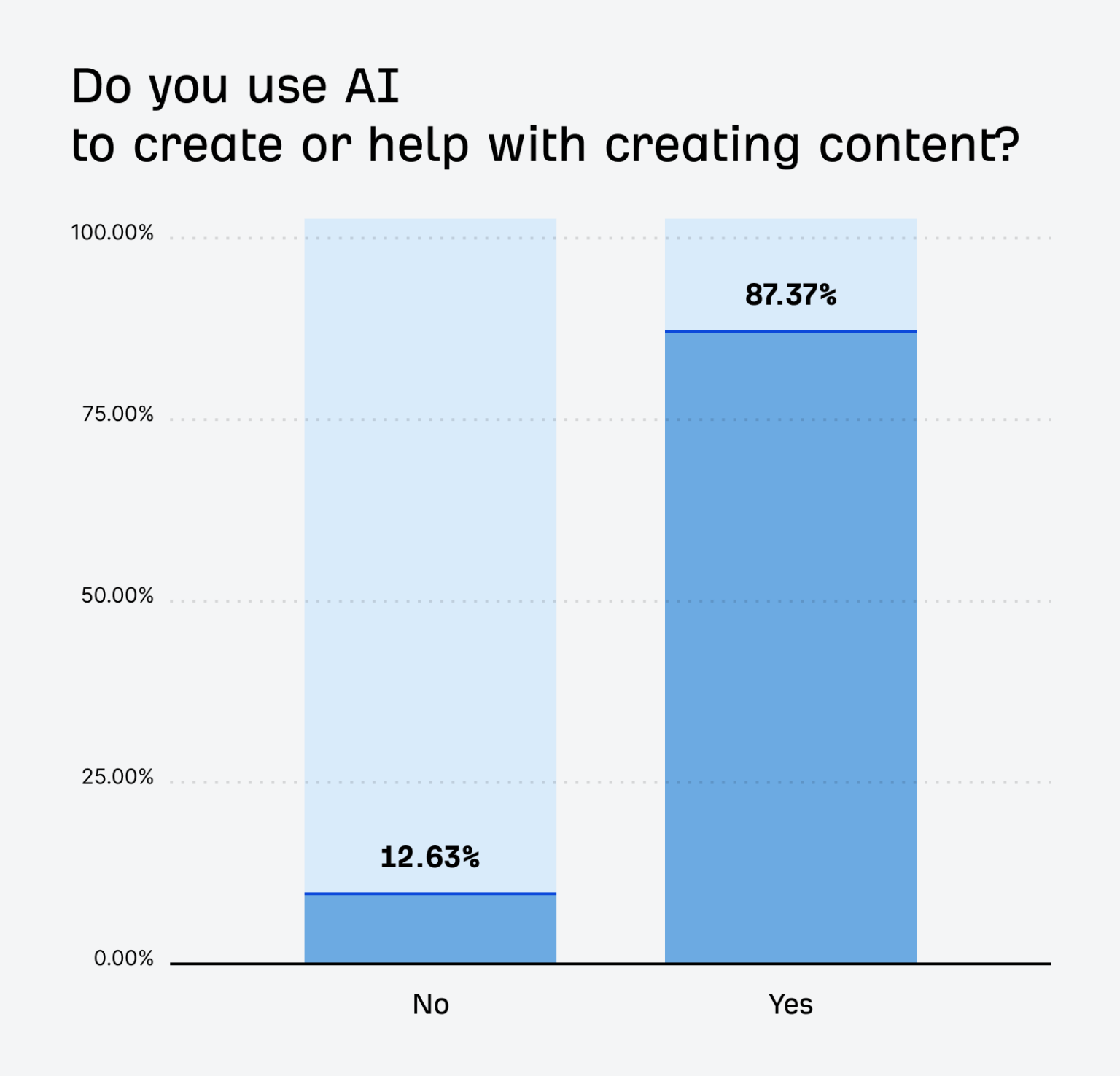
Many content creators now use AI to create or get assistance for creating content. Image source: Ahrefs.
How we compared each movie generator
We anchored the comparison on the 4 axes that decide whether an AI film is publishable, not just generatable.
- Output length: longest single clip per render, max stitched length, and whether scenes hold continuity across cuts
- Scene control: how much the tool lets you direct prompts, storyboards, camera angles, and edit-level pacing
- Voice and lip-sync quality: native voiceover, lip-sync accuracy on faces, and multi-language coverage
- Pricing: monthly entry tier, generation credits, and what a realistic creator workflow costs at publishing cadence
The rubric weighs voice and lip-sync more heavily than most AI movie generator roundups do, because that single axis decides whether a creator can ship a narrator-led short or has to assemble a silent visual collage.
The leading AI movie generator tools in 2026
We picked tools that creators are actually shipping publishable work with in 2026, not every model on a benchmark leaderboard. Each entry covers strengths, limitations, best use case, and pricing where available.
Runway Gen-3
Runway is the closest the text-to-video category has to a default. The motion brush, camera move controls, and image-to-video pipeline give a creator real directorial control over a single shot.
- Strengths: cinematic visual quality, strong motion, mature image-to-video pipeline, broad creative control with motion brush and camera moves
- Limitations: short clip length per generation, no native on-screen narrator, voice and lip-sync are not a core part of the workflow, costs climb at production volume
- Best use case: visually-driven music videos, mood pieces, and abstract narrative shorts where no recurring human face is needed
- Pricing: free tier with 125 one-time credits, Standard plan at $12 a month billed annually for 625 monthly credits (Runway pricing)
Pika
Pika leans into fast turnarounds and a friendly UI for non-editors. The creator-focused effects library makes it the easiest tool to experiment with for someone who is not an editor by trade.
- Strengths: fast generations, fun creator-focused effects, low entry price, friendly UI for non-editors
- Limitations: shorter clip ceiling, less consistency across scenes, weaker for long-form storytelling, no built-in narrator presence
- Best use case: social-first creators who want quick visual experiments and stylized b-roll cutaways
- Pricing: free plan with 80 monthly video credits, Standard plan at $8 a month billed annually for 700 monthly credits (Pika pricing)
Higgsfield
Higgsfield has carved out a slice of the field with cinematic camera moves and a growing motion control library. It reads as a director's tool for visual-led work.
- Strengths: cinematic camera moves, distinct visual style, expanding motion control library, strong for short atmospheric films
- Limitations: still primarily a scene generator, not a narrator-led tool, scripted voiceover and lip-sync are not the core workflow
- Best use case: creators chasing a specific cinematic look in fashion, music, and aesthetic-led shorts
- Pricing: subscription plans starting on the higher end of the category, check the live page for current tiers
Veo, Kling, Hailuo, and LumaLabs Dream Machine
These 4 engines push the visual ceiling in different directions: Veo leans long and coherent, Kling and Hailuo handle character motion well, and LumaLabs Dream Machine is the most creator-accessible of the group.
- Strengths: each pushes the ceiling on visual realism, motion, and prompt fidelity, with Veo strong on long coherent shots and Kling and Hailuo strong on character motion
- Limitations: same category constraints as the rest of text-to-video, no recurring on-screen narrator, voice and lip-sync are not core, scene-to-scene continuity is improving but still fragile
- Best use case: high-end visual experiments and cinematic shots that get cut into a wider edit
HeyGen
HeyGen is the most direct enterprise competitor to Argil in the avatar-driven camp. The strength is breadth of avatars and language coverage, and the workflow is built for corporate video output more than creator personal-brand video.
- Strengths: very broad avatar library, 175+ languages and dialects, mature translation pipeline, enterprise-friendly admin controls
- Limitations: workflow oriented around stock avatars and templates rather than a single creator brand, customization of style and edit feel more constrained
- Best use case: enterprise teams producing localized internal comms, training, and explainer video across many languages
- Pricing: Creator plan at $29 a month, dropping to $24 a month on annual billing (HeyGen pricing)
Argil
Argil is built around 1 simple premise: record a 2 minute training video of yourself, get an AI clone that delivers any future script as a fully edited film with accurate lip-sync.
That premise narrows the use case in a useful way. Argil is not a tool for abstract music videos or wide cinematic worlds with no human lead. It is built for personality-led short-form films, explainer films, and brand stories where a recognizable on-screen narrator carries the story across the full edit.
- Strengths: 2 minute training video produces a high-fidelity AI clone, fast script-to-finished-edit pipeline, accurate lip-sync, full editing pipeline with captions, b-rolls, and transitions built in
- Strengths continued: any script length runs through a single avatar pass with continuous narration, A/B testing across hooks, avatars, and languages from one script, commercial use rights on output
- Limitations: not the right tool for purely abstract music videos or wide cinematic worlds with no human lead, b-roll usually layered in alongside avatar footage for visual range
- Best use case: creators, founders, and brands shipping narrative shorts, explainer films, and brand stories where a recognizable on-screen narrator carries the story
- Pricing: Classic plan at $39 a month for 1,600 credits and 100+ avatars, Pro plan at $149 a month for 6,000 credits, 30% discount on annual billing taking Classic to $27 a month (Argil pricing)
The reason Argil keeps showing up on creator workflows is the cadence math. Most tools in the field are priced for experimentation, while Argil's Classic plan is built around a creator publishing a narrated short every day for roughly the cost of a coffee, rather than generating 1 experimental film a month.
Output length and scene control across the field
Single-clip length is the first axis where the 2 camps separate cleanly, and it is also where the limits of text-to-video become visible to anyone working at publishing cadence.
Single-clip length is where text-to-video shows its age. Most of the leading engines cap a single render at the 5 to 10 second range, which is enough for a stylized b-roll cutaway but not for a 60 to 90 second narrated short on its own. Stitching across clips is the standard workaround, and stitching introduces the continuity problem every text-to-video user already knows: characters drift between clips, lighting jumps, and the cut feels sewn rather than shot.
Avatar-driven movie generator tools handle continuous narration natively. A 90 second script becomes a 90 second avatar pass with no stitching, the lighting holds, and the lead's face does not drift across the full take. The cuts that matter happen at the edit level, where the creator decides to break the narrator to b-roll on a specific beat, not because the engine ran out of frames.
Scene control follows the same split. Runway, Higgsfield, and Veo lead on intra-shot camera and motion control, which is the granular dial a director wants inside a single visual moment. Argil leads on script-driven edit control across the full film, which is what matters when the work is shipping a finished narrated piece every week.
Voice and lip-sync quality, the hidden deciding factor
Most AI movie generator comparisons skip this axis or bury it. For most short-form films, it decides whether the output is publishable.
Native voice generation is split along the same camp lines. Most text-to-video tools rely on third-party voice tools added in post, which means the creator owns an extra step in the pipeline and an extra subscription to keep the voice consistent across the catalog. Avatar-driven tools generate voice and lip-sync in 1 pass, which collapses 2 steps into 1 and removes the alignment problem at the edit stage.

Native voice generation is split, too — and many text-to-video tools still rely on outside voice tools, adding another step and another subscription.
Lip-sync accuracy is where the split becomes obvious to a viewer. Argil and the other avatar-led tools are built around accurate lip-sync as the core product, and the output reads as a real person talking. Text-to-video tools struggle with talking heads, and the failure mode is uncanny mouth movement that pulls a viewer out of the film inside 3 seconds. A 60 second narrated film with bad lip-sync does not get a second view.
Multi-language coverage is the third sub-axis here. Voice cloning and translation pipelines vary widely across the field. HeyGen leads on raw language count at 175+. Argil supports cloning the creator's own voice and delivering scripts in multiple languages from the same avatar pass. The honest test is always the same: pick the languages your audience actually consumes and check whether the tool clears the publishable bar in those specific languages, not the count on a marketing page.
Pricing reality check
The marketing pricing across the field is broadly honest at the entry tier, in the $8 to $39 a month range. The hidden cost is credit burn.
A creator who regenerates a single 8 second scene 4 to 6 times to land the prompt is burning 4 to 6 credits per usable shot. Multiply that across the 10 to 20 shots a short film needs and the credit-month math starts to wobble.
Avatar-driven generation tends to be more predictable per finished video. A narrator pass on Argil renders the full script in 1 generation. B-roll layered in afterwards consumes credits in the text-to-video tool of choice, but the variance is bounded by the b-roll budget, not the narrator budget. A creator shipping 2 to 3 narrated shorts a week can price the workflow at the monthly tier with confidence, instead of guessing how many regenerations a particular script will need.
Buffer's own social media benchmarks show that short-form video keeps climbing as the dominant attention format on social, which is why the publishing-cadence pricing model matters more than the per-clip pricing model for serious creators.
Pure text-to-video versus avatar-driven storytelling, how to choose
This is the decision the rest of the buyer's guide hinges on. The choice between pure text-to-video and avatar-driven storytelling comes down to film type, not output quality, and the right answer changes per project.
Choose pure text-to-video when the film is visually-led, abstract, or world-driven, and there is no recurring human narrator. A mood-led music video, a stylized brand atmosphere piece, or a concept short where the world itself is the lead all sit cleanly in the text-to-video camp.
Choose avatar-driven storytelling when the film is personality-led, when audience trust is built on a recognizable face, and when the story is delivered by a narrator on screen. Creator personal brand video, founder thought leadership, explainer films for SMBs, brand stories with a presenter, and educational short-form video all sit cleanly in the avatar-driven camp.
Many serious creators end up combining both. The proven stack is avatar-driven narration as the spine of the film, plus text-to-video b-roll layered into the edit for visual range, with the narrator carrying the trust and the story and the b-roll carrying the visual world.
Why Argil is the strongest pick for short-form narrative video
Here is the honest case for Argil against the 4-axis rubric the rest of this article was scored on, axis by axis.
On output, Argil produces continuous narration of any script length from a single avatar pass, with b-roll layered in afterwards. That removes the stitching problem on the narrator track, which is the half of the film that has to feel human.
Scene and edit control sit at the script level rather than the prompt level. For most short narrative films the creator wants to direct the edit and the pacing, not the individual shot, and Argil maps cleanly to that need.
On voice and lip-sync, Argil is built around the on-screen narrator from the start, and it shows up in the output as lip-sync that reads like a real human talking. Voice can be cloned from the creator's own recording, which is the only way to keep a personal brand consistent across video, audio, and written content.
On production economics, the cost per finished video is predictable. The Classic plan at $39 a month covers a daily publishing cadence for a single creator, and the Pro plan at $149 a month covers a team-level cadence or a workflow that runs multiple avatar styles for A/B testing.
If you are shipping personality-led narrative shorts, explainer films, or brand stories, Argil is the strongest pick in the avatar-driven camp. For the upstream script step, see the deeper ai movie script walkthrough. For an even broader read on the ai avatar generator field, the deeper guide compares the avatar camp head-to-head.
Frequently asked questions
What is the best AI movie generator in 2026?
There is no single best tool, because the right pick is anchored to the type of film. For visually-led abstract or world-driven shorts, Runway, Sora, and Higgsfield lead the text-to-video camp. For personality-led narrative shorts, explainer films, and brand stories with a recognizable narrator, Argil leads the avatar-driven camp at $39 a month.
Can AI generate a full movie from a script?
Script-to-finished-film is realistic for short-form work today, especially in the 30 to 90 second range. Feature-length output still needs significant human assembly across scenes, characters, and edit decisions. Most creators shipping in 2026 work inside the short-form envelope and use AI for production speed, not for replacing the editor.
Are AI movie generators free?
Free tiers exist on most leading tools, including Runway, Pika, and HeyGen, but they cap output length, resolution, and commercial use rights. A serious creator workflow lands between $8 and $39 a month for the lead tool, plus optional spend on a complementary engine for b-roll.
Which movie generator has the best voice and lip-sync?
Avatar-driven tools lead this dimension by design, because voice and lip-sync are the core product rather than an add-on. Argil, HeyGen, and Synthesia all clear the publishable bar on lip-sync for personality-led films. Argil specifically lets a creator clone their own voice from a short recording, which is what keeps a personal brand voice consistent across every video.
Should I use one movie generator or stack multiple tools?
For visually-led abstract shorts a single text-to-video tool is enough. For personality-led narrative shorts the proven stack is avatar-driven narration plus text-to-video b-roll, since each tool plays to its strength. Stacking 2 tools usually adds clarity to the pipeline rather than complexity, because each tool covers a distinct half of the edit.
How long does it take to make a short film with an AI movie generator?
A scene-by-scene text-to-video pipeline for a 60 to 90 second short typically lands at half a day to a day, mostly spent on prompt iteration and stitching. A narrator-driven pipeline using Argil plus a b-roll layer typically lands at 2 to 4 hours from finished script to exported film, because the narrator pass runs as a single generation.
Related Articles
- How to make engaging training videos with AI in 2026
- How to create video content without being on camera
- How to lip-sync a video with AI in 2026
The right movie generator in 2026 depends on whether your film leads with a presenter or a world.