9 Best Viral Finder Tools in 2026, Ranked and Priced
A viral finder surfaces rising sounds, formats, and topics fast. Compare the 10 best viral finder tools of 2026 by price, signal type, and ICP fit.
Article Highlights
- 10 viral finder tools ranked by signal type and price
- Verified 2026 pricing for every viral finder tool
- Best viral finder picks for creators, agencies, and B2B
- Sound, format, topic, and creator signal compared
- The production gap that wastes most viral finder spend
- Argil turns a viral finding into a posted video same day
10 Best Viral Finder Tools in 2026, Ranked and Priced
You found the trend. Now you have about 72 hours before it stops mattering. That gap, between spotting a rising signal and actually shipping a video against it, is where most of the money spent on a viral finder quietly disappears. The tool surfaces a sound, a format, or a topic, then sits there while you scramble to produce something before the window closes.
This guide ranks the 10 best viral finder tools in 2026 by what they actually surface, what they cost, and who they fit. Every price below was checked against the live pricing page during writing. Where a vendor hides numbers behind a sales call, we say so plainly, because pricing opacity is itself a signal about whether a tool is built for a solo creator or an enterprise buyer.
How we ranked these 10 viral finder tools
We scored each tool against five things a buyer actually cares about, not feature-sheet trivia.
Signal coverage came first: which surfaces a tool indexes, whether that is TikTok, Reels, YouTube Shorts, X, LinkedIn, or Reddit. A tool that only watches one platform is not wrong, it is just narrow, and narrow is fine if you only post there.
Signal type came next. A tool might cover sounds, hashtags, formats, creators, or topics, and most are genuinely good at one or two of those while staying mediocre at the rest. We noted the lane each one actually owns.
Refresh rate matters because a viral window is short. A sound that took 3 weeks to peak in 2022 now peaks in 72 hours and is effectively dead within 5 days, according to Dash Social's 2026 trend reporting. A weekly-refresh tool is useless against that clock.
We marked down tools that hide pricing behind a demo, since solo creators and SMBs cannot evaluate what they cannot see. And we weighted ICP fit, because the right tool for a one-person creator brand is the wrong tool for a 12-person agency. With over 200 million people now identifying as content creators worldwide, per Demandsage's 2026 data, the buyer pool spans far too many use cases for one tool to win them all.
1. Exploding Topics
Exploding Topics is a macro trend detector, not a TikTok tool. It surfaces rising topics, keywords, and product categories across the broader web before they hit mainstream search volume.
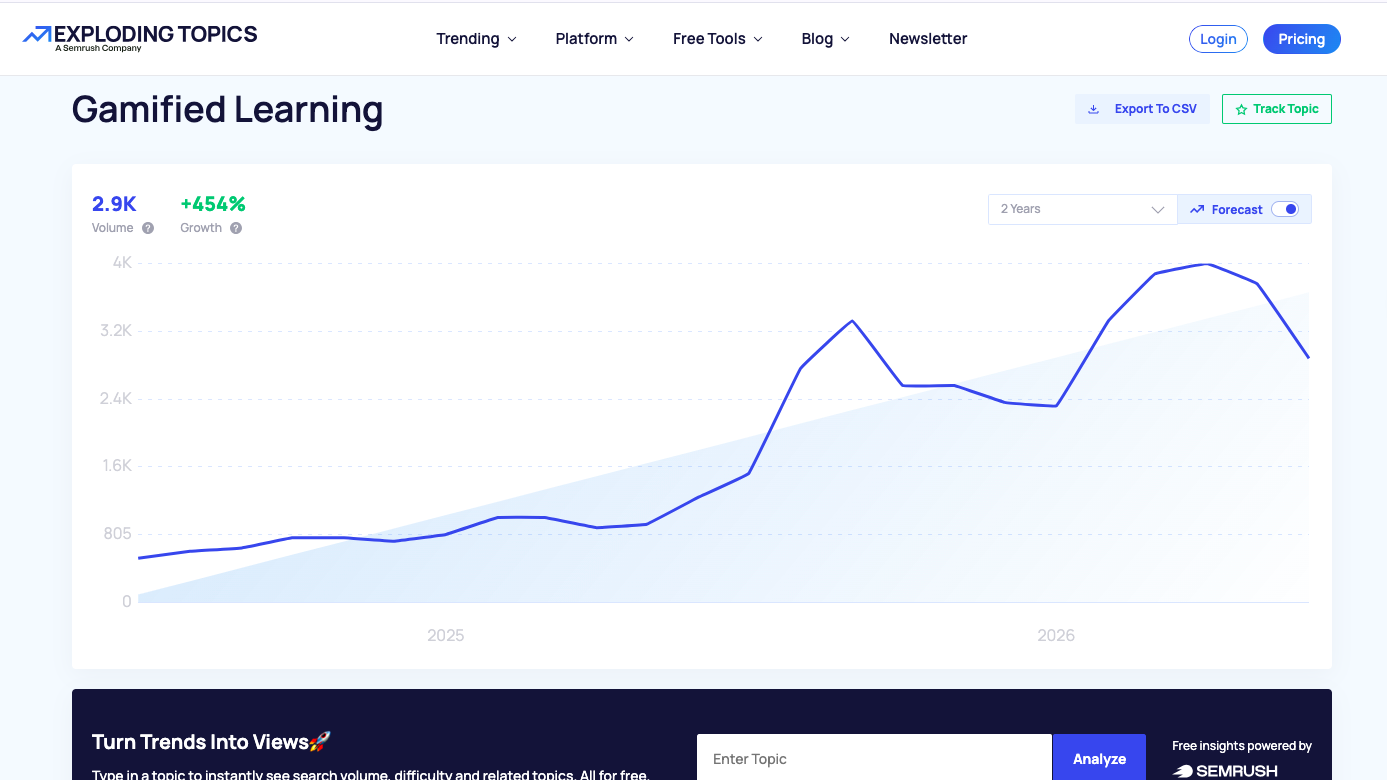
Image source: Gamified Learning Trend, Exploding Topics
- What it surfaces: rising topics, keywords, and emerging product categories, with a leading window measured in weeks not days.
- Pricing: a free tier exists, and paid plans run $39/mo for Entrepreneur, $99/mo for Investor, and $249/mo for Business.
- Workflow fit: pull rising topics weekly and use them as the brief for both written content and short-form video angles. One topic becomes a blog post and 5 videos.
- Best for: B2B marketers, SEO-driven content teams, and agencies briefing thought leadership.
- Limit: it does not track sounds or formats. Pair it with a dedicated TikTok tool when you need sound and format signal too. Our breakdown of the video content strategy that lifts lead quality through SEO shows how topical signal feeds a repurposing pipeline.
2. TrendTok
TrendTok is a mobile-first app built to predict rising TikTok sounds and hashtags with adoption-velocity scoring. It leans on the algorithm rewarding early sound adoption.
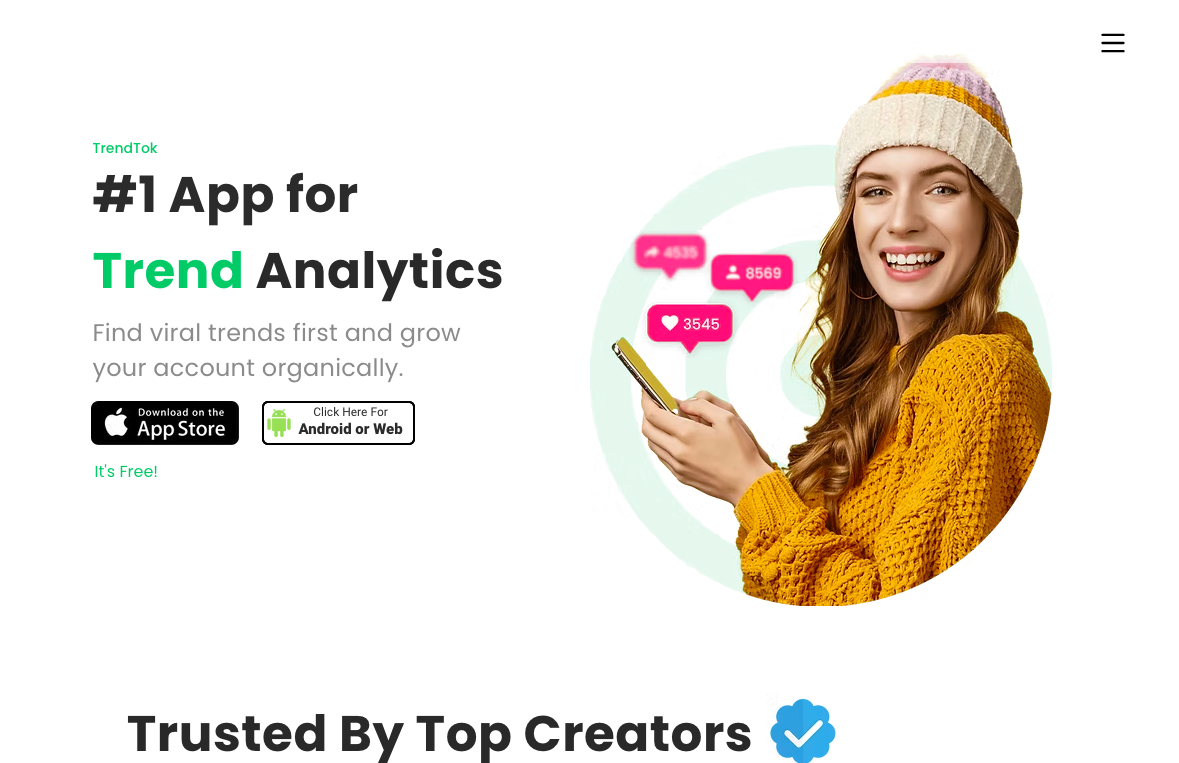
Image source: TrendTok
- What it surfaces: trending and predicted TikTok sounds, hashtags, and creators, scored by how fast they are climbing.
- Pricing: a free Basic version exists, with Pro at $19.99 per year or $2.99 per week per the in-app subscription. Among the lowest-cost options here.
- Workflow fit: scan daily for rising sounds, filter by region or category, and brief a 30 to 60 second video against the sound inside 24 hours.
- Best for: solo TikTok and Reels creators who need a steady drip of sound and hashtag signal without a big monthly bill.
- Limit: TikTok-only. Not useful for B2B, YouTube long-form, or LinkedIn.
3. Tokboard
Tokboard monitors past and present TikTok trends through a web dashboard, with engagement-velocity metrics on sounds, hashtags, and creators.
- What it surfaces: trending sounds, hashtags, and creators on TikTok, with historical and current views so you can see what is climbing versus what already peaked.
- Pricing: pricing is not published on a public page at the time of writing, so treat it as pricing on request and confirm directly before buying.
- Workflow fit: bulk-export rising sound lists into a weekly brief, pick the 3 to 5 sounds that match your voice, and ship variations within 48 hours.
- Best for: agencies running multiple TikTok accounts and creators posting 5 or more times per week.
- Limit: TikTok-heavy coverage. Cross-platform users need a second tool for Reels and Shorts.
4. Buzzsumo
Buzzsumo indexes trending articles, social posts, and influencers across the open web. It is strong on long-form and X content and lighter on short-form native signal.
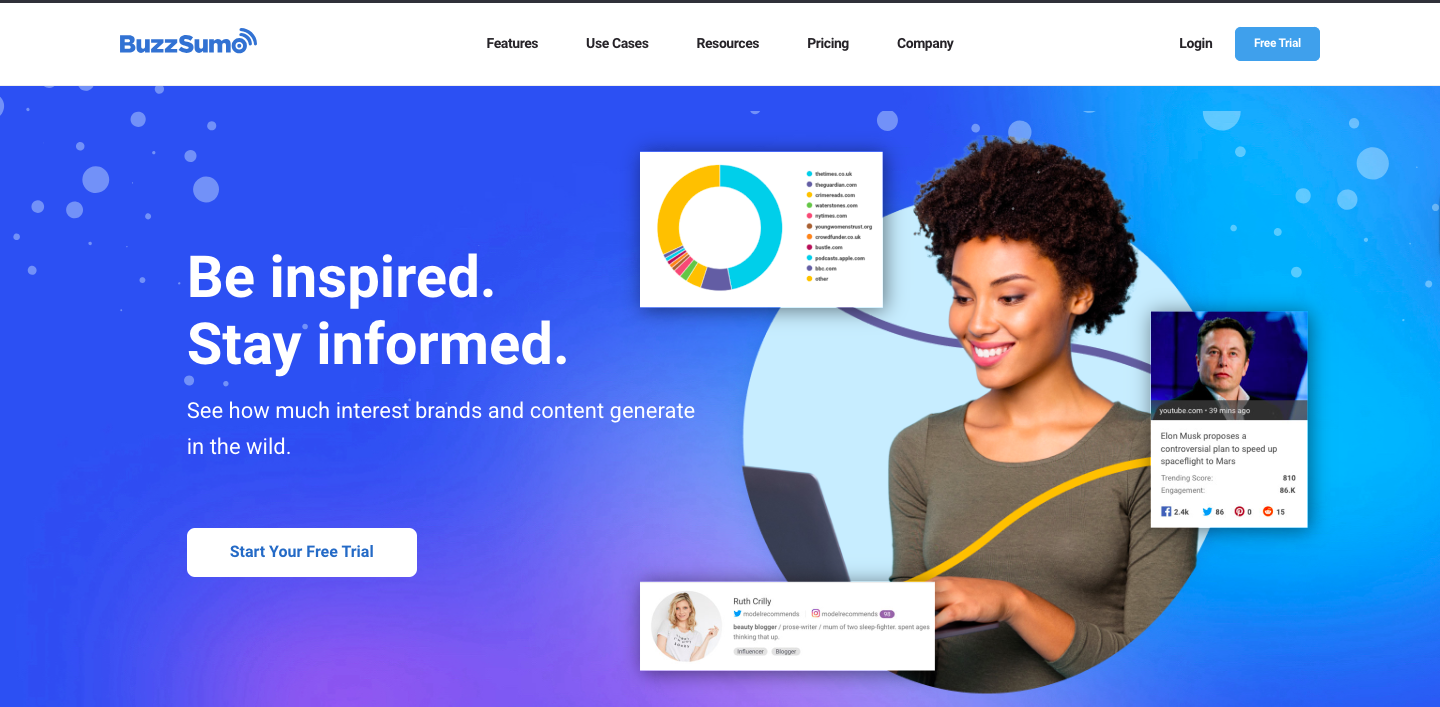
Image source: Buzzsumo
- What it surfaces: viral articles, social posts, and the influencers driving a conversation across the wider web.
- Pricing: plans run $199/mo for Content Creation, $299/mo for PR and Comms, $499/mo for Suite, and $999/mo for Enterprise, billed yearly.
- Workflow fit: find viral articles in a niche, repurpose the angle into short-form video, and identify who is amplifying the topic.
- Best for: content marketing teams, PR agencies, and B2B brands turning written trends into video.
- Limit: not short-form native. Use it as a topical layer, then act on it with a repurposing workflow like the one in our guide to turning any blog into unlimited viral video content.
5. Tubular Labs
Tubular Labs is enterprise video intelligence. It benchmarks video performance and trends across YouTube, Facebook, Instagram, TikTok, and Twitch with depth no consumer tool matches.
- What it surfaces: cross-platform video performance, rising creators, and category trends at a scale built for media teams.
- Pricing: no public dollar figures. Tubular uses seat-based custom quotes through a demo request, which in practice means 4-figure-plus monthly commitments.
- Workflow fit: agency and in-house teams benchmark video across platforms, spot rising creators, and brief content programs at scale.
- Best for: media companies, large agencies, and brands running multi-platform video with real budget.
- Limit: overkill for solo creators and most SMBs. The pricing model alone disqualifies it for the majority of viral finder buyers.
6. Predis.ai
Predis.ai sits a layer above raw signal. It serves trending hashtags, post ideas, and competitor patterns through an AI recommendation engine rather than handing you a firehose to interpret.
- What it surfaces: trending hashtags, AI-generated post ideas, and competitor content patterns.
- Pricing: $19/mo for Core, $40/mo for Rise, and $212/mo for Enterprise+, with credit allocations per tier.
- Workflow fit: input a brand or topic, get a feed of ideas and hashtags, then push the best ones into production the same day.
- Best for: SMBs and solo marketers who want recommendations served rather than raw data to decode.
- Limit: AI recommendations vary in quality. Treat the output as a first draft of a brief, not a finished one.
7. Pentos
Pentos brings deeper time-series data than most TikTok-focused competitors. It tracks how sounds, hashtags, and creators move over time, so you can tell the rising phase from the saturation phase.
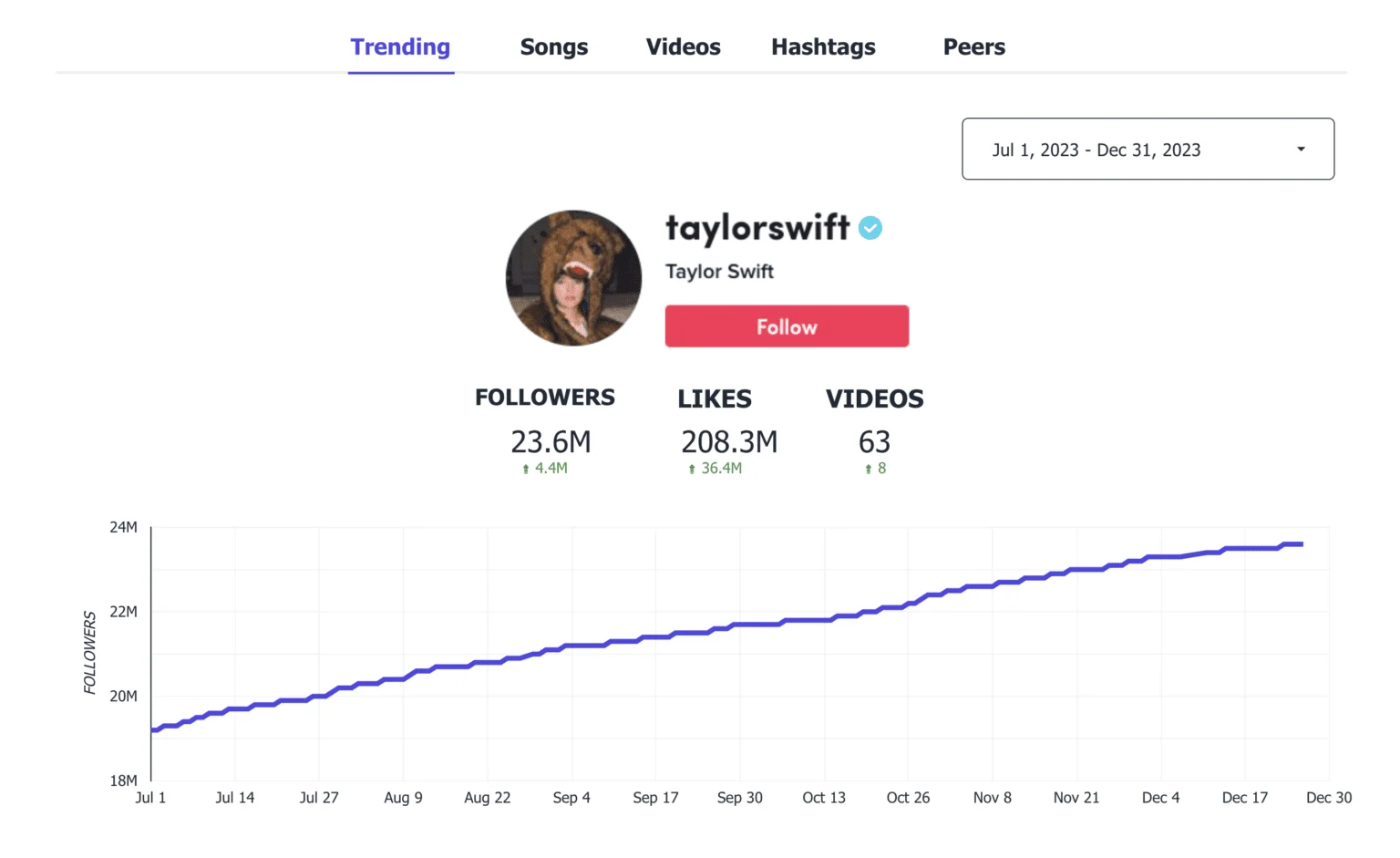
Image source: Pentos
- What it surfaces: TikTok analytics, sound performance, hashtag tracking, and creator monitoring with historical depth.
- Pricing: $99/mo for Trends Pro, $299/mo for Icon, and $999/mo for Mega.
- Workflow fit: track specific sounds or creators over time, identify when a signal is still climbing versus already saturated, and time your content accordingly.
- Best for: agencies and analysts who need time-series TikTok data rather than a single real-time snapshot.
- Limit: TikTok-only platform coverage. Cross-platform programs need a companion tool for Reels and Shorts.
8. Trendpop
Trendpop built its reputation on creator discovery and sound tracking. It has since become part of Collab, and its creator-intelligence capabilities now sit inside that broader platform.
- What it surfaces: fast-growing TikTok creators, sound and hashtag tracking, and creator-level engagement metrics.
- Pricing: with the move under Collab, public self-serve pricing is no longer listed, so treat it as agency pricing on request and confirm before committing.
- Workflow fit: find fast-growing creators in a niche, reverse-engineer their content mechanics, then either recruit them or replicate the mechanic in-house.
- Best for: brand partnership teams, agencies running influencer programs, and competitive intelligence.
- Limit: weighted toward creator scanning, not sound or format trends. Pair it with a sound finder for full coverage.
9. Viraly (and RivalIQ as the alternative)
Viraly focuses on TikTok and Reels content performance with a free analytics layer, useful for creator-level signal on a budget. For teams that need competitive benchmarking instead, RivalIQ is the stronger alternative, covering cross-platform social analytics with trend layers built in.
- What it surfaces: Viraly tracks TikTok and Reels performance metrics. RivalIQ covers cross-platform competitive analytics with a social-trend overlay across the accounts you benchmark.
- Pricing: Viraly's TikTok analytics tool is free at its core tier. RivalIQ runs $239/mo for Drive, $349/mo for Engage, and $559/mo for Engage Pro.
- Workflow fit: Viraly for fast, low-cost creator-level signal. RivalIQ for competitor and category benchmarking with a viral-content lens.
- Best for: Viraly suits solo creators and small SMBs. RivalIQ suits agencies and in-house teams that live in competitive analysis.
- Limit: Viraly's signal depth is shallower than the established TikTok specialists. RivalIQ is broad but does not specialize in catching a trend at the moment it breaks.
The production layer most creators forget
Every tool above surfaces a signal, but none of them produce the video, and that is exactly where the workflow breaks for most buyers.
The finder hands you a sound, a format, or a topic while the clock is already running, and you have maybe 48 to 72 hours of real value before the cycle moves past peak. A fast solo creator still spends 4 to 8 hours filming and editing one short-form video, and an agency burns 16 to 40 hours per video once editor handoffs are counted. So the signal shows up in seconds while the video takes days, and for most teams that gap is the whole problem.
Argil closes that gap. You train it once on a 2 minute video of yourself, then generate fully edited videos from a script in minutes, with captions, b-roll, and transitions handled inside the pipeline. The workflow becomes simple: the viral finder surfaces a signal Monday morning, you write the script by lunch, Argil renders the video by Monday afternoon, and the post ships Monday evening.
The A/B layer is where it pays off. From one script you can spin up 3 hook variants, 2 avatar styles, or 2 language versions, so the finder tells you which format is working and Argil produces every variation you want to test against it. We walked through that same setup when mapping how AI agents 10x creative video output. It suits a specific buyer, someone with voice and authority but no production team, which describes most solo creators, real estate agents, lawyers, SMB founders, and B2B operators.
Which viral finder to pick
Match the tool to your team size and budget, then never buy signal you cannot act on.
Free or under 50 dollars per month: solo creators just starting
Use TikTok Creative Center, which is free, for sounds and hashtags, plus Google Trends for topical signal, plus the Exploding Topics free tier for rising web topics. Add Predis.ai's Core plan or TrendTok at its low annual price once a manual scan stops being enough.
50 to 200 dollars per month: SMB or agency running 3 to 10 accounts
Pick one TikTok specialist for sound and format signal, either Tokboard or Pentos at its entry tier. Layer Buzzsumo or Predis for topical and B2B coverage when your audience is mixed across platforms.
200 dollars per month and up: agencies, brand teams, content companies
Use RivalIQ or Trendpop for competitive and creator-level intelligence. Bring in Tubular Labs for cross-platform video intelligence when you have enterprise scale and budget. Add Buzzsumo for editorial and PR-led programs.
The non-negotiable: pair the finder with production capacity
Without same-day production, the subscription is a tax, and a tool is only worth what your time-to-publish actually lets you extract from it. That is the whole case for AI video tooling: the finder spots the wave, and an AI video engine lets one operator ride it before it breaks. Argil starts at $39/mo, the same entry price as Exploding Topics, so the production half of the workflow costs you no more than the signal half.
Frequently asked questions
What is the best free viral finder tool?
TikTok Creative Center is the strongest free option for sounds, hashtags, and creator discovery. Google Trends covers macro topical momentum, and Exploding Topics has a usable free tier for rising web topics. The paid tools add speed, filtering, and cross-platform unification on top of that base.
Are viral finder tools worth the monthly subscription?
Only if your production capacity matches your discovery rate. A team that finds 10 trends a month and ships against 1 is paying 10 times more per published post than a team that ships against 8. The bottleneck is almost never the signal. It is the speed of turning that signal into a finished video.
Which viral finder works best for B2B content?
Buzzsumo and Exploding Topics translate best to B2B because they index topical and editorial trends rather than TikTok sounds. Sound-finder tools rarely carry over to B2B audiences. For LinkedIn-specific signal, social listening platforms and topic trackers give you better coverage.
How fast does a viral trend die after the finder surfaces it?
Sound trends die in 5 to 9 days, format trends in 14 to 21 days, and topical or editorial trends last 4 to 8 weeks. A viral finder only earns its keep inside that window, which is exactly why same-day production capacity is the make-or-break variable.
Can I use a viral finder for YouTube long-form content?
Yes, with caveats. Tubular Labs and Buzzsumo index long-form YouTube performance well. Most TikTok-focused finders do not translate, because the format and audience expectations differ. For long-form, topical trend tools beat format-focused ones.
Do viral finders integrate with content production tools?
Most do not natively. The workflow is manual: export from the finder, brief in a doc, and produce in a separate video tool. AI video platforms like Argil shorten the production half so you can act on the signal the same day it is surfaced, which is the only day it still has full value.
Related Articles
- 7 best AI video generators for content creators in 2025
- How to go viral on TikTok, the 2026 guide that actually works
- Top 10 video hooks that stop the scroll in 2025
Viral finder tools ranked by price and signal type for 2026