What's the Best Way to Compare Pricing for Leading AI Avatar Services?
Real 2026 prices for HeyGen, Synthesia, D-ID and Argil: credits, avatar limits, watermark fees and hidden costs compared so you pick the right plan.

If you've spent any time trying to compare pricing for leading AI avatar services, you've probably noticed it's not always easy.
The best way to compare costs normally is to look at the pricing pages of each tool and compare them. However, these pages can be deceiving: on first glance, the prices look reasonable, everything appears straightforward, but then you start actually using the product and everything changes.
Credits disappear faster than expected, exports are capped, watermarks show up unless you upgrade, and you find out that custom features cost extra. Some AI video services even advertise themselves as an "all-in-one solution," but then you find out that you need another tool for editing and exporting for social media.
Suddenly, what looked like a $30/month solution becomes far more expensive.
This is why buyers in 2026 aren't just asking which tool is cheapest. Instead, they're trying to compare pricing for leading AI avatar services based on what they actually get per dollar.
This guide breaks down the real costs behind HeyGen, Synthesia, D-ID and Argil, using a practical, creator first lens to determine what you actually get for your money.
Quick Answer: Entry Price for Each Tool
- D-ID: from $5.90/month (10 video minutes, 1 avatar, D-ID logo on every clip)
- Argil: $25/month (flat monthly credits, every avatar model included, no feature paywalls)
- HeyGen: $29/month (600 credits, videos up to 30 minutes, 1 custom avatar, watermark removed)
- Synthesia: $29/month (1,200 credits, about 10 minutes of video, no personal avatar included)
The lowest headline price rarely means the lowest real cost. The breakdown below shows what each plan actually lets you produce.
What's the Real Cost of AI Avatar Tools in 2026?
So, how do you compare pricing for leading AI avatar services?
Most AI avatar platforms price themselves to look approachable. Low entry tiers reduce friction and encourage sign-ups, but those tiers are rarely designed for real usage.
For creators, marketers and entrepreneurs, the problem isn't usually the subscription fee itself, but the mismatch between advertised pricing and actual output.
When you compare pricing for leading AI avatar services, the biggest cost drivers usually aren't obvious upfront – they show up later as usage limits, gated features or forced upgrades once you try to publish consistently.
If your goal is to produce around ten branded videos per week (which is now fairly standard for short form content), these hidden constraints matter more than the monthly headline price.
Understanding this upfront saves time, money and momentum.
Platform Overview: What Are the Main AI Avatar Solutions in 2026?
Before diving into cost breakdowns, it helps to understand who these tools are built for.
HeyGen
HeyGen is known for clean, professional avatars and is commonly used for marketing explainers and business videos. It appeals to teams that want polished output with minimal setup.
Synthesia

Synthesia is heavily positioned toward enterprise use. It dominates internal training, onboarding and corporate communication, with a strong emphasis on security and multilingual coverage for global teams.
D-ID
D-ID focuses on talking avatars and creative experimentation. It's often used for short clips, demo or lightweight projects rather than full production pipelines.
Argil

Argil is designed for creators and professionals producing content at volume. It combines avatars, scripting, editing and publishing in one workflow, prioritizing speed and repeatability.
When you compare pricing for leading AI avatar services, these positioning differences matter. Each platform optimizes for a different type of user, and the pricing reflects that.
True Cost Breakdown by Pricing Tier
When trying to compare pricing for leading AI avatar services, looking at advertised plans alone doesn't tell the full story. The real question is what you can actually produce without friction.
HeyGen
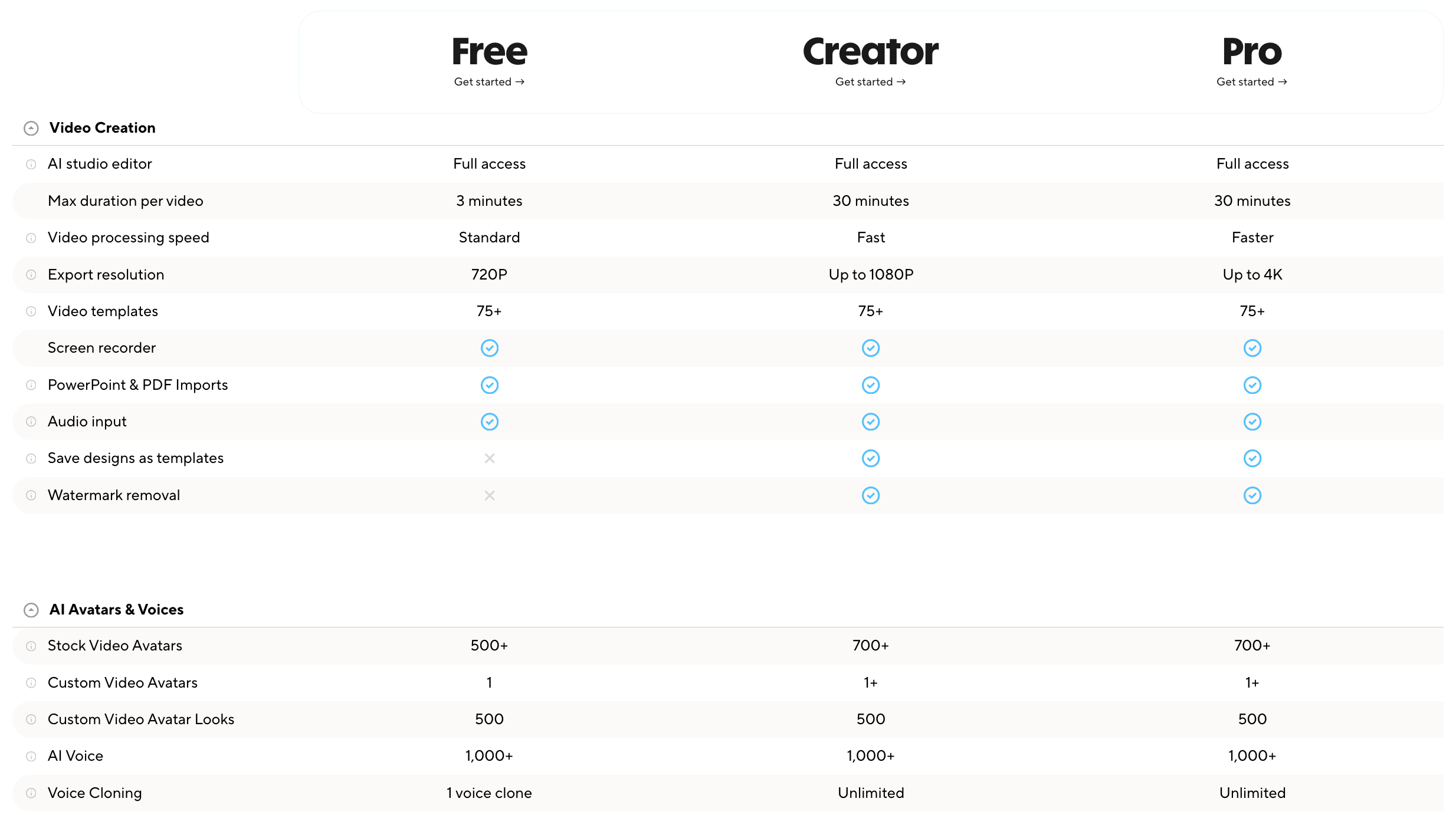
HeyGen's Creator tier sits at $29 per month ($24 per month billed annually) and includes 600 credits a month, videos up to 30 minutes long, 1 custom avatar, voice cloning and watermark removal. Once you burn through the credits or need more than one avatar, the next steps up are Pro ($49 per month, 1,000 credits) or Business ($149 per month plus $20 per seat, 1,500 credits and 5+ avatars).
Synthesia
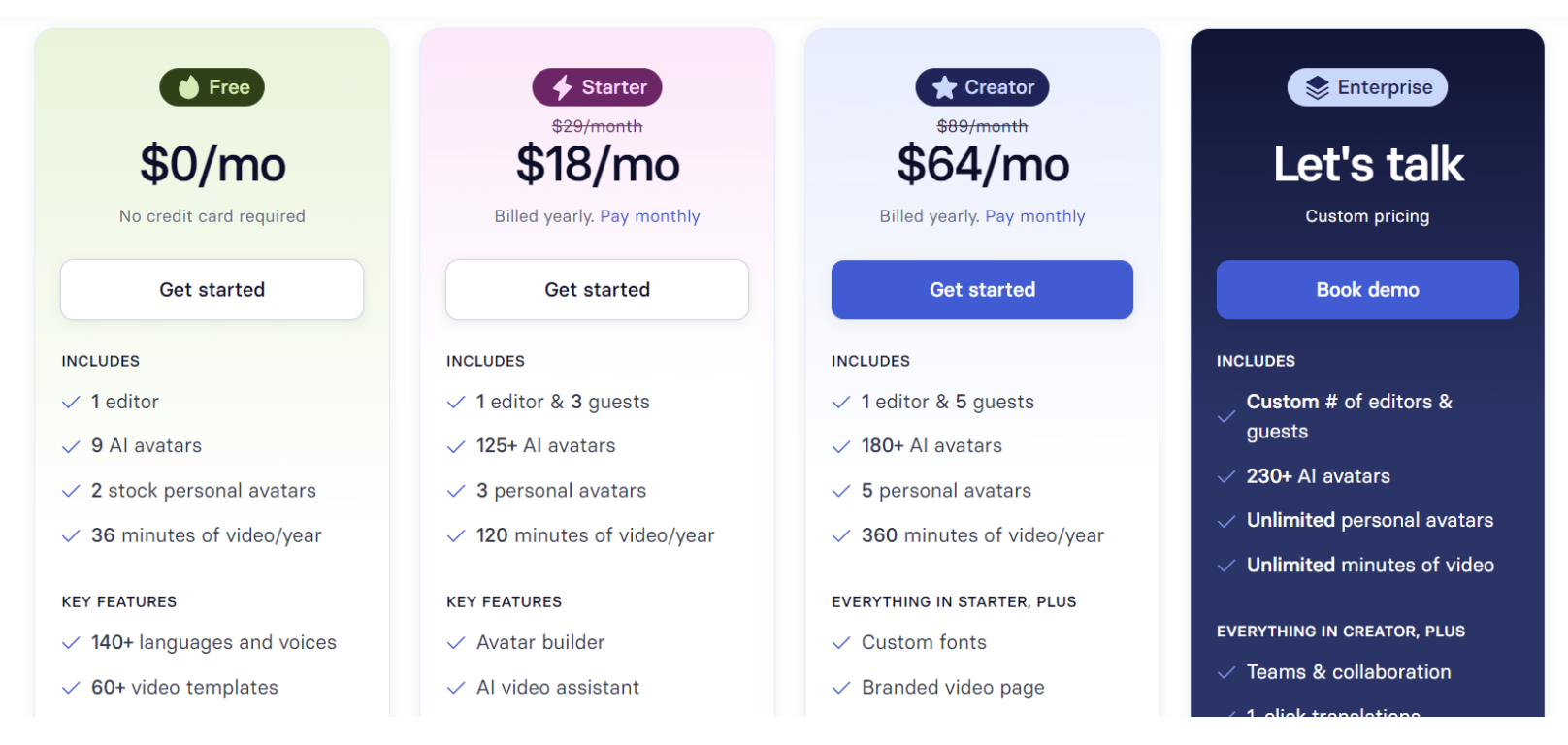
Synthesia's pricing is credit based. The Starter plan includes 1,200 credits a month, which covers roughly 10 minutes of video (or up to 48 minutes of AI dubbing), for $29 per month ($18 per month billed annually), but it doesn't include a personal avatar. Credits disappear fast for anyone posting regularly. For a personal avatar, you need the Creator tier at $89 per month ($64 per month billed annually), which adds 5 personal avatars and 3,600 credits, though editing flexibility is still limited.
D-ID
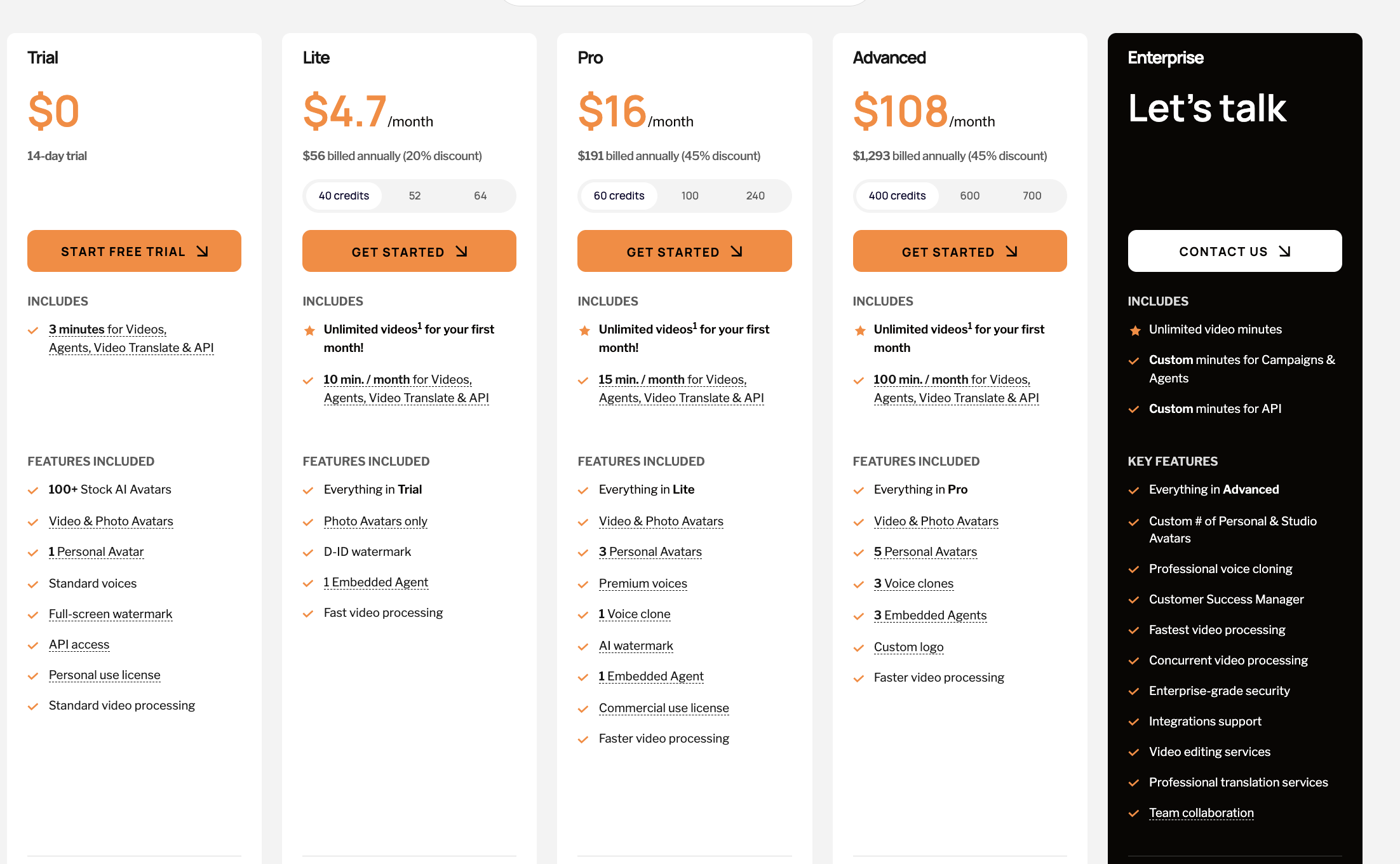
D-ID has the lowest entry price of the group, but the sticker numbers only hold if you pay annually. Lite runs $5.90 a month ($4.70 billed annually) for 10 video minutes and 1 avatar, with a D-ID logo stamped on every clip. Pro runs $29 a month ($16 billed annually) for 15 video minutes and 3 avatars, but the "AI" watermark stays on your videos regardless.
To drop the watermark, you need Advanced at $196 a month ($108 billed annually), which raises the cap to 100 video minutes and 5 avatars, and lets you swap the watermark for your own logo.
Argil
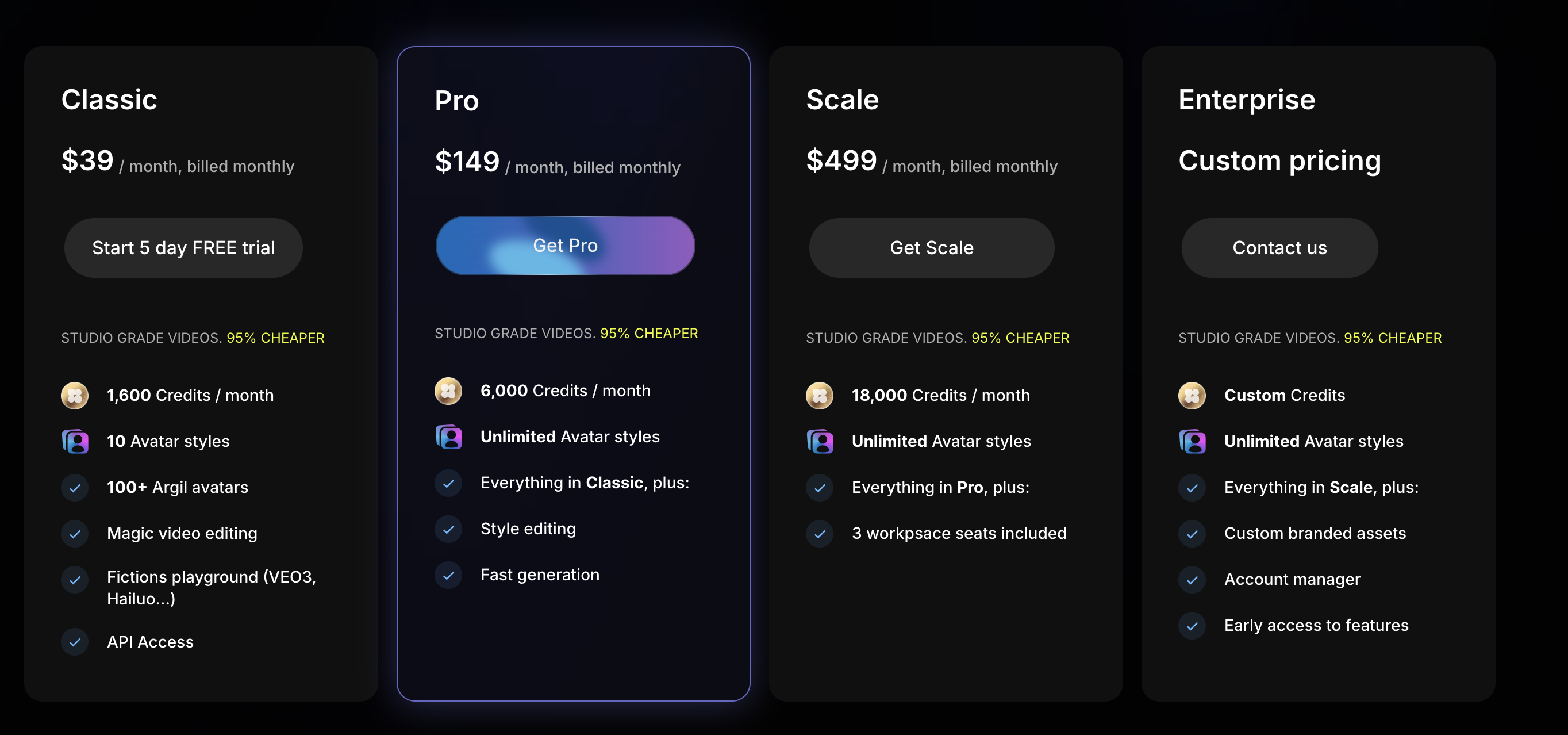
Argil's pricing structure is flatter and simpler than the plans above. Pro is $25 per month with a flat monthly credit allowance (it doesn't stack or roll over) and access to every avatar model. Business is $50 per month and adds the Director workflow plus a shared team workspace. Watermark removal, full resolution exports and publishing to any platform are all part of the first plan, with no separate charge for any of it.
You'll also have access to Argil Fictions, ready made templates for faster production and an API for plug and play integration.
When you compare pricing for leading AI avatar services this way, Argil keeps the friction described above to a minimum. Extra avatars are included in the plan rather than billed separately, the watermark is off from day one, and there's no second tool to buy for editing or exporting.
Why Argil's Pricing Model Works Better Long Term
Argil's pricing philosophy is built around output. Instead of limiting editing features or exports, it assumes users want to create high quality videos often. Avatar creation is part of onboarding, and not an additional upsell, and all tools are included rather than paywalled.
This model aligns with how modern creators and professionals actually work. If you're building a personal brand around video or scaling out regular video content, predictable costs and fewer workflow breaks matter more than a slightly lower headline price. For content creators, marketers and entrepreneurs, that means you don't have to rethink your tool stack every time your content cadence increases.
That's why Argil tends to feel cheaper over time, even if its base price isn't the lowest.
How to Make Smarter Pricing Decisions in 2026
Choosing an AI avatar tool based on headline price alone is risky. The more useful question is how much usable, platform ready content you can produce per dollar.
For some use cases, enterprise platforms make sense. For lightweight experiments, cheaper tools may be fine. But for anyone publishing weekly or daily, pricing models built on credits and limits quickly become bottlenecks.
When you compare pricing for leading AI avatar services with real workloads in mind, flat, all-in-one pricing becomes far more attractive.
Argil: The Best Choice for Price and Value
When you come to compare pricing for leading AI avatar services, you'll need to consider your unique needs and pricing constraints.
For business leaders and teams, HeyGen delivers quality avatars, but it becomes expensive as output increases. Synthesia excels at corporate training but is not cost efficient for high volume creators. Similarly, D-ID offers accessible entry pricing but lacks depth and workflow support.
Argil is an all-in-one video solution that combines AI avatar creation, scripting, editing and publishing into a single system designed for scale.
If your goal is to publish consistently without worrying about upgrades or hidden fees, Argil delivers the strongest value per dollar in 2026. Plus, with Pro, Business and Enterprise plans available, you're investing in a tool that will grow with you. Sign up today to get started, and enjoy your first 5 days completely free.