AI Movie Script Generator: 7 Tools and What a Script Can't Do
AI movie script generator tools compared on verified 2026 pricing, what each one really does, and the step after the script that nobody covers.

Article Highlights
- 7 AI movie script generator tools, priced from $0
- Final Draft 13 costs $199.99 once and has no AI
- Celtx and WriterDuet format, they do not generate
- Sudowrite is a novel tool, screenplay is a plugin
- Best AI movie script generator for shooting: FinalBit
- Argil directs a script into shots, from $50 a month
An AI movie script generator drafts scenes and dialogue from a premise. For a screenplay you intend to shoot, FinalBit is the strongest pick at $40 a month, because it pairs generation with script breakdowns. The criterion that decides your choice is whether a tool writes new text or only formats what you already wrote.
What an AI movie script generator actually does
Three different jobs hide behind the phrase ai movie script generator, and none of the pages ranking for it separates them.
Generation writes new scene text from a premise you type. Formatting enforces the screenplay layout the industry reads, applied to words you supply. Production planning takes a finished script apart into elements, schedules, and budgets.
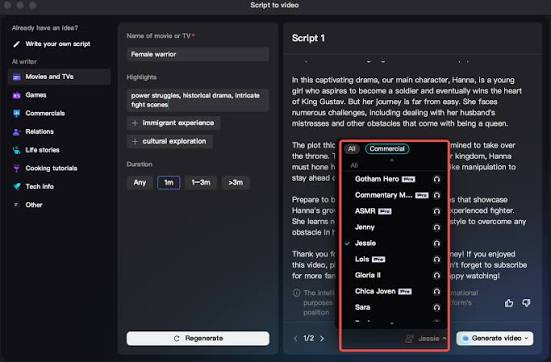
Buy the wrong one of the three and the price stops mattering. Squibler's Pro tier is $89.99 a month billed monthly, or $49.17 a month billed annually, and what it buys is unlimited AI credits. WriterDuet formats three projects for $0 on either billing basis. A writer whose problem is page layout can spend $1,079.88 a year on the first at the monthly rate, or $590.04 on annual billing, and get none of what the second hands over free. Work out which job you are buying, then compare prices.
The test that sorts any tool on any of these lists takes a minute. Give it one sentence and ask for a cold open. Final Draft and WriterDuet will not return one. We ran the same question at a chat model instead of a dedicated tool in our write-up on whether AI can get from an idea to a finished movie script.
7 AI movie script generator tools compared
Every price below was read from the tool's own page during this write-up, and each one links to the page it came from. No roundup was used as a source.
Squibler
Squibler ranks third on Google for this search with a page titled "No Sign-Up, Unlimited". Open it and the import box reads "Attach manuscripts to your prompts after creating your Squibler account." The unlimited part covers the demo. Your manuscript needs the account.
Squibler's real allowance on its pricing page is 1,000 AI credits a month on a free plan the page calls free forever. Squibler Plus is $29.99 a month, or $15.83 a month billed annually. Squibler Pro is $89.99 a month, or $49.17 annually, and it is the only tier with unlimited credits.
FinalBit, formerly NolanAI
If you went looking for NolanAI, it has moved. The nolanai.app address now serves finalbitai.com, and FinalBit's own customer carousel carries the line "I came across NolanAI aka FinalBit last year," which is as close to a public confirmation of the rename as the site offers.
FinalBit is the only tool here that generates a script and then follows it past the page. Its pricing runs Basic at $0 with one project and AI requests on a 30 day usage period, Creator at $40 a month, and Pro at $100 a month. A USEFB30 code sitting on the page currently takes those to $28 and $70. Creator includes unlimited AI requests and 100 monthly credits for AI video. Pro raises the video credits to 210 and adds AI film budgets with PDF and Excel export, plus an automated pre-production suite.
For a short film you actually intend to shoot, FinalBit's breakdown layer is what the $40 Creator plan buys. The budgets and the pre-production suite sit one tier up at $100, so $40 buys the script and the breakdown and stops there. The limitation is continuity. The nolanai.app address still answers with a 301 to finalbitai.com, so a tool you will be inside for months has already changed both its name and its address once. The free Basic tier is a look rather than a plan, at 100 one-time AI requests on a 30 day usage period, with exports watermarked.
Taskade
Taskade ranks first on Google for the same search and is a project management tool. It describes itself as an "AI-powered workspace where teams build and run AI apps, agents, and workflows," and its pricing page says the free plan "has no monthly credits" at all. Paid Taskade plans run $10, $25, $100, and $250 a month. A movie script comes out of one of its templates.
Sudowrite
Sudowrite appears on nearly every AI screenwriting list and sells itself as "the best AI tool for fiction." Its Muse model is described on the homepage as "built just for fiction," and screenplays show up exactly once, inside the plugins section, as a feature that converts a novel into a screenplay.
So the fit is sideways. Sudowrite is a reasonable buy for a novel you may adapt later, at $10 a month for Hobby & Student, $22 for Professional, or $44 for Max, per its pricing page. Sudowrite Max carries 2,000,000 credits a month and rolls unused credits over for 12 months, the only plan among the seven tools here that does. Every Sudowrite plan starts as a trial. There is no $0 tier.
Final Draft
One-time purchase, no subscription, no AI. Final Draft 13 is $199.99, listed against a $249.99 original price, and the alternative is Final Draft Suite at $16.99 a month or $99.99 a year.
Nothing on the product page mentions AI generation. Final Draft keeps turning up in AI script roundups because its file format is what every other tool exports to, which makes it the destination and never the generator.
Celtx
Celtx sits closest to a production department. Its pricing page gives a free tier of one project and one seat, then Writer at $11.24 a month billed yearly, Writer Pro at $18.74, and Team at $44.99, with Education at $600 a year. Breakdowns and scheduling live in the Team tier.
Seats, projects and production planning are the whole of Celtx's price list. Celtx Team at $44.99 a month lands within $5 of FinalBit's $40 Creator plan. FinalBit's $40 includes script generation.
WriterDuet
The most generous real free tier in this set belongs to WriterDuet. Three projects at one document each, read-only collaborators, industry-standard formatting, and imports from Final Draft, Fountain, and PDF, with no time limit on any of it.
Paid WriterDuet tiers go Plus at $9.99 a month or $89.88 a year, Pro at $11.99 or $107.88, Premium at $13.99 or $125.88. Going up buys custom formatting, revision tracking, production tools like page locking and scene omission, then history and multi-column work. Every feature WriterDuet charges for is something done to text you have already written.
Those WriterDuet figures come from WriterDuet's own subscription article, last updated June 17, 2025.
Where the general models fit
Most people drafting a script with AI are doing it in Claude or ChatGPT, and the single video in Google's top ten for the term is somebody writing a full screenplay that way.
Claude is free at $0, Pro is $20 a month billed monthly or $17 a month on the annual plan at $200 up front, and Max starts at $100, per Anthropic's pricing page. ChatGPT's own pricing page refuses automated requests, so no figure for it is quoted here.
The limit shows up over a full-length script. A chat model writes one scene well and will not hold Final Draft layout across a whole screenplay. So the common route costs nothing. Draft in Claude's free tier, then format in WriterDuet's free three projects.
What a script cannot do
A script written by AI has a specific status in the industry, and the Writers Guild of America wrote it down. The 2023 contract's own know-your-rights page on AI states that "no written material produced by traditional AI or GAI can be considered literary material." A company "can't require the writer to use AI software (e.g., ChatGPT) when performing writing services," and it has to disclose to the writer if any materials it hands over were generated by AI.
Set the credit question aside and the mechanical problem is simpler. A script carries dialogue, action, and scene headings, and that is the whole of what it carries. Neither FinalBit's breakdown nor Celtx's Team-tier scheduling decides which shot opens the film. Somebody decides that after the writing, on a board.
The work after the script is staffed and paid. The US Bureau of Labor Statistics counts 72,000 film and video editors and camera operators working in 2025, at a median $75,100 a year, with 3 percent growth projected through 2035. Their job, in the BLS's own words, is to "manipulate moving images," and it begins once a script exists.
From script to shots, and where Argil comes in
The step after an AI movie script generator is the storyboard. Somebody decides what the camera sees in shot one, then shot two, and keeps the character looking like the same character across both.
That is the job Argil is built around. You bring an idea or a finished script, set the world, the characters, and the visual style, then direct it shot by shot as a storyboard, approving or redoing each board. The worked example on Argil's own homepage breaks a script into 7 shots, builds the storyboard, draws one board per shot, and ends on a 30 second 1080p film. You do not paste a screenplay in and collect a finished film. The thesis page sets out where Argil puts the human and where it puts the model.
Argil's homepage serves its plan summary in the HTML, and Pro reads from $50 a month, Studio at $1,250 a month labeled "Done with you," and Enterprise from $2,500. The word "from" is doing work in that first figure. Argil's pricing page says you "choose a monthly credit allowance using the selector on your plan," and that what a generation costs in credits "depends on the model and what you create." So $50 is where Pro opens, and the worked example on the homepage runs 30 seconds.
One constraint before you budget for it. Argil's pricing FAQ says "Plan credits refresh each month and do not stack," so an allowance you do not spend inside the month is gone, and the pay-as-you-go top-ups that "do not expire" are a separate purchase. Nothing Argil publishes converts credits into finished minutes, so nobody can quote you a per-episode price, us included.
Our walkthrough of the idea to script to video workflow covers the handoff in more detail, and the AI video creation library covers the production side.
How to pick an AI movie script generator
Pick by who is going to read the script.
If nobody but you will read it, draft in Claude's free tier and buy nothing. The output at the drafting stage holds up against the paid dedicated tools, and the formatting does not matter yet.
If you are sending it out, you are buying formatting, and WriterDuet's free three projects covers most writers long before Final Draft's $199.99 does. Pay the $199.99 when a production asks for the file format by name.
If you are shooting it, buy production planning before you buy generation. FinalBit and Celtx Team both give you breakdowns at the prices above, and the breakdown is the line item that changes how a shoot week actually runs.
FAQ
Is there a free AI movie script generator?
Yes, several, with different catches. Squibler's free plan gives 1,000 AI credits a month, FinalBit's Basic plan is $0 for one project with AI requests on a 30 day usage period, and Claude's free tier will draft scenes with no credit system at all. Celtx and WriterDuet are free for formatting, at one and three projects respectively, and neither generates. Taskade's free plan carries no monthly AI credits.
Can AI write a whole movie script?
It can produce a full-length draft. Squibler advertises generating a 200 to 300 page book on its Plus plan, and a chat model will write scene after scene for as long as you keep prompting. What comes back is a draft that needs rewriting, and under the WGA agreement that draft is not treated as literary material.
Does an AI-written script count for WGA writing credit?
No. The WGA's AI page states that "no written material produced by traditional AI or GAI can be considered literary material," which keeps AI output out of credit arbitration. A company also cannot hand you an AI-generated screenplay, pay a rewrite fee and treat you as a second writer. You would be credited as the first writer.
What is the best AI movie script generator for a short film?
FinalBit, because the $40 Creator plan generates the script and then breaks it down for production, which is the next thing you need. Budget separately for the board.
Related articles
- Movie Generator: How to Make a Film Without a Camera
- AI Voice Movies: The Best Tools for AI-Generated Video
An AI movie script generator gets you the pages. Start the board in Argil when you want the shots.
AI movie script generator tools compared on price, formatting, and what happens after the script.