Free AI Movie Generator: Where Each Free Tier Stops in 2026
A free AI movie generator caps you on credits, watermarks and commercial use. See what LTX, Runway, Pika, Luma and Kling give you free, from their own pages.

Article Highlights
- Free AI movie generator plans are capped by credit allowance
- LTX Studio free: 800 one-time credits, personal use only
- Runway free: 125 credits, about 10 seconds of Gen-4.5
- Pika's free plan ships zero monthly credits
- No free AI movie generator grants you a copyright
- Argil has no free tier and starts at $50 per month
The strongest free AI movie generator right now is LTX Studio, which hands new accounts 800 one-time credits. Every free plan in this category runs on a credit allowance, and the thing that decides your pick is usage rights. LTX Studio's free plan is personal use only, and Pika's free plan carries no commercial license.
What a free AI movie generator actually gives you
The word free does three different jobs across these tools, and the difference matters more than any model benchmark. LTX Studio gives you 800 credits once. Runway gives you 125 credits once. Pika's free column lists 0 monthly credits and runs on purchased packs only. Every figure in this article was read off the tool's own pricing page on October 20, 2026, because these plans change month to month and the roundups lag behind them.
Watermarks are a paid line item rather than a quality setting. On Runway's pricing page, "No watermarks" first appears on Standard at $15 a month. LTX Studio puts "No watermarking" on Lite, also $15 a month. Pika is the exception and prints no watermark on its free plan.
Commercial use gets withheld rather than throttled. LTX Studio's free column carries a Personal use license and spells it out in a sentence: "For personal projects only. Cannot be used for business, marketing, or paid work." Pika's plan comparison prints Commercial license as No for Free and for Starter at $10 a month, then Yes from Creator at $35.
You can generate and download on every free plan here. The downloaded file is where the limit sits, since that is the one carrying the watermark and the license terms, and it is also the only part of what an AI movie generator actually produces that you can hand to anyone else.
The free AI movie generator tools, and where each one stops
LTX Studio
No other tool on this list is as blunt in print. The free column on LTX Studio's pricing page says the plan is for personal projects only and cannot be used for business, marketing, or paid work. You get 800 credits, once, with no monthly refill.
Above that the ladder goes Lite at $15 a month for 8,000 credits, Standard at $35 for 28,000, and Pro at $125 for 110,000. Commercial rights arrive with Standard, so the first plan that lets you sell the output is $35. The page was carrying a promotional second column when it was read, so those are the standing monthly list prices rather than the discounted ones.
LTX Studio is also the closest thing here to a storyboard-first product, with blank storyboards on the free plan and AI storyboards and pitch decks from Standard up. If the thing you want to test is planning a film rather than generating a clip, this is the free tier to spend first.
Runway
Do the arithmetic and the free plan shrinks fast. Runway's pricing page gives free accounts 125 one-time credits, and its own model table prices Gen-4.5 at 60 credits per 5 seconds. That is 12 credits a second, so the free plan is roughly ten seconds of Gen-4.5 in total, for the life of the account.
Runway publishes the next steps itself. Standard's 625 monthly credits equal 52 seconds of Gen-4.5. Pro's 2,250 equal 187 seconds. Now price a real short. Ninety seconds of finished film at three takes a shot is about 270 seconds of generation, which is past Pro at $35 a month, and nobody edits at a one-to-one take ratio.
No vendor page does that arithmetic for you. Free is a sample of the model, and the paid tiers are a seconds-per-month budget that is smaller than a short film. Our breakdown of Runway's pricing plans goes through the credit mechanics tier by tier.
Pika
Zero. That is the monthly credit figure in the free column on Pika's pricing page, followed by the words "packs only". The free plan, on its own, generates nothing until you buy credits.
Packs start at 1,500 credits for $25, which Pika converts on the same page to 12 Seedance 2.5 clips. Starter is $10 a month for 900 credits, and this is the trap worth naming, because Starter still prints Commercial license: No. The cheap-looking way onto a paid plan does not give you the right to sell anything you make. Creator at $35 is the first tier that does.
Luma
There is no free plan to review. Luma's pricing page lists Plus at $30 a month, Pro at $90, and Ultra at $300, and its own structured description of those plans says they include free trial credits, which puts the trial inside a subscription rather than beside one.
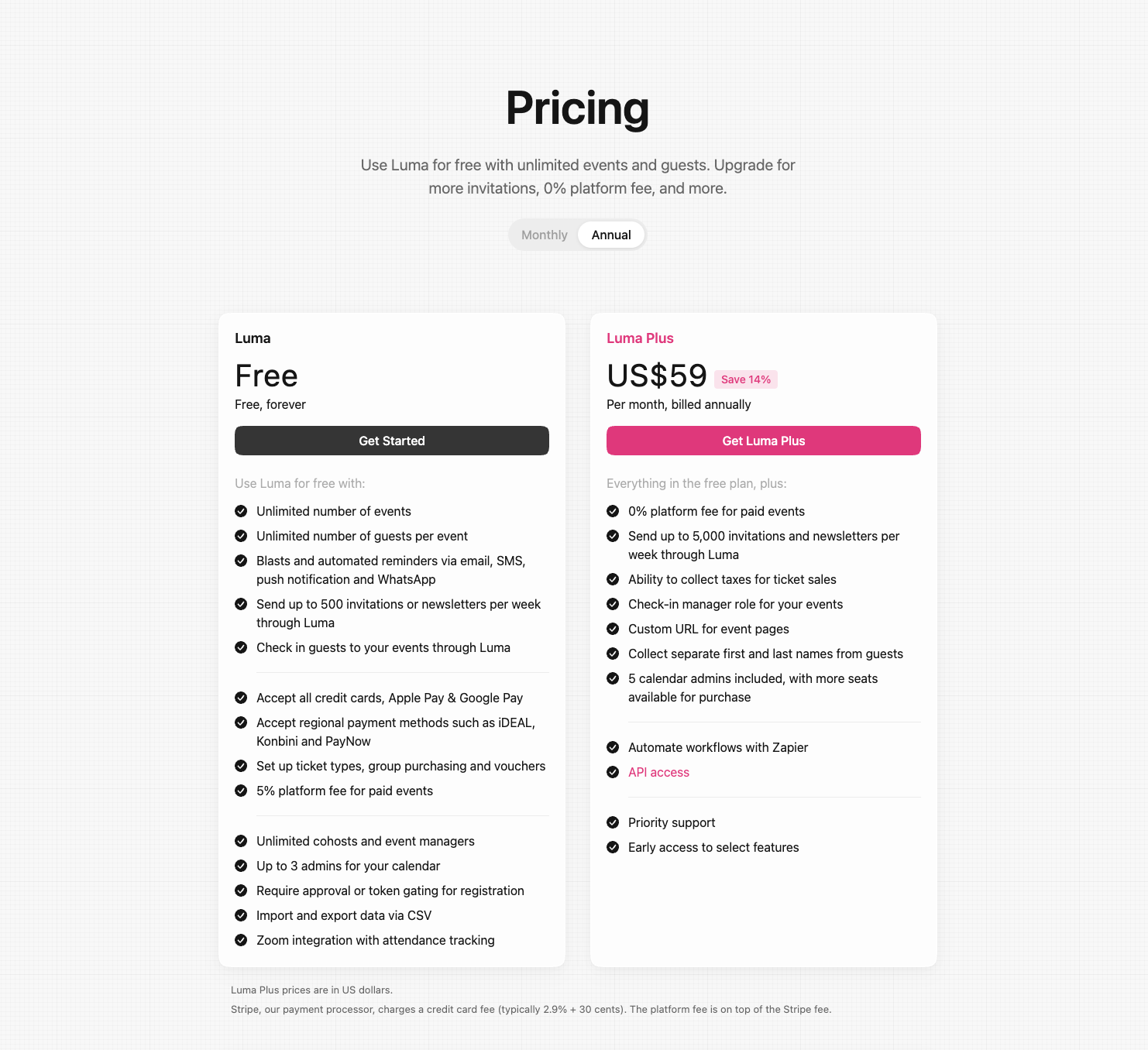
Luma does publish a usable credit table. Ray3.2 at 1080p costs 400 credits per 5 seconds, so Plus's 10,000 credits run to about 125 seconds of 1080p a month. The Dream Machine name is retired, so searches for it now land on the agent products. If the $30 floor is the blocker, we tested the free Luma AI alternatives separately.
Kling
This one has to come with a caveat about what could not be read. Kling's consumer membership page renders in the browser rather than on the server, and a fetch of the Kling membership plan page on October 20, 2026 returned no plan figures at all. So this article quotes no Kling free credit allowance.
What Kling does publish in readable form is its API rate card, and it is arguably the more useful number. One unit lists at $0.14, and Kling 3.0 at 720p costs 0.6 units per second, about $0.084 a second. Ninety seconds of 720p comes to roughly $7.60 at list price. That is the marginal cost sitting behind every free tier on this page, which is why none of them is generous for long.
Higgsfield
Higgsfield's pricing page behaves the same way. The plan figures load client-side and a fetch returned the page furniture and nothing else, so there is no free-tier limit to report here. The site offers a Try Free sign-up, and that is as far as anyone gets without an account.
A commercial-use license is not a copyright
Clearing the vendor's license only solves half of the problem, and the other half is not on any pricing page. The United States Copyright Office's registration guidance of March 16, 2023 says that when an AI technology determines the expressive elements of its output, the generated material is not the product of human authorship, so it "is not protected by copyright and must be disclaimed in a registration application" (U.S. Copyright Office, 2023).
The Office went further in its Part 2 Copyrightability Report of January 2025, drawn from more than 10,000 public comments from all 50 states and 67 countries. Its conclusion is that prompts alone do not provide sufficient human control to make the user the author of the output, and that prompts "essentially function as instructions that convey unprotectible ideas" (U.S. Copyright Office, 2025).
Two separate gates, then. The vendor's license decides whether you are allowed to sell the film. The Copyright Office decides whether you own it. Paying Pika $35 a month clears the first gate and does nothing at all about the second.
The same guidance names the route through. A human's selection and arrangement of AI-generated material, or a human's own modification of it, can support a copyright claim. That is a shot-by-shot argument rather than a prompt argument, which is worth knowing before you build paid work on a generated file. We compared the license terms across the category in our look at the best AI video generator for commercial use.
Argil is not a free AI movie generator
Argil has no free plan. If free is the hard requirement, the list above is the list, and LTX Studio or Runway is where to start.
Argil publishes its plan summary in its homepage source, and read on October 20, 2026 it says Pro from $50 per month, Studio at $1,250 per month labeled "Done with you", and Enterprise from $2,500 per month. The $50 is a floor and not a price, because the monthly credit allowance is what you are choosing when you subscribe. The same source lists plan credits as monthly and non-stacking, while top-ups are billed once, separately from the subscription, and do not expire.
What the money buys is a different order of events. You bring an idea, shape the world, the characters and the visual style, and Argil turns that brief into a storyboard you approve shot by shot before anything renders. Reusable characters and locations are what makes the person in shot 12 the same person as in shot 3, which is the problem every free tier spends its allowance failing to solve. Argil's thesis page puts the position in two sentences. The human is the director. AI is the crew.
Set that against the Runway arithmetic. A higher tier raises your seconds per month and leaves the take count alone. Deciding the shot on a board before you render is the only thing that moves takes per shot, and takes per shot is what turns ninety seconds of film into 270 seconds of generation. Writing the movie script from an idea does the same work one step earlier.
How to choose
Stay on free credits for as long as the open question is what the film is. Once the open question becomes whether shot 12 matches shot 3, free credits stop being a budget and start being a sampler.
- Testing whether any of this works, on a personal project: LTX Studio's free plan, 800 credits, personal use only. It is the largest published free allowance here and it comes with blank storyboards.
- One paid deliverable, no series behind it: Runway Standard at $15 a month or Pika Creator at $35. Read the commercial-license line on the plan you actually buy, not the one above it.
- A film or a series where a character has to survive across shots: a storyboard-first tool. Argil at $50 a month is in that category and is not in the free one. If the input is a still rather than a script, our ranking of AI image to video generators covers the cheaper path.
If the storyboard is the part you want, start an Argil account and bring it one scene. If free is the part you want, the free AI movie generator options above are the honest set, and these limits are the ones to re-check before you commit a project to any of them.
FAQ
Is there a completely free AI movie generator?
No tool here produces a finished film on a free plan. LTX Studio's 800 one-time credits is the largest free allowance any of the six publishes, and it is licensed for personal projects only. Luma lists no free plan at all, and Pika's free plan carries zero monthly credits.
Do free AI movie generators add a watermark?
Usually, and the pricing page is where you can tell. Runway lists "No watermarks" starting on Standard at $15 a month, and LTX Studio lists "No watermarking" starting on Lite at $15, which means the free plans below them do watermark. Pika is the exception and shows no watermark on its free plan.
Can I use a free AI movie generator video commercially?
Check two things rather than one. LTX Studio's free plan says in writing that it cannot be used for business, marketing, or paid work, and Pika withholds its commercial license from both Free and Starter. Separately, the U.S. Copyright Office holds that material whose expressive elements were determined by the AI is not protected by copyright, so a license to sell is not the same as ownership.
How long a video can you make with free credits?
Short, on the order of seconds. Runway's 125 free credits buy about ten seconds of Gen-4.5 at the 12 credits per second its own model table publishes. Kling's API rate card puts 720p video at roughly $0.084 a second, which is the real cost a free tier is covering for you.
Related Articles
- 7 Best AI Video Generators for Content Creators: Free and Paid
- Turn Ideas Into Scripts Into Videos: The AI Agent Workflow Guide
- How to Create SaaS Explainer Videos for Free: 3 Best AI Tools
Free AI movie generator credit limits, watermark rules and commercial-use terms, read off each tool's own pricing page.