How Much Does YouTube Pay Per View? 10 Niches Ranked 2026
YouTube pays $2,000 to $4,000 per million views on average, but RPM ranges $4 to $30+ by niche. See the 2026 ranking, real earnings, and how to pick yours.

Article Highlights
- How much does YouTube pay per view by niche in 2026
- Why finance tops the YouTube pay per view chart
- Real creator earnings data behind every niche
- Posting cadence each high RPM niche demands
- The production stack that powers top channels
- How Argil removes the on-camera bottleneck
How Much Does YouTube Pay Per View? 10 Niches Ranked 2026
Quick answer: YouTube pays $2,000 to $4,000 per million views on average, or roughly $0.01 to $0.03 per view platform-wide (vidIQ, 2026). But YouTube does not actually pay per view, it pays per ad impression, and that platform-wide average hides everything that matters: a finance creator earns $15 to $30 per 1,000 views while an entertainment creator earns $2 to $4 for the same 1,000 views. A finance creator with 1 million views can out-earn an entertainment creator with 10 million views, and the niche is doing almost all of that work, not the talent.
A bank chasing a new brokerage customer worth thousands in lifetime value will pay far more for an ad slot than a game studio chasing a teenager, and that gap between a $3 niche and a $30 niche is the single biggest factor in whether your channel funds a side income or a full business.
This guide ranks the 10 highest-paying YouTube niches in 2026 by RPM (revenue per 1,000 views, the number you keep after YouTube's cut). Each entry reads like a scouting report: what it pays, the production stack it demands, who is winning, and the realistic on-ramp if you start today. The point is to help you find the one niche you could actually win, rather than just gawk at the top of the table.
The 10 highest paying YouTube niches in 2026, ranked by RPM
Skim this in 30 seconds and you have your shortlist. RPM ranges below reflect US-heavy audiences, where advertiser demand is strongest. Tier-3 traffic earns a fraction of these figures.
- Personal finance and investing - RPM $15 to $30. Cadence: 3 to 5 long-form per week. Difficulty: high (credibility and disclosure compliance required).
- Business and entrepreneurship - RPM $12 to $25. Cadence: 3 to 4 long-form per week. Difficulty: moderate (story-driven, lighter compliance burden).
- Real estate and property - RPM $10 to $22. Cadence: 2 to 4 per week plus local market updates. Difficulty: moderate (geo-local advantage).
- Legal and law education - RPM $10 to $20. Cadence: 2 to 3 long-form per week. Difficulty: high (bar rules, jurisdictional care).
- Education and tutorials - RPM $4 to $10. Cadence: 3 to 7 per week. Difficulty: low to moderate (depth beats polish).
- Tech reviews - RPM $4 to $10. Cadence: 4 to 7 per week. Difficulty: high (hardware costs, fast product cycles).
- Insurance - RPM $10 to $20. Cadence: 2 to 3 per week. Difficulty: high (regulated, niche audience).
- Software and SaaS reviews - RPM $8 to $18. Cadence: 3 to 5 per week. Difficulty: moderate (high-LTV viewers, B2B advertisers).
- Marketing and digital strategy - RPM $7 to $15. Cadence: 3 to 5 per week. Difficulty: moderate (saturated but high CPM).
- Health and wellness - RPM $5 to $12. Cadence: 3 to 5 per week. Difficulty: moderate (YMYL rules, supplement ad limits).
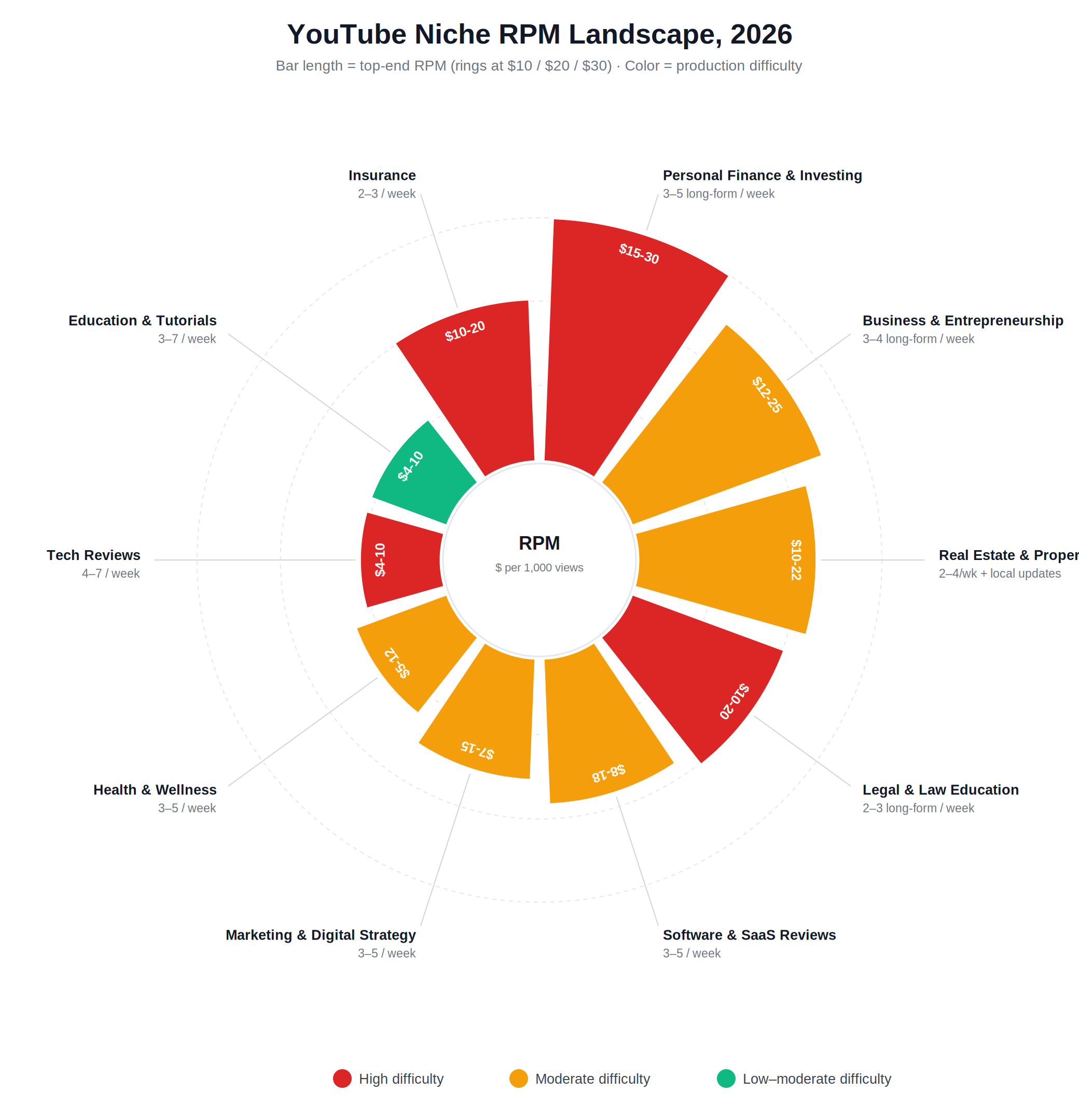
Image generated using Claude.ai
These ranges line up with independent niche data showing finance, insurance, and legal at the top of the RPM table and consumer entertainment at the bottom (vidIQ, 2026). Now the scouting reports. If you want the average across every genre rather than niche by niche RPM, see how much YouTubers make overall.
1. Personal finance and investing
The highest-paying niche on YouTube, and it is not close. Advertisers fight for high-intent viewers researching mortgages, brokerages, credit cards, and retirement accounts, because a single converted viewer can be worth thousands over their lifetime.
- Typical RPM: $15 to $30. Outliers with US-heavy audiences in Q4 push past $50 as financial advertisers flood the auction before year-end.
- Average creator earnings: a channel doing 500K monthly views earns roughly $7,500 to $15,000 per month from ads alone. Sponsorships and brokerage affiliate commissions often double that.
- Cadence to compete: 3 to 5 long-form uploads per week, plus daily Shorts for discovery. Channels publishing once a week tend to stall under 50K subscribers.
- Production stack: scripted long-form videos of 10 to 20 minutes, chart-heavy b-roll, screen recordings of brokerage interfaces, and on-camera presence. Heavy editing load.
Example creator profile
Look at Graham Stephan, Andrei Jikh, and Humphrey Yang. The through-line is the same: a financial advisor or analyst background, near-daily uploads, and education-first scripts. Graham Stephan's main channel has reported earnings of over $2 million from 134 million views, an RPM in the $16 to $20 range (vidIQ). Newer entrant Joshua Mayo reportedly cleared $613,960 in first-year revenue, with monthly RPM swinging between $6 and $29.30 (OutlierKit, 2026).
The on-ramp is narrow. Most successful finance creators were certified planners, advisors, or finance professionals before they ever filmed a video. Authority is the moat, and viewers test it within the first 30 seconds. If you have that background, this is the most lucrative place on the platform to put it to work. For a deeper look at building credibility before the camera ever turns on, see this guide to becoming a content creator in 2026.
2. Business and entrepreneurship
B2B advertisers, recruitment platforms, productivity tools, and online course companies bid heavily for founder-curious viewers. The audience is smaller than finance but the commercial intent is just as strong.
- Typical RPM: $12 to $25.
- Average creator earnings at 500K monthly views: $6,000 to $12,500 per month from ads. Course and community revenue is often 5 to 10 times larger than the ad income.
- Cadence to compete: 3 to 4 long-form per week. Founders posting weekly do grow, but at roughly a third of the rate of those posting 3 times a week.
- Production stack: interview-style or solo to-camera. Lower b-roll demand than finance, higher demand for sharp hooks and tight pacing.
Example creator profile
Alex Hormozi, Codie Sanchez, and Ali Abdaal define the pattern: operator credibility from a real business paired with relentless upload frequency. The economics here are worth studying. One Ali Abdaal video with 9.8 million views earned $191,258 in ad revenue, an RPM near $19.50 (UNILAD Tech, 2025). Yet ad revenue is reportedly only about 15% of his total income, with courses making up the bulk, which tells you something about the model. In business YouTube, the ads are the small line and the audience you build is what actually pays. If you want to model a founder-voice format, this breakdown of creating videos in the Alex Hormozi style is a useful starting point.
3. Real estate and property investment
Mortgage lenders, agents, property platforms, and home-services brands drive the bidding. The local angle is what gives a small creator an unfair edge here, because a channel built around your specific city is up against almost no one, while national finance channels are fighting thousands of rivals for the same viewer.
- Typical RPM: $10 to $22.
- Average creator earnings at 200K monthly views: $2,000 to $4,400 per month from ads. The real money sits in agent commissions, course sales, and brokerage referrals.
- Cadence to compete: 2 to 4 long-form per week, plus weekly market updates tied to your local geography.
- Production stack: property walkthroughs, market-data screen recordings, and on-camera presence in the city you serve.
Example creator profile
The winners are usually licensed agents or active investors, plus contributors in communities like BiggerPockets. The pattern is geo-targeted content and deal-by-deal breakdowns that a national channel could never replicate. An agent who turns every listing into a walkthrough and every closing into a case study builds a content moat and a lead pipeline at the same time. Agents already doing this at scale lean on AI video to keep up, as covered in this piece on how real estate agents create viral UGC videos in 2026.
4. Legal and law education
Personal injury, immigration, estate planning, and small business law carry some of the highest cost-per-click rates on the entire web. That demand bleeds straight into YouTube RPMs, because the same advertisers chase the same viewers.
- Typical RPM: $10 to $20.
- Average creator earnings at 150K monthly views: $1,500 to $3,000 per month from ads. Case-referral fees and consultation bookings typically run 10 to 20 times larger.
- Cadence to compete: 2 to 3 long-form per week. Most attorneys never break through, because billable hours compete directly with filming time.
- Production stack: explainer-style to-camera, court-precedent screen captures, and simple b-roll. Lower visual demand than finance.
Example creator profile
LegalEagle (Devin Stone) and Steve Lehto are the archetype: practicing attorneys giving jurisdiction-specific commentary with clear disclaimers, on a near-daily schedule. LegalEagle's YouTube ad revenue alone has been estimated in the range of $240,000 to over $500,000 a year, before referrals and his exam-prep business (NetworthSpot). The bottleneck for nearly every lawyer is the same one: they have the knowledge, but the billable hours leave no time to film.
5. Education and tutorials
Lower RPM, far higher volume potential. Online-learning platforms, language apps, and software-training advertisers fill this auction. What it gives up in rate, it makes back in scale and durability, since tutorials rank in search for years.
- Typical RPM: $4 to $10.
- Average creator earnings at 1M monthly views: $4,000 to $10,000 per month from ads, with course sales frequently 3 to 5 times larger.
- Cadence to compete: 3 to 7 per week. The niche rewards both depth (full courses posted free) and breadth (many topics covered).
- Production stack: heavy screen recording, voiceover, and low on-camera demand. This is the most accessible high-volume niche to enter.
Example creator profile
Fireship, freeCodeCamp, and Khan Academy show the shape: a subject-matter expert with a teaching instinct, a consistent format, and dense, useful information per minute. Credentials matter less here than clarity. If you can explain a hard thing simply and do it on repeat, the algorithm rewards you. The low on-camera demand also makes this the easiest niche to produce without a studio, a theme explored in this guide to creating video content without being on camera.
6. Tech reviews and consumer electronics
Hardware brands, software tools, and accessory makers underwrite this niche. It is predictable on RPM but brutal on competition and cost.
- Typical RPM: $4 to $10.
- Average creator earnings at 500K monthly views: $2,000 to $5,000 from ads, often matched by sponsorship revenue.
- Cadence to compete: 4 to 7 per week to stay aligned with product release cycles.
- Production stack: high. Multiple camera angles, product b-roll, and on-camera demos. This is the highest production cost per video of any niche on the list.
7. Insurance
A smaller audience pool, but the CPC pressure from auto, life, health, and business insurance advertisers is intense. That keeps RPM high even when view counts are modest.
- Typical RPM: $10 to $20.
- Average creator earnings at 100K monthly views: $1,000 to $2,000 from ads. Brokerage commissions are the real income driver.
- Cadence to compete: 2 to 3 per week. The topic moves slowly and is less news-driven, so evergreen explainers carry the channel.
- Production stack: simple to-camera explainer with screen recordings of comparison sites.
8. Software and SaaS reviews
The closest cousin to tech reviews, but with much higher-LTV viewers and a stronger B2B advertiser pool. A buyer comparing CRM platforms is worth far more than one comparing earbuds.
- Typical RPM: $8 to $18.
- Average creator earnings at 200K monthly views: $1,600 to $3,600 from ads, with SaaS affiliate revenue often 5 times the ad take.
- Cadence to compete: 3 to 5 per week. SaaS ecosystems move fast and reward timely takes.
- Production stack: screen recordings, side-by-side comparisons, and voiceover. Low on-camera demand.
9. Marketing and digital strategy
A saturated niche where advertiser bidding stays elevated because the audience (agency owners, founders, in-house marketers) carries serious lifetime value.
- Typical RPM: $7 to $15.
- Average creator earnings at 300K monthly views: $2,100 to $4,500 from ads, with consulting and course revenue 3 to 10 times larger.
- Cadence to compete: 3 to 5 per week. Punditry and timely takes drive growth here more than evergreen content does.
- Production stack: solo to-camera plus screen recordings of platforms like Meta, Google, and LinkedIn. Low b-roll demand.
10. Health and wellness
A YMYL category, so RPM is solid but ad restrictions cap the upside, especially around supplements. The strongest income comes from product sales and affiliate programs rather than ads.
- Typical RPM: $5 to $12.
- Average creator earnings at 1M monthly views: $5,000 to $12,000 from ads. Credentialed practitioners (MDs, physical therapists, nutritionists) earn far more through consultations and programs.
- Cadence to compete: 3 to 5 per week.
- Production stack: practitioner credentials shown on screen, simple to-camera explainer, and light to moderate b-roll.
Which niche should you actually pick
Most readers skim those 10 niches and do one of two things. They default to the highest RPM, which is finance, or they pick the niche closest to their day job. The second instinct is the one worth following.
- Pick the niche where you hold real authority. A $30 RPM is worthless if your content cannot survive a viewer asking why they should listen to you. Authority is what converts a view into a subscriber and a subscriber into a client.
- Filter the list by your existing credibility. A CPA leans toward finance and small business, a litigator toward legal, an agent toward real estate, and a company owner toward business.
- Avoid niches where you would be the 100th faceless channel saying the same thing. Most beginners default to tech reviews or generic business advice, the two most crowded lanes with no built-in edge.
- Cadence beats niche when authority is equal. A $10 RPM niche at 5 uploads a week will out-earn a $20 RPM niche at 1 upload a week, every time, because frequency compounds in a way that a higher rate alone never will.
That last point is where most creators come unstuck, and it is the part that gets skipped over almost everywhere else.
The cadence problem (and how experts actually solve it)
Look back at the top of the list. 5 of the 6 highest-RPM niches, finance, business, real estate, legal, and SaaS, are all places where personal authority drives growth. The expert already has the knowledge, so the real constraint is the time cost of being on camera 3 to 5 times a week while running a demanding job.
- A CPA, attorney, agent, or founder hits a wall the moment they try to film at the cadence the niche demands. The day job does not pause for uploads.
- Outsourcing editing and scripting helps, but it leaves the worst part untouched. Filming still means setting up lighting and audio, bringing energy to every take, and reshooting a whole segment the moment a single number changes, and that work still falls entirely on the expert, who has to show up in person for every video.
- This is where AI video platforms change the math. Tools like Argil work differently from generic editors. You record a 2-minute training video of yourself once, get a personalized AI clone, and then turn any written script into a fully edited video with captions, b-rolls, and transitions, without sitting in front of a camera again.
- The fit is sharpest in exactly the high-authority niches above. An attorney can publish 5 jurisdiction-specific explainers a week without taking an hour from clients. A financial advisor can ship daily market commentary and rewrite the script the moment the market moves, with no reshoot. If Shorts are part of that cadence, keep them inside YouTube's Shorts length limits so they stay eligible for Shorts distribution and ad revenue sharing.
- This works because the human inputs stay human. The taste you bring, the domain knowledge you have built, and the specific angle you take on a case or a market are still entirely yours, and only the production pipeline gets removed. The tool fits experts whose face and voice already carry weight rather than faceless entertainment channels. You can see how creators map this into a real workflow in this guide to turning any blog into video content.
- The practical math: script 5 finance videos on a Sunday in about 90 minutes, generate them through Argil in roughly 30 minutes, then schedule across the week. Total weekly cost of around 2 hours for output that would otherwise eat 20 to 30 hours of filming and editing. For the mechanics of getting a Short live and eligible for the Shorts ad pool, see how to upload a YouTube Short the right way.
That is the difference between a niche that pays well on paper and one you can actually sustain. The niche sets the RPM, and your workflow decides whether you can keep up the cadence long enough to collect it.
FAQ
What is the highest paying niche on YouTube in 2026?
Personal finance and investing, with RPMs of $15 to $30 and Q4 outliers above $50. Advertisers bid aggressively because a single viewer who opens a brokerage account or switches credit cards is worth thousands in lifetime value. Verified creator data backs this up: Graham Stephan averaged around a $14.56 RPM across 108 million views, and newer finance creators have reported single-month RPMs near $29 (OutlierKit, 2026).
Can you really make money on YouTube with under 10,000 subscribers?
Yes, if you are in a high-RPM niche and your videos rank for high-intent search queries. A real estate or legal channel with 5,000 subscribers pulling steady search traffic can out-earn a 100K-subscriber gaming channel, because the per-view rate and the downstream lead value are both far higher. Subscriber count matters far less than your RPM and the buying intent behind each view. If you are weighing platforms rather than niches, TikTok's per-view payouts run lower across the board than YouTube's, since its revenue-share program pays out at a fraction of YouTube RPM.
How long does it take to start earning meaningful money on YouTube?
Plan for 6 to 18 months at 3 or more uploads per week in a high-RPM niche. The two variables that compress that timeline more than anything else are niche choice and posting cadence. Nothing else, not editing quality, not equipment, moves the date forward as much as picking a paying niche and showing up frequently.
Do I need to show my face to earn high RPM?
Not technically. Tutorials and SaaS reviews do well on screen recordings alone. But the highest-authority niches (finance, legal, real estate) convert far better when the expert is visible, because trust is the product. AI video tools now let experts stay on camera through a personal clone without paying the daily time cost of filming, which closes the gap between faceless ease and face-led trust.
What is the easiest high-paying niche to break into?
Education and tutorials. The RPM ($4 to $10) sits below finance or legal, but the entry bar is depth of subject knowledge plus consistent posting, not formal credentials. Software and SaaS reviews come a close second, with higher RPM and the same low on-camera demand.
How many videos per week do you need to grow on YouTube?
Established channels grow on 3 to 5 long-form uploads a week. New channels often need 5 to 7 to gain traction. This is precisely the point where most expert creators give up, because the cadence collides with a full-time job, and it is where an AI video workflow stops being a nice-to-have and becomes the thing that keeps the channel alive.
Related Articles
- How to make a YouTube channel from scratch
- How to automate short-form videos in 2026, step by step
- How to repurpose blog content into short-form videos with AI
The highest RPM YouTube niches in 2026 reward authority plus cadence over raw view counts