How Much Does YouTube Pay Per View

Article Highlights
- YouTube pays roughly $0.018 to $0.05 per view on average
- RPM, not per view, is the number creators actually read
- Niche moves earnings 20x: finance vs gaming on identical views
- Posting cadence is the lever beginners underestimate most
- How much YouTube pays per view depends on niche, not luck
- Argil lets experts publish daily without filming every day
How Much Does YouTube Pay Per View in 2026? RPM by Niche, Real Numbers, and the Cadence That Compounds
How much does YouTube pay per view in 2026
YouTube pays creators roughly $0.018 to $0.05 per view on average. High value niches like finance and B2B land between $0.10 and $0.30 per view, and a handful of outliers clear $1 per view. That spread is the whole story, because the per view number you actually take home depends far more on what you cover than on how many people watch.
Here is the part most articles skip. YouTube does not report earnings per view. Inside YouTube Studio, you see RPM, which is revenue per 1,000 views. So the cleaner way to read those numbers is as RPM: roughly $18 to $50 per 1,000 views on average, $100 to $300 for high value niches, and the rare channel earning above $1,000 per 1,000 views.
Across niches in 2026, average RPM ranges from about $1.61 on the low end to $29.30 on the high end, based on AdSense aggregations from Tubular, Influencer Marketing Hub, and creator reported income reports. Those figures are already net of YouTube's cut. The platform keeps 45% of ad revenue and pays creators 55%, so every per view number here is your share, not the gross amount advertisers spent.
How YouTube actually pays creators: CPM vs RPM vs total revenue
Most search results conflate CPM and RPM, which is why the answer to how much does YouTube pay per view feels so slippery. Once you separate the two, your own dashboard starts to make sense, and you can predict your income instead of guessing at it.
CPM: what advertisers pay
CPM is the cost per 1,000 ad impressions. It is what the advertiser pays, not your take home. In 2026, global CPM runs from about $4 to $35 depending on niche, viewer country, season, and ad format. Q4 is the spike, because brands dump budget before the holidays and bid each other up.
The trap is assuming every view earns CPM. It does not. Only a fraction of views serve an ad at all. Roughly 40 to 60% of long form views are monetized, and far fewer Shorts views, because not every viewer sees an ad, has ad blockers off, or watches long enough to trigger one.
RPM: what creators actually earn
RPM is revenue per 1,000 total views, monetized or not, already net of YouTube's 45% cut. This is the number that matters, because it folds in the unmonetized views that CPM ignores. As a rule of thumb, RPM lands at 30 to 60% of CPM once you account for the cut and the unmonetized drag.
A worked example makes it concrete. Say your CPM is $20. Only 50% of your views get monetized, and you keep 55% of that revenue. Run the math: $20 times 0.50 times 0.55 gives you about $5.50 RPM. So a $20 CPM does not mean $20 per 1,000 views in your pocket. It means closer to $5.50.
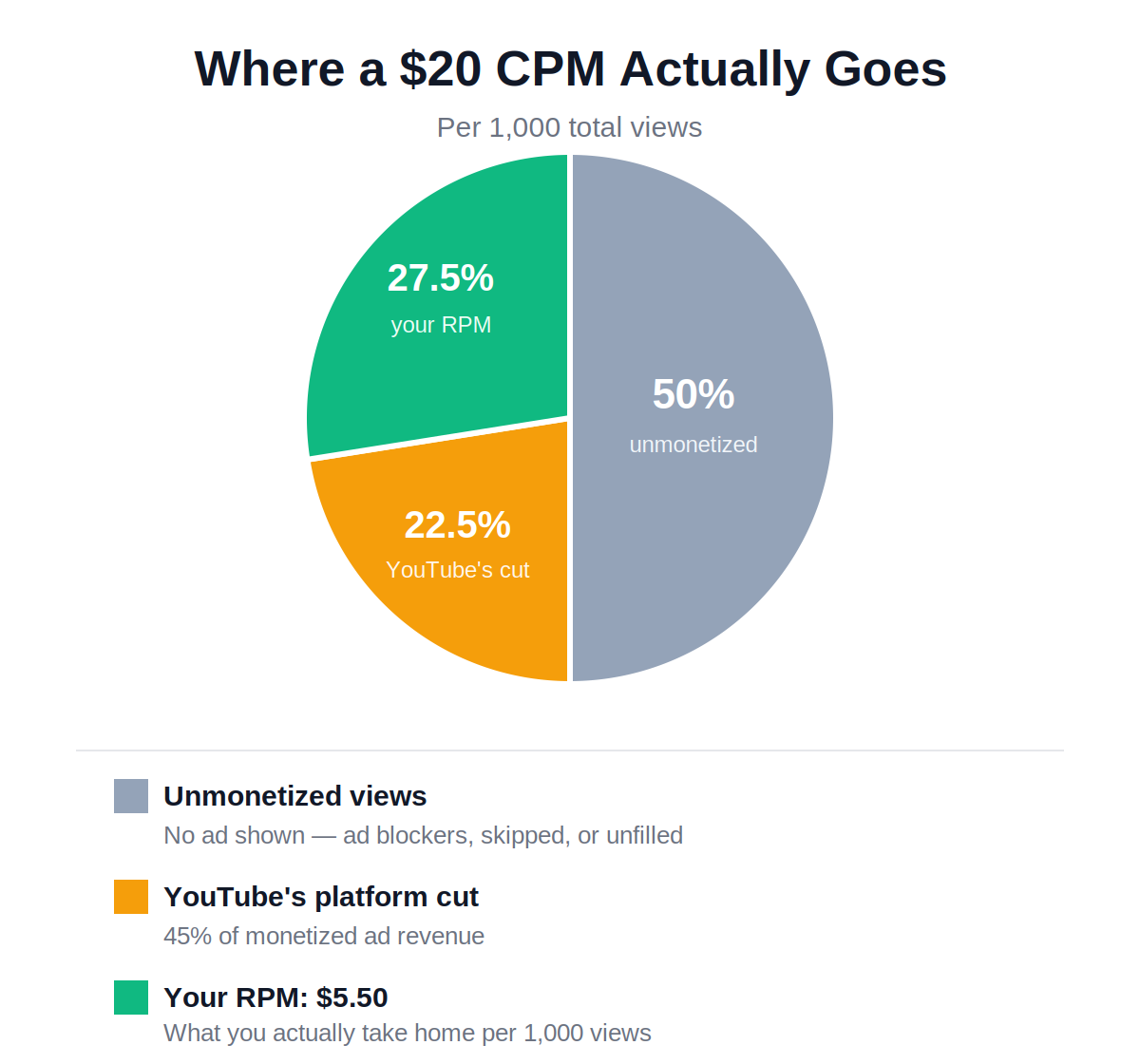
Image generated using Claude.ai
Revenue streams beyond ads
Ad revenue is the floor, not the ceiling. Several other streams stack on top, and they move your effective RPM:
- YouTube Premium share: a per watch time payout from Premium subscribers, often adding $0.50 to $2.00 to effective RPM
- Shorts ad pool: a separate fund based payout averaging $0.03 to $0.20 RPM, far below long form
- Memberships, Super Thanks, Super Chats, and shopping affiliates: additive, typically 10 to 30% on top of ad RPM
RPM by niche: where the money actually is
The single biggest variable in how much YouTube pays per view is not country, video length, or audience size. It is niche. A finance channel can earn 20 times what a gaming channel earns on the exact same view count, because advertisers will pay a fortune to reach someone researching a mortgage and almost nothing to reach someone watching a speedrun. If you want a wider view of total creator income across these tiers, our breakdown of how much YouTubers make maps the full earnings picture.
Top tier RPM, above $15
- Personal finance and investing: $15 to $30 RPM, driven by high intent viewers researching credit cards, brokerages, and mortgages
- Business and B2B SaaS reviews: $12 to $25 RPM, because software buyers convert at high lifetime value and advertisers bid aggressively
- Real estate and property investment: $10 to $22 RPM, with mortgage lenders, agents, and REIT platforms driving the bids
- Legal and law education: $10 to $20 RPM, since personal injury, immigration, and estate planning carry some of the highest costs per click on the web
Mid tier RPM, $5 to $15
- Health, wellness, and supplements: $5 to $12 RPM
- Tech reviews and consumer electronics: $4 to $10 RPM
- Education, tutorials, and online courses: $4 to $10 RPM
- Cars and automotive: $3 to $8 RPM
Lower tier RPM, under $5
- Gaming: $1 to $4 RPM, with high view counts but low ad value per viewer
- Entertainment, vlogs, and lifestyle: $1.50 to $4 RPM
- Music covers and reaction content: $0.50 to $2 RPM, often capped by copyright claims
- Kids and family content: $0.50 to $2 RPM, since COPPA restricted ads pay far less
How much you earn at 100K, 1M, and 10M views
Ranges are useful, but income brackets are where the numbers get real. Here is what the same view count earns across 3 niches: gaming at $2 RPM, tech reviews at $7 RPM, and personal finance at $22 RPM. Watch how the gap widens as you scale.
At 100,000 monthly views
- Gaming at $2 RPM: $200 per month
- Tech reviews at $7 RPM: $700 per month
- Personal finance at $22 RPM: $2,200 per month
At 100K views, niche choice alone is the difference between a side hustle and a part time salary. Same effort, same audience size, 11 times the income.
At 1,000,000 monthly views
- Gaming at $2 RPM: $2,000 per month
- Tech reviews at $7 RPM: $7,000 per month
- Personal finance at $22 RPM: $22,000 per month
This is the bracket where most full time creators sit. The detail worth sitting with: the finance creator at 1M views out earns the gaming creator at 10M views. The niche carries more weight than 10 times the reach.
At 10,000,000 monthly views
- Gaming at $2 RPM: $20,000 per month
- Tech reviews at $7 RPM: $70,000 per month
- Personal finance at $22 RPM: $220,000 per month, before sponsorships
At this scale, sponsorships, affiliate revenue, and product sales typically double total income. Ad RPM is just the base a big audience earns before any of that stacks on.
What actually drives high RPM beyond niche
Beginner advice points at niche and country. Both matter, and we have covered niche at length. But the lever creators consistently underestimate is posting cadence. Every algorithm signal that determines how much YouTube pays per view compounds when you publish frequently and consistently: watch time, session duration, returning viewers, and subscriber to view ratio all build on each other.
- Niche choice sets the ceiling on RPM. Cadence determines how fast you reach it
- Channels publishing 3 or more long form videos per week grow subscribers roughly 3.7x faster than channels posting weekly, per Tubular 2025 benchmarks
- Higher upload frequency also lifts average RPM, because the algorithm serves your videos to more relevant viewers as session data accumulates and ad targeting sharpens
- Country matters less than people assume. A Brazilian finance channel out earns a US gaming channel on the same view count, so niche beats geography
The reason most experts never crack YouTube is rarely a lack of knowledge. Lawyers, financial advisors, agents, and founders sit on exactly the high RPM expertise advertisers pay the most for. What stops them is the time cost of filming, editing, and shipping at a cadence that compounds. If you have been weighing whether the platform is worth it, our guide on how to make a YouTube channel covers the setup, and the cadence problem is what the next section solves.
How experts actually post daily without sitting in front of a camera
Most people landing on the question of how much does YouTube pay per view are not idly curious. They want the revenue. So the real question becomes: now that you know your niche pays $20 RPM, how do you actually publish at the cadence that compounds? This is where the math runs into the wall of production time.
- Filming is the bottleneck. A 5 minute video typically takes 2 to 3 hours to film, then 4 to 6 hours to edit. That is a full work day per upload, before you have even written the script
- Outsourcing editing fixes the back end, not the front end. The expert still has to sit in front of a camera, lit, on script, with energy, every single day
This is the gap AI video platforms close. With Argil, you upload a 2 minute training video of yourself once, get a personalized AI clone, and then turn any script into a fully edited video without re-filming. The captions, b-roll, transitions, and hooks are built into the pipeline, so your attention goes to what you actually know, your topic and your angle, instead of lighting and audio levels. If you want the broader playbook first, Argil's guide to creating video content without being on camera walks through the approach end to end.
The model works best for experts whose audience already trusts their face and voice: financial advisors, attorneys, real estate agents, B2B founders, and educators. Personal authority compounds on YouTube, and these are exactly the high RPM niches. Argil removes the production drag that stops experts from ever building that authority, which is a different proposition from the faceless content approach that works when your face is not the asset.
The practical workflow looks like this:
- Script your video in about 15 minutes
- Generate it through Argil in about 5 minutes
- Review and publish in about 10 minutes
That is roughly 30 minutes per upload against the 6 to 9 hours a filmed and edited video demands. The cadence that grows subscribers 3.7x faster stops being a question of stamina and becomes a question of having something worth saying.
FAQ
How many views do you need on YouTube to earn $1,000 per month?
It depends entirely on niche. At $2 RPM in gaming, you need 500,000 monthly views to clear $1,000. At $20 RPM in finance, you need just 50,000. RPM is the variable you control through niche choice, which is why two creators with identical view counts can earn wildly different amounts.
How much does YouTube pay per 1,000 views in 2026?
Roughly $1 to $30 across niches, with a global average around $5 to $7 per 1,000 views. That figure already reflects YouTube's 55% creator share. The 2026 Tubular and Influencer Marketing Hub aggregations put the niche spread at $1.61 to $29.30 RPM.
Do YouTube Shorts pay the same as long form videos?
No. Shorts pay roughly $0.03 to $0.20 RPM compared to $1 to $30 for long form, because Shorts run on a fund share model rather than direct CPM. Treat long form as your income engine and Shorts as your discovery engine that feeds subscribers into it.
Does the country my viewers are in affect how much I earn?
Yes, but less than niche does. The US, Canada, Australia, UK, and Germany pay the highest RPM, while India, Brazil, and Indonesia pay the lowest. Geography swings RPM about 3 to 5 times, but niche swings it 20 times, so where your viewers live matters less than what you cover.
How often should you post on YouTube to maximize revenue?
Aim for 3 to 7 long form uploads per week on a new channel, and 2 to 4 once you are established. Tubular 2025 data shows 3.7x faster subscriber growth at 3 or more uploads per week. For experts who cannot realistically film daily, AI video tools are the practical way to hit that cadence without burning out.
Can you actually quit your job from YouTube ad revenue?
Yes, if you pick a high RPM niche and hit a consistent cadence. A finance channel at 250,000 monthly views and $22 RPM earns roughly $5,500 per month in ads alone, before sponsorships, affiliates, courses, or memberships. What gets you there is mostly publishing often enough for the algorithm to compound, not luck.
Related Articles
- How Much Do YouTubers Make
- How to Create Video Content Without Being On Camera
- What Is Malva AI and How to Create a Better AI YouTube Channel
YouTube pay per view by niche: RPM benchmarks, real income brackets, and the cadence that compounds