What Is a Viral Finder? Types and Uses Explained
A viral finder surfaces rising content patterns before they peak. Learn what a viral finder is, the 4 types, and how creators use them to brief faster.

Article Highlights
- What a viral finder is and what it is not
- The 4 types of viral finder tools defined
- How a viral finder surfaces signal inside the window
- The weekly routine that makes a viral finder pay off
- When chasing trends costs more than it returns
- Argil acts on a viral finding within hours, not weeks
What Is a Viral Finder? Types and Uses Explained
A viral finder is a software tool or workflow that surfaces content patterns gaining unusual traction on TikTok, Reels, YouTube Shorts, and X before a trend reaches its peak. The job is to let you brief your next post against evidence rather than a hunch. Instead of guessing what might land, you see which sounds, formats, and topics are already accelerating, then build for the wave while it is still rising.
The core function is narrow and specific: spot rising sounds, hashtags, formats, and creators inside a 24 to 72 hour window. Timing is the whole point. A signal that surfaces too late is just a description of something that already happened.
It helps to define a viral finder by what it is not. It does not report on your own past posts the way an analytics dashboard does, it does not schedule your content, and it does not write or produce anything. A viral finder surfaces signals, and the actual production happens somewhere else entirely. That separation matters more than most buyers expect when they sign up.
Under the hood, every viral finder ingests roughly 3 inputs. It pulls from platform APIs where they are available, reads public engagement velocity such as likes per hour or sudden follow-rate spikes, and runs proprietary scoring models that rank what is climbing fastest. The quality of a tool comes down to how good that scoring is at separating a real wave from ordinary noise.
There is one limitation worth sitting with before going further. Almost every viral finder is purely a detection tool, so it can tell you what is hot without telling you how to win on it, and it will never make the video for you. That gap is what shapes the typology below, since the 4 types of viral finders each detect a different kind of signal.
The 4 types of viral finders
Treat each type as its own world. Each one has a different user, surfaces a different signal, and produces a different kind of brief.
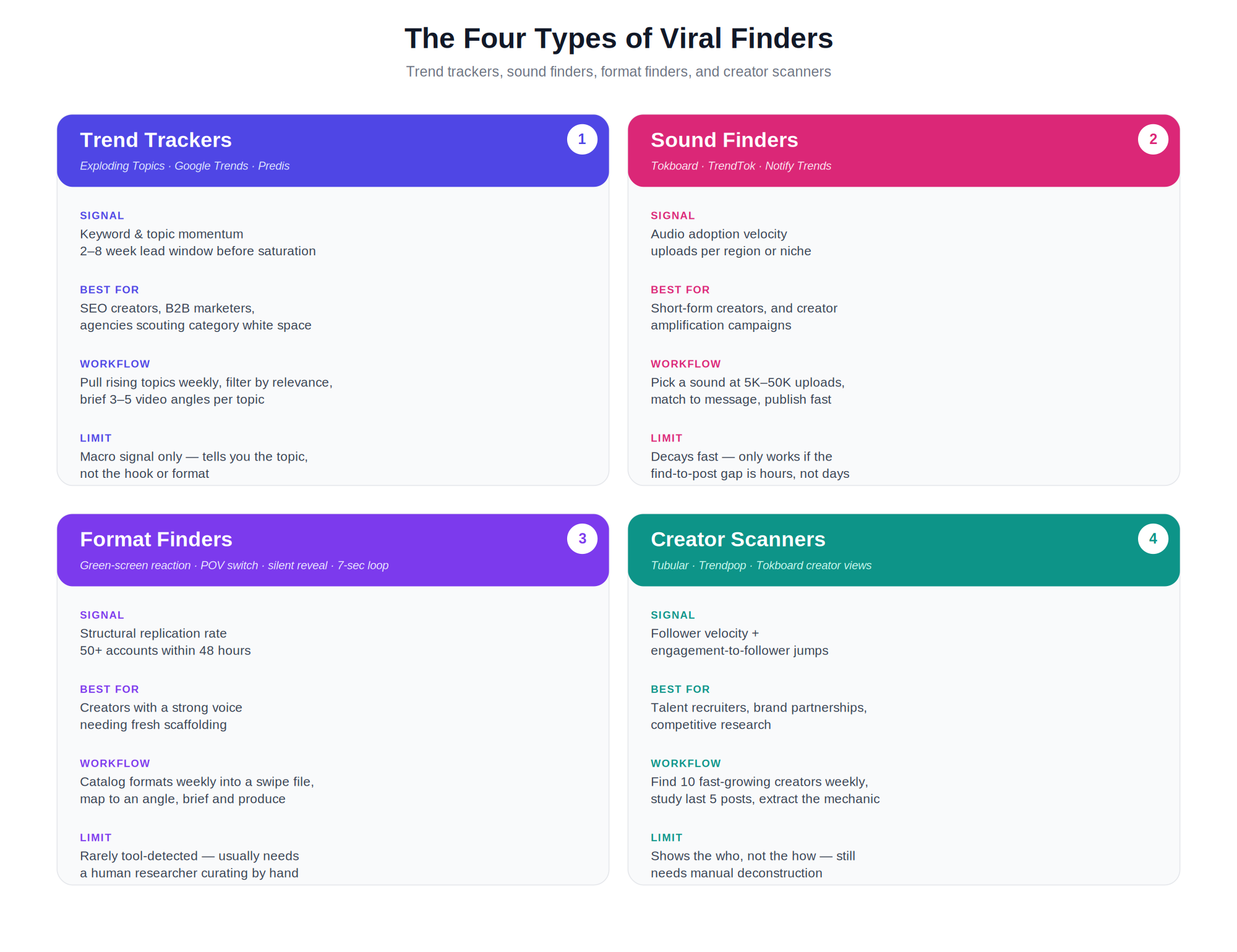
A quick look at the 4 types of viral finder. Image generated using Claude.ai.
Trend trackers
Trend trackers surface rising topics, hashtags, or themes across platforms. Exploding Topics, Google Trends, and the trend feeds inside tools like Predis all fit here.
- Signal type: keyword and topic momentum, usually with a generous lead window of 2 to 8 weeks before mass saturation.
- Best for: SEO-driven creators, B2B marketers briefing thought leadership, and agencies hunting category-level white space.
- Workflow: pull a list of rising topics weekly, filter by audience relevance, then brief 3 to 5 video angles per surviving topic. This is also the foundation of a strong repurposing engine, since one rising topic can seed a blog post and several short-form videos built without a camera.
- Limit: trend trackers are macro signals. They tell you the topic, not the hook or the format that will carry it.
Sound finders
Sound finders surface trending audio on TikTok and Reels. Tokboard, TrendTok, and Notify Trends are the recognizable names in this lane.
- Signal type: audio adoption velocity, measured by how fast a sound is being added to new uploads inside a region or niche.
- Best for: short-form creators on platforms where the algorithm explicitly rewards sound-based replication, and agencies running creator amplification campaigns.
- Workflow: pick a sound that has crossed roughly 5,000 to 50,000 uploads but has not yet hit 500,000, which tends to be the sweet spot, match it to a brand message, and publish quickly.
- Limit: audio trends decay fast. A sound finder only earns its place if the gap between finding and posting is measured in hours.
Format finders
Format finders surface viral structural patterns rather than audio or topics. Think of the green-screen reaction, the POV switch, the silent reveal, or the 7 second loop.
- Signal type: format replication rate across unrelated accounts. When the same structure appears in 50 or more accounts within 48 hours, that is a format trend forming.
- Best for: creators with a strong personal voice who need fresh scaffolding to plug their message into.
- Workflow: catalog formats weekly into a swipe file, map each format to a content angle, then brief and produce against it. Choosing the right opener inside the format matters, which is why reel hook selection is its own discipline.
- Limit: most tools do not officially surface formats. Tokboard and Trendpop partially do, but reliable format detection usually still requires a human researcher curating by hand.
Creator scanners
Creator scanners surface fast-growing creators inside a niche, often flagged by audience overlap or sudden follow-rate jumps. Tubular, Trendpop, and the creator views inside Tokboard live here.
- Signal type: follower velocity and engagement-to-follower ratio jumps, read as a leading indicator that a creator has cracked something repeatable.
- Best for: agencies recruiting talent, brands building creator partnerships, and competitors reverse-engineering what is working.
- Workflow: identify 10 fast-growing creators in a niche each week, study their last 5 posts, and extract the repeatable mechanic underneath.
- Limit: a creator scanner shows the who, not the how. You still have to deconstruct the post yourself to understand why it worked.
How creators actually use viral finders
Most people install a viral finder, poke at it for a week, and then never fold it into a real routine. The tool usually works fine, but the habit around it never forms. The weekly loop below is the version that actually turns signal into shipped posts.
As a creator using a viral finder is always beneficial to keep your content relevant.
The week opens with a signal scan, about 30 minutes on Monday, to pull rising sounds, formats, and topics and save 10 to 15 of them into a swipe file. A relevance filter follows in roughly another 30 minutes: cross-reference each signal against your content pillars and discard anything that would force you to twist your message to fit. Discipline here is what separates a focused account from a confused one.
The briefing sprint comes next, usually Tuesday. Write 3 to 5 short briefs against the signals that survived the filter. Each brief names the hook, the format, the call to action, and a hard deadline. Then comes the production window, which is non-negotiable: ship inside 48 hours of the signal surfacing, because after that the cycle is past peak. The week closes with a Friday post-mortem to track which signal-driven posts hit, which did not, and update the heuristic for next time.
The time horizons drive the whole rhythm. Sound trends die in 5 to 9 days, format trends in 14 to 21 days, and topic trends in 4 to 8 weeks. The faster the decay, the tighter your production has to be. That pressure is real, and it is worth the effort: 85% of marketers say short-form video is the most effective format on social media, according to HubSpot's 2026 marketing data. Videos under 60 seconds also generate roughly 2.5 times more engagement per impression than other content types, per Marketing LTB's 2026 short-form analysis. The signal is genuinely valuable. The question is whether you can convert it before it expires.
The production gap (why finding the trend is the easy part)
This is where the concept meets reality. A viral finder hands you a brief, and a brief is worthless if you cannot ship inside the trend window.
Look at the 5 steps standing between a viral finding and a published video: script, film, edit, caption, schedule. Each one is its own bottleneck, and they are sequential, so delays compound. Even disciplined solo creators spend 4 to 8 hours per short-form video when filming themselves, and agency teams spend 16 to 40 hours per video once editor handoffs enter the picture.
The cycle does not pause while you produce. A sound spotted at the start of the week is often dead by the start of the next one for most niches. A large share of creators who buy a viral finder never act on what it surfaces, and the reason is almost always missing production capacity rather than a bad signal. The tool solved the easy half of the problem and left the hard half untouched.
How to close the gap with AI video
Hiring a faster editor will not close this gap. The real fix is taking the human out of the production loop entirely for the volume layer of your content engine, so detection and creation finally run at the same speed.
Argil takes a 2 minute training video of you and generates a fully edited AI clone that produces short-form video straight from a script. The captions, b-roll, and transitions are handled inside the pipeline rather than tacked on afterward. So when a sound or format surfaces, you write a 90 second script, generate the finished video in minutes, and publish while the trend is still climbing. Detection and production end up moving at the same pace as the signal itself.
The testing layer is where this gets interesting. From a single script you can run 3 hook variants, 2 avatar styles, or 2 language versions, which means the format your viral finder identified can be tested several ways in the time it used to take to produce one cut. A single creator can sustain 5 to 10 short-form videos a week without ever picking up a camera, which is the cadence that finally makes a viral finder subscription return more than it costs. The fit is specific: solo creators, real estate agents, lawyers, and SMBs who carry real voice and authority but have no production team, exactly the people our guide to building consistent video branding without high production costs was written for.
When NOT to use a viral finder
A balanced view builds more trust than a sales pitch, so here is when a viral finder is the wrong tool.
Original-voice creators with established, engaged audiences often lose more than they gain by chasing trends. An audience that came for a specific thesis does not want the format of the week. Long-form educators publishing 15 minute YouTube essays face a flat format mismatch, since you cannot reasonably retool a deep explainer around a 7 second sound. Brand-safe verticals such as legal, medical, and financial advisory carry compliance and tone risks that a trending sound can quietly violate. And in extremely noisy niches like general lifestyle content, the signal-to-noise ratio gets so bad that even a good viral finder struggles to separate a real wave from algorithmic churn.
A simple heuristic settles most cases. If you can name 3 reasons your audience follows you that have nothing to do with format, you probably need to chase trends less and brief original content more.
Frequently asked questions
Are viral finders worth the monthly subscription?
Worth it only if you ship inside the trend window. Most paid viral finders run 39 to 299 dollars a month, and the return depends entirely on production capacity. A team that finds 10 trends a month and ships against 1 is paying far more per published post than a team that ships against 8.
Are there free viral finder options?
Yes. TikTok Creative Center surfaces trending sounds, hashtags, and creators for free, Google Trends covers macro topic momentum, and YouTube Studio surfaces format trends inside the platform. The paid tools add speed, filtering, and cross-platform unification, not raw signal.
How fast can a viral trend die?
Sound trends die in 5 to 9 days, format trends in 14 to 21 days, and topic trends in 4 to 8 weeks. Creator-driven patterns can persist for months, but their replicability fades after the first 4 to 6 weeks.
Do viral finders work for B2B content?
Yes, with adjustments. The signal types that translate are topic trends and creator scanners, especially LinkedIn-focused ones. Sound and short-form format trends rarely carry over, since B2B audiences expect substance over format and the platform mix is different.
Can a viral finder surface trends on Reddit?
Most do not. Reddit's signal type is different, built around subreddit-specific topical waves rather than platform-wide format replication. For Reddit specifically, social listening and topic-tracking platforms work better than a typical TikTok-focused viral finder.
How long until I see results from using a viral finder?
Expect results in 2 to 4 weeks if production capacity is in place. The first 2 weeks teach you which signals translate to your audience. By week 3 or 4, posts briefed against viral finder signals start beating your baseline. Without same-day production, that payoff never arrives.
Related Articles
- How to never run out of video ideas in 2025
- How to turn forum discussions into viral video content
- How to convert any link to a viral video in 5 minutes
A viral finder explained, from definition to the 4 types creators rely on