Internet Advertising Platforms 2026: The Operator's Guide
How senior marketers pick, brief, and measure internet advertising platforms in 2026, plus why creative volume now decides who wins.

Article Highlights
- Pick internet advertising platforms by objective, not habit
- The 4 channel categories that own your budget
- Creative volume beats bidding on every advertising platform
- Brief hooks first, because hooks carry 80% of performance
- Measure blended CAC, not last-click platform numbers
- Argil makes 40 native video variations a week realistic
Internet Advertising Platforms 2026: The Operator's Guide
You already know the names. Google, Meta, TikTok, LinkedIn, YouTube, and the eight or so platforms behind them. What you need in 2026 is not another roster of internet advertising platforms. You need the operating system that sits on top of them. That means knowing how to decide where each dollar goes, how to brief creative that actually earns attention, and how to read numbers that no longer reconcile cleanly. It also means testing fast enough that when a competitor lands a great hook, you can match it within the week instead of watching it pull ahead.
This guide is written for the person holding the budget. It assumes you have run paid media before, that you have felt the gap between what a platform reports and what your bank account shows, and that you are tired of advice that stops at "test creative" without telling you how many, how often, or how to afford it. The honest answer to that last question changed in the last 18 months, and most teams have not adjusted yet.
The internet advertising landscape in 2026
The structural story of 2026 is that the dollars keep concentrating while the inventory keeps fragmenting. Google, Meta, and Amazon alone will pull in 62.3% of worldwide digital ad spending this year, according to eMarketer's parent-company forecast. Total digital ad spend sits around $835 billion globally per GroupM's 2026 forecast as compiled by PPC Chief, growing roughly 5% year over year. The giants still own most of the budget, but the layer outside them, the open web and connected TV bought through demand-side platforms, is growing faster than any single walled garden, which is why a serious media plan in 2026 has to reach past the big five.
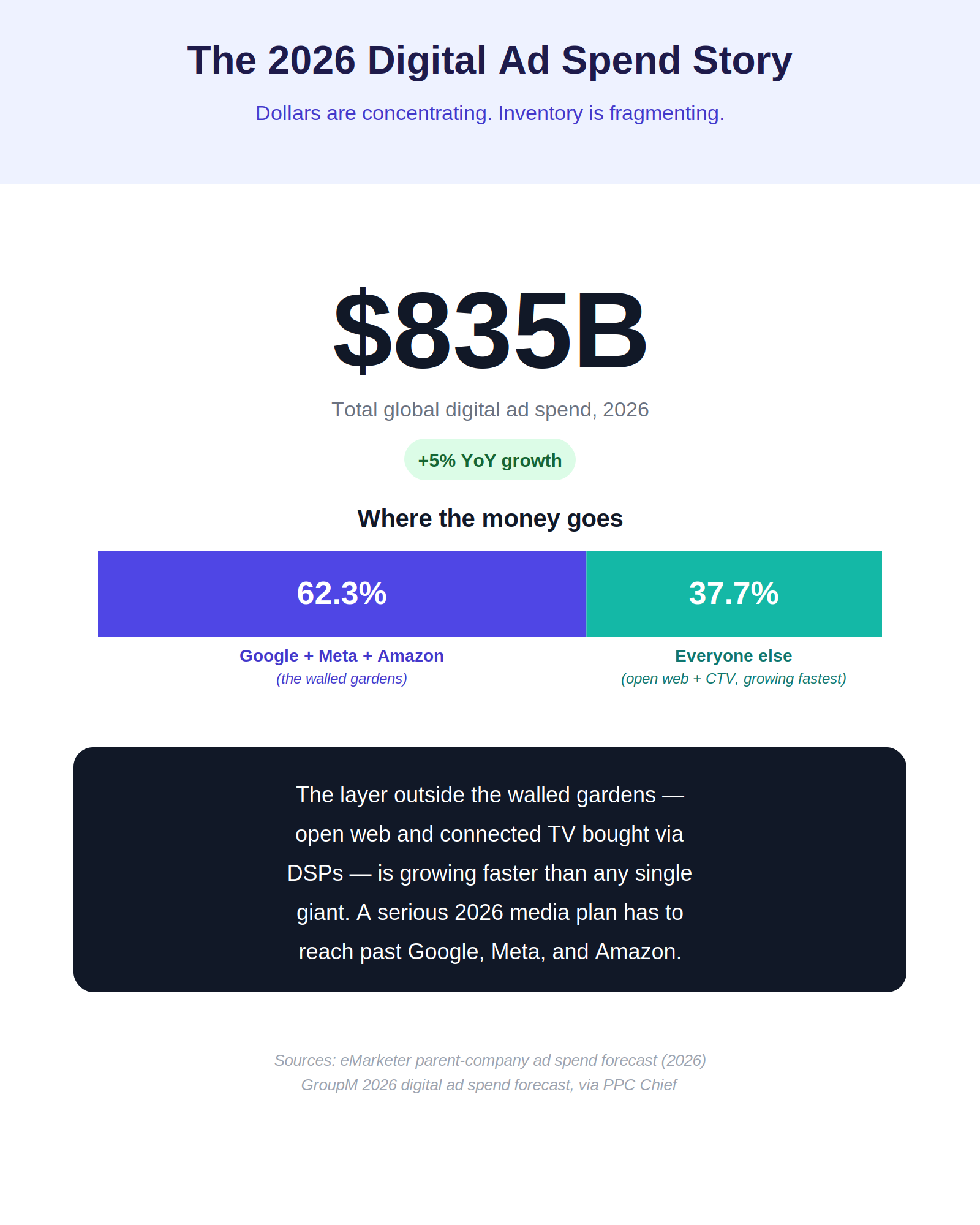
This image was generated using Claude.ai
There is a cleaner way to see the whole field than a ranked list. Plot every platform on two axes. The first axis is intent: does the platform capture demand that is already in motion, or does it create demand by interrupting a feed. The second axis is data trust: does the platform own closed, logged-in targeting data, or does it buy against open signals. Google Search sits in the high-intent, closed-data corner. Programmatic display sits in the create-demand, open-data corner. Everything else falls somewhere in between, and once you can place a platform on that map, you can usually tell at a glance what it is good for.
The inflection worth internalizing is that bidding has been commoditized. Every major platform now ships some flavor of AI-driven, goal-based buying along the Performance Max pattern, and they are converging on the same automated logic, so the auction itself is no longer where you win or lose. The differentiator has moved to creative quality and creative volume, and that shift looks permanent. Short-form video ad spend is forecast near $122 billion in 2026 on PPC Chief's reading of the same forecast set, and that money is chasing the one input the algorithm cannot produce for you: a good hook, shot in the right format, at the pace the platform wants to chew through.
Intent vs interruption channels
Intent platforms catch a buyer mid-search. Google Search, Microsoft Ads, and Amazon Sponsored Products all work because the person typed the query. Cost per click runs higher, conversion rate runs higher, and you are operating at the bottom of the funnel where the decision is nearly made.
Interruption platforms work the opposite way. Meta, TikTok, Pinterest, Snap, and X inject a message into a feed the person did not open to shop. Cost per impression is low and so is conversion rate, so the creative has to earn the attention that intent platforms get for free. That is why a mediocre ad dies fast on a feed and survives longer on search.
Then there are the hybrids. LinkedIn, YouTube search, Reddit inside the right subreddit, and programmatic with intent signals layered in. These pay back when intent and creative arrive together, a buyer who is partway down the path meeting a piece of content good enough to move them the rest of the way. Treat them as their own category, because budgeting them like pure interruption or pure capture will misprice them.
The 4 channel categories that matter for budget allocation
Search and product ads cover Google, Microsoft, and Amazon. This is capture, bottom funnel, high intent, harvesting demand that exists. If people search for your category, this category is non-negotiable.
Social feed ads cover Meta, TikTok, Pinterest, LinkedIn, and X. This is where you create demand, mid-funnel, and it is video-led now in a way it was not three years ago. A static image still works in narrow cases, but feed reach increasingly rewards motion and a human face.
Video and CTV ads cover YouTube, Snap, and programmatic connected TV through The Trade Desk and DV360. Upper funnel, brand-building, and the hardest of the four to attribute cleanly. You buy this knowing the payback shows up as lift, not as a clean last-click line.
Community and niche ads cover Reddit and the smaller programmatic networks. High-intent micro-audiences that punish a corporate tone and reward writing that sounds like a member of the community. Small in spend, occasionally enormous in efficiency.
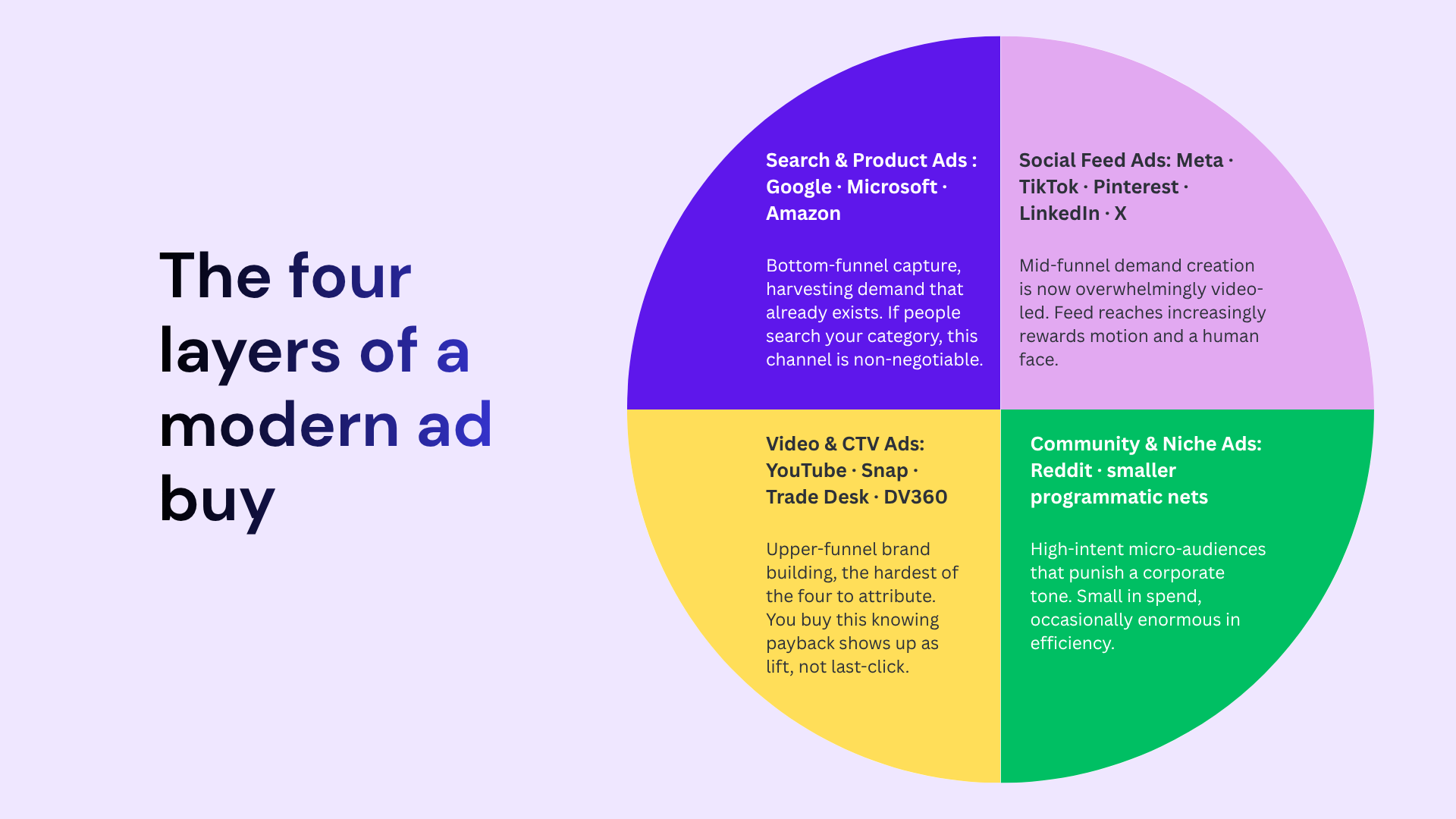
The four layers of internet advertising platforms.
How to pick the right platform for your objective
Start with the objective. The single most common allocation error is starting with the platform, the one the founder likes or the one that worked for a friend's company, and reverse-engineering an objective to justify it. The same dollar spent against awareness, consideration, and conversion buys completely different platforms.
For an awareness objective, you want reach and frequency, which means programmatic CTV plus YouTube plus Meta Reels plus TikTok. Video format is mandatory here. Stop trying to attribute it to a last click. The honest measure is brand search lift, the rise in people googling your name after the campaign runs.
For a consideration objective, you want to show up in the feed while a buyer is still researching. LinkedIn for B2B, plus Meta, plus YouTube, plus Reddit. Measure cost per visit and cost per content engagement, the cheaper signals that tell you whether the message is landing before the conversion ever fires.
For a conversion objective, return to capture. Google Search, Microsoft Ads, Meta retargeting, and Amazon if you sell a product. You are harvesting intent already in motion, so cost per acquisition and return on ad spend are the right scoreboard.
For a retention objective, you want to reach people you already know. Meta retargeting from CRM uploads, LinkedIn matched audiences, and YouTube retargeting built on owned video assets. Measure repeat-purchase rate and expansion revenue, not the front-end CPA that retention campaigns will flatter.
One rule sits above all of these. Run at least a 3-platform mix: one to capture, one to create, one experimental. Single-platform dependency is the most reliable way a small marketing team gets blindsided, because the day that platform's auction tightens or its policy changes, the whole pipeline goes dark with no second engine warm. Concentrating spend makes sense at small budgets, but running on a single channel does not.
Briefing and producing creative for each platform
The rule that governs everything in this section is that creative spec is not optional. A 16:9 horizontal video uploaded to TikTok will lose to a native 9:16 by 40% to 60% no matter how strong the idea inside it is. The platform crops it, the feed buries it below native posts, and the viewer's thumb is gone before your point arrives. You can have the better message and still lose on format alone.
Every brief, on every platform, carries the same three-part spine. The hook lives in the first 1 to 3 seconds and decides whether anyone sees the rest. The proof is the claim plus the evidence that makes it believable. The call to action tells the viewer the one thing to do next. That spine stays constant while the format wrapped around it changes from platform to platform. Our breakdown of how to choose reel hooks for better performance is worth reading before you write a single one, because the hook is where amateur and professional creative actually separate.
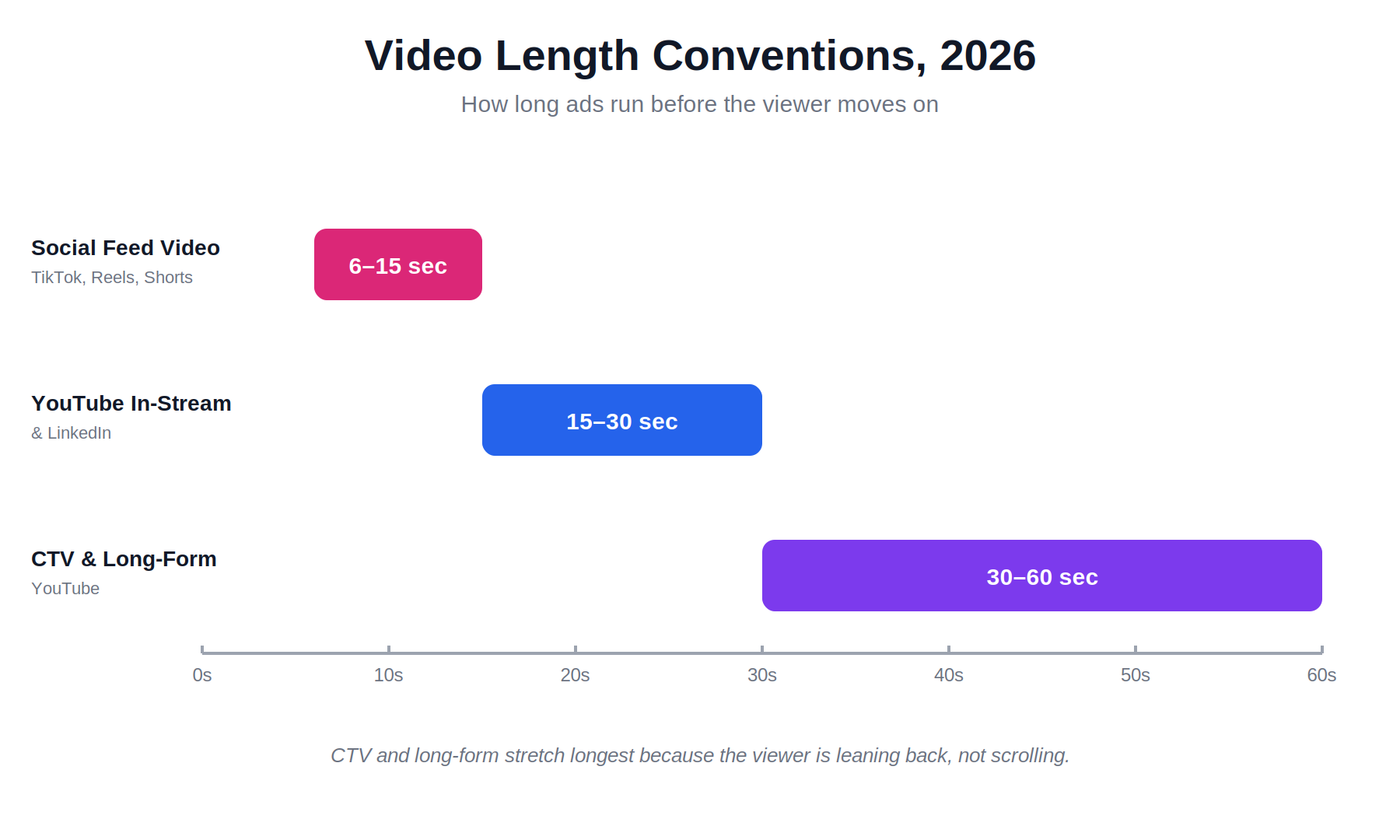
Length conventions in 2026 have settled into reliable bands. Social feed video runs 6 to 15 seconds on TikTok, Reels, and Shorts. YouTube in-stream and LinkedIn sit at 15 to 30 seconds. CTV and long-form YouTube stretch to 30 to 60 seconds, because the viewer is leaning back rather than scrolling.
Production cadence is where ambition meets reality. For an account spending over $5,000 a month, the target is 8 to 30 creative variations per platform per week. Below $2,000 a month, 3 to 5 variations a week is defensible. Most teams ship 2 or 3 and call it a test, when that volume is really just a guess with a media budget attached.
Creative spec by platform category
Vertical 9:16 video covers TikTok, Reels, Shorts, Snap, and Stories. Burn the captions in. Design for sound-on but legible when muted. Land the hook inside the first second and keep it between 9 and 30 seconds.
Square 1:1 video covers LinkedIn and the Meta feed. Captions are optional but recommended, the hook gets a slightly more generous first 3 seconds, and the runtime sits at 15 to 45 seconds. A talking-head shot reliably beats a glossy studio production here, a pattern we unpack in our piece on AI clone versus human videos.
Horizontal 16:9 video covers YouTube in-stream and programmatic CTV. The hook has a 5-second window before the skip, the runtime runs 15 to 60 seconds, and you can afford more production polish because the viewer is in lean-back mode rather than thumbing past.
Static formats cover Google Display, Pinterest, and Sponsored Products. One clear message, one call to action, and a brand that registers in half a second. There is no room for a slow build in a unit someone glances at.
Native conversational formats cover Reddit promoted posts and X promoted threads. These are written, not shot. They have to read like something a real member of the community would post, and the moment they smell like an ad, they are done.
Briefing format that scales
For each creative concept, write five lines and no more. The hook in one sentence. The proof point in one or two. The call to action. The format, vertical or square or horizontal. The platform list it will run on. That is the entire brief, and its discipline is what lets you produce at volume without drowning in documentation.
The production handoff carries the rest. Voice, founder or UGC or studio. Required visuals, b-roll, screen recording, or talking head. The aspect ratios to deliver. The caption style. Hand that over cleanly and production stops being a negotiation.
The versioning rule is the one people skip and regret. Never ship a creative concept with fewer than 5 hook variants over the same body. The hook is roughly 80% of performance, so testing one hook is testing almost nothing.
Testing and measurement
The 2026 testing principle reverses the old instinct: test hooks, not platforms. Pick the platform first based on objective and ICP, then run your hook tests inside that platform. Cross-platform comparisons are noisy because the audiences, formats, and auctions all differ at once. Within-platform hook tests isolate the one variable that actually moves the number.
The mechanics are simple to state and hard to sustain. Ship 5 to 10 hook variations over the same body and the same call to action, launch them in the same week so they share market conditions, and kill the bottom 60% at 72 hours based on hook-rate, which is 3-second video views divided by impressions. Hook-rate tells you whether the opening earned attention before any downstream metric is statistically alive, so you stop wasting budget on losers a full week earlier than a CPA-based read would let you. Our walkthrough on getting clips that convert goes deeper on reading those early signals.
Attribution in 2026 is genuinely broken, and pretending otherwise is how teams burn budget chasing ghosts. After the iOS privacy changes and the long death of the third-party cookie, multi-touch attribution no longer reconstructs the journey it claims to. Lean instead on platform-reported view-through numbers read with heavy skepticism, backed by a lightweight marketing-mix model and incrementality holdout tests on your top spenders. Do not chase last-click, because in 2026 last-click mostly lets the smallest platforms take credit for conversions the big ones created.
For the stack, GA4 plus platform-native reporting plus a unified dashboard, Triple Whale or Northbeam for DTC, HockeyStack or Dreamdata for B2B. Discount platform-reported numbers by 20% to 30% on principle and validate quarterly with holdout tests, because every platform has a structural incentive to overcount its own contribution.
The single number to optimize is blended CAC by cohort week. Hold the platform mix constant and watch how it moves. When blended CAC drops while the mix stays steady, your creative is doing the work. When you change the mix and CAC moves with it, the platform itself was the lever. That one discipline cuts through more attribution noise than any dashboard will.
How AI video is changing the cost of testing creative variations
Here is the structural problem in plain numbers. A B2B team running four platforms, LinkedIn plus Meta plus YouTube plus Reddit, at the 10-variations-per-platform-per-week pace, needs 40 finished video creatives every week, in three aspect ratios. At traditional production cost of $300 to $800 per variation, that is $12,000 to $32,000 a week in production alone, before a cent of media. No SMB marketing team has that budget, so they ship 2 or 3 variations, lose the volume game, and quietly conclude that testing does not work for companies their size.
The math changes when production stops being a film shoot. A tool like Argil lets one team member record a 2-minute clone setup once, then generate fully-edited, founder-voice video creatives in every aspect ratio directly from scripts. Cost per variation drops from hundreds of dollars to single digits. Production time per variation drops from a half-day to under 30 minutes. The barrier that made multi-platform testing impossible for lean teams quietly disappears.
The practical workflow looks like this. The founder records the clone once on a Monday. The marketing lead writes 40 hook scripts that week, 10 per platform, and generates the variations Tuesday morning. Everything ships by Wednesday. Friday is review, and the 4 winners across the 4 platforms inherit next week's budget. The same loop that used to take a month now closes in a week, which is the difference our guide to automating short-form videos was built to make repeatable.
What you get out of this is real testing volume, which is what lets you stop guessing and start reading actual results. Instead of betting 80% of spend on the one hook you hope works, you put 5% behind 10 hooks and let the platform algorithm surface the winner with live money. Your better creative ships in week 2 instead of month 3, and that head start usually buys you more than any bidding optimization you could make.
The qualitative shift matters as much as the numbers. The founder no longer blocks four hours a week to film, and the marketing team no longer waits on an editor's queue. The bottleneck moves from production capacity to strategic taste, the judgment about which hook angle and which proof point and which call to action will land, and that is exactly where the bottleneck should sit. Argil handles the captions, b-rolls, transitions, multi-aspect-ratio rendering, and the script-to-video pipeline, but the results still hinge on the operator bringing real judgment. Once volume is cheap, hook quality is the thing left to compete on.
Common mistakes and what to do instead
Mistake 1: spreading $1,000 a month across 5 platforms. The fix is to concentrate on 1 or 2 platforms below $2,000 total monthly spend until CPA stabilizes, then expand. Thin spend everywhere learns nothing anywhere.
Mistake 2: uploading the same horizontal video to every platform. Produce native aspect ratios per platform. The 30% to 50% performance gap from cross-uploading is not a rounding error you can absorb.
Mistake 3: optimizing for CPM instead of CPA. Ignore CPM until CPA is healthy. A cheap-CPM platform that does not convert is worse than an expensive-CPM platform that does.
Mistake 4: shipping 3 variations and waiting 3 weeks for a signal. Ship 10 in one week and kill the bottom 60% at 72 hours on hook-rate. Speed of learning is the whole game.
Mistake 5: chasing platform attribution numbers. Lean on blended CAC and holdout incrementality on top spenders instead. Platform numbers inflate by 20% to 50% in the post-privacy era, and they inflate in the platform's favor.
Mistake 6: outsourcing creative strategy to the agency or the algorithm. Keep hook strategy in-house and use AI video for production speed. Taste is the moat now that production capacity is cheap, so do not hand away the one thing that is hard to copy. Our look at why AI agents are reshaping content workflows sits squarely on this line.
Mistake 7: treating CTV and programmatic as enterprise-only. CTV CPMs in 2026 are reachable for SMBs through The Trade Desk's self-serve and StackAdapt, and $5,000 a month is enough to genuinely test the channel rather than just dip a toe.
Frequently asked questions
What is the difference between intent and interruption advertising platforms?
Intent platforms, Google, Microsoft, and Amazon, capture demand already in motion, because the buyer is the one searching. Interruption platforms, Meta, TikTok, Pinterest, and Snap, create demand by injecting a message into a feed. Intent platforms carry higher conversion rates and higher cost per click. Interruption platforms carry lower CPM and live or die on creative quality.
How do I decide how much budget to put on each advertising platform?
Start with the objective, awareness or consideration or conversion, then pick 3 platforms that match it, one capture, one create, one experimental. Put 70% on the highest-confidence platform, 20% on the second, and 10% on the experiment. Rebalance monthly based on blended CAC by platform, not on the platform's own reported numbers.
Why does the same video underperform on TikTok versus LinkedIn?
Aspect ratio, length, sound conventions, and audience expectations all differ. TikTok wants 9:16 vertical, 9 to 30 seconds, sound-on, native creator tone. LinkedIn wants 1:1 square, 15 to 45 seconds, captions on, professional framing. Same script, different render. Native format beats cross-uploaded format by 30% to 50%, which is why one master video is never enough.
How many creative variations should I ship per platform per week?
For accounts over $5,000 a month, 8 to 30 per platform per week. Below $2,000 a month, 3 to 5. The constraint used to be production cost. AI video tools collapse that cost to single-digit dollars per variation, so the real constraint now is how many strong hook angles you can write.
How do I attribute conversions across multiple advertising platforms in 2026?
Multi-touch attribution is unreliable after the iOS privacy changes. Lean on blended CAC by week, platform-native view-through read with 20% to 30% skepticism, a lightweight marketing-mix model, and quarterly holdout incrementality tests on top spenders. The number that matters is blended CAC by cohort week, not last-click.
Can a small B2B team realistically run paid ads on 4 platforms?
Yes, in 2026, once creative production is automated. The bottleneck was never bidding or analytics, it was producing 40 native-format video variations a week. AI video tools let one founder plus one marketing lead match the creative cadence of a 10-person team. The skills you need are taste and analytics, not a production crew.
Which advertising platform should I start with if I have never run paid ads before?
Google Search if buyers already search for your category by name. Meta if you have a clear visual identity and a DTC product. LinkedIn if you sell B2B with a clean job-title ICP. Skip TikTok, Snap, and CTV until the first platform turns profitable. Concentration beats spread for the first 90 days, without exception.
The teams that win on internet advertising platforms in 2026 are not the ones with the cleverest bidding setup, because that part of the game is largely settled. They are the ones who can write a strong hook and put it in front of the right audience, in the right format, faster than anyone else. Production used to be the wall between a good idea and a live test, and it is not anymore. Start your clone on Argil and find out how many hooks you can ship this week.
Related Articles
- The ultimate guide to distributing video content across multiple platforms
- Static ad creatives vs dynamic ad creatives, when to use which
- Improving conversion rates with automation in 2025
The operating system for buying internet advertising platforms in 2026.