Short Drama Explained: How Vertical Series Get Made
Short drama is the vertical, 1 to 2 minute episodic format out of China. What it is, how the apps earn, and what a series really costs to make.
Article Highlights
- Short drama means 1 to 2 minute vertical episodes
- A series runs 20 to 100 episodes, cliffhanger each
- Started in China as duanju, now a global format
- Deloitte predicts $7.8bn in-app revenue for 2026
- Short drama crews run 60 to 90 people in China
- Build the world bible and a pilot before pricing a season
Short Drama Explained: How Vertical Series Get Made
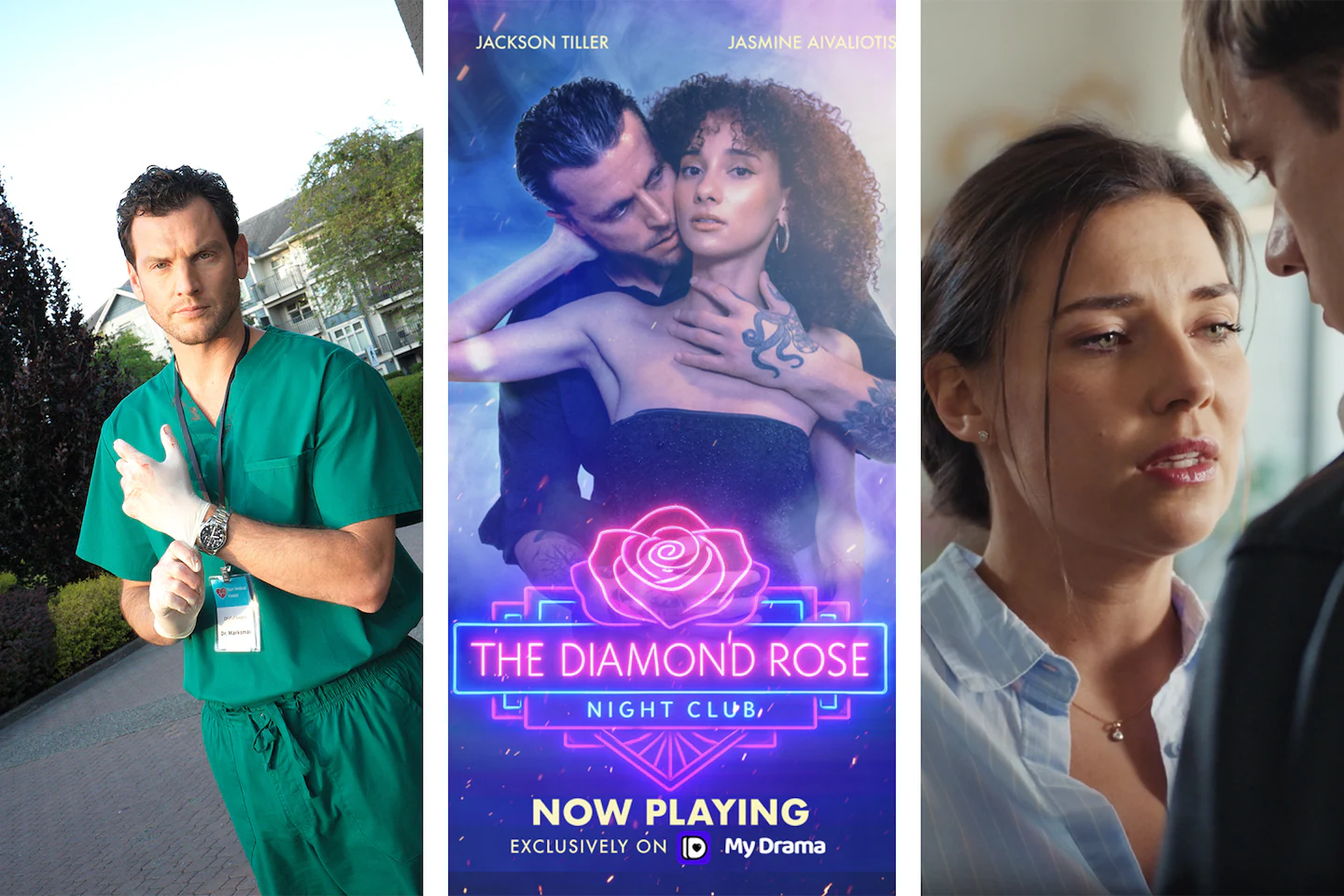
A short drama is a serialized story told in 1- to 2-minute vertical episodes made for a phone screen. A series runs 20 to 100 episodes, and nearly every one ends on a cliffhanger. The format started in China as duanju and is also called microdrama, vertical drama, or vertical series.
What is a short drama?
The native term is duanju, Chinese for short play. English-language coverage has settled on several interchangeable names for it, including microdrama, short drama, vertical drama, vertical series, and mobile drama. So two articles that look like they cover different formats are usually both covering duanju.
Episodes are filmed in 9:16, the vertical aspect ratio that fills a phone held in portrait. A full series of 20 to 100 episodes adds up to a runtime comparable to one or two feature films, delivered minute by minute.
Duanju are not user-generated video, which most app store descriptions leave out. They are professionally produced with hired actors and crew, according to the format's reference entry, which is what separates a short drama from the phone footage sitting next to it in the same feed.
Short drama, short film, and the 1952 TV series
Three different things share this phrase, which is why a search for it returns such a strange mix of results.
This article covers the vertical serial. A short film is a complete, self-contained story of roughly 5 to 30 minutes with no episodes and no cliffhanger. And Short Short Dramas was an American anthology that aired on NBC from September 30, 1952 to April 9, 1953, running 78 episodes of 12 minutes each excluding ads. There is also the classroom meaning, a scripted one-act play, which is what many of the template pages ranking for this term are selling.
How short dramas are structured
Episode count surprises people coming from television, because a season is 20 to 100 installments rather than 8 or 10. The endings are the bigger break. A television episode resolves something and gives you a reason to come back next week. With a short drama almost nothing resolves, and what you get instead is a reason to tap once more, because cliffhangers are engineered to fall at the end of nearly every episode. The hook is doing the same job it does in short form social video, except it has to fire 60 times in a row without the audience feeling worked.
The writing is deliberately fast and emotionally heightened, and the genre set is narrow on purpose. The same tropes recur, among them billionaire romance, contract marriage, revenge arcs, mafia romance and werewolf romance. They let a viewer enter at episode 14 and still follow, which matters when the distribution is a feed.

How short drama platforms make money
The business model has more in common with mobile gaming than with streaming, and it comes in three forms.
IAP, in-app purchase, charges for episodes one at a time or in bundles. Individual episodes typically run $0.30 to $0.50 and a full series $10 to $15, and this model dominates high income markets including the United States. Under IAA, in-app advertising, the episodes are free and the whole thing runs on ads, which is how it works in price sensitive markets such as Southeast Asia and Latin America. Most platforms globally use the IAAP hybrid, where the opening episodes are free, a paywall starts after them, rewarded ads sit alongside it, and there is usually an optional subscription tier.
Region shifts the mix again. Ad driven IAA overtook pay per episode IAP as the dominant revenue structure inside China by 2025, while international markets still lean on IAP.
The $7.8 billion forecast for short drama in 2026
Deloitte's 2026 Technology, Media and Telecommunications Predictions puts in-app micro-series revenue at about US$7.8 billion in 2026, more than doubling from the US$3.8 billion forecast for 2025. Deloitte also expects the United States to account for about half of global revenue in 2025 and for that share to fall to 40 percent as other markets convert views and downloads into money.
The falling US share is the one to plan against. The US is the richest single short drama market today and it is getting relatively smaller, so build for an international audience rather than an American one.
The quarterly curve is steeper than the annual one. Deloitte reports global micro-drama app revenue rising from US$178 million in Q1 2024 to nearly US$700 million in Q1 2025. ReelShort reported around US$400 million in revenue in 2024 and DramaBox US$323 million, and DramaBox has passed 100 million Google Play downloads with roughly 44 million monthly active users.
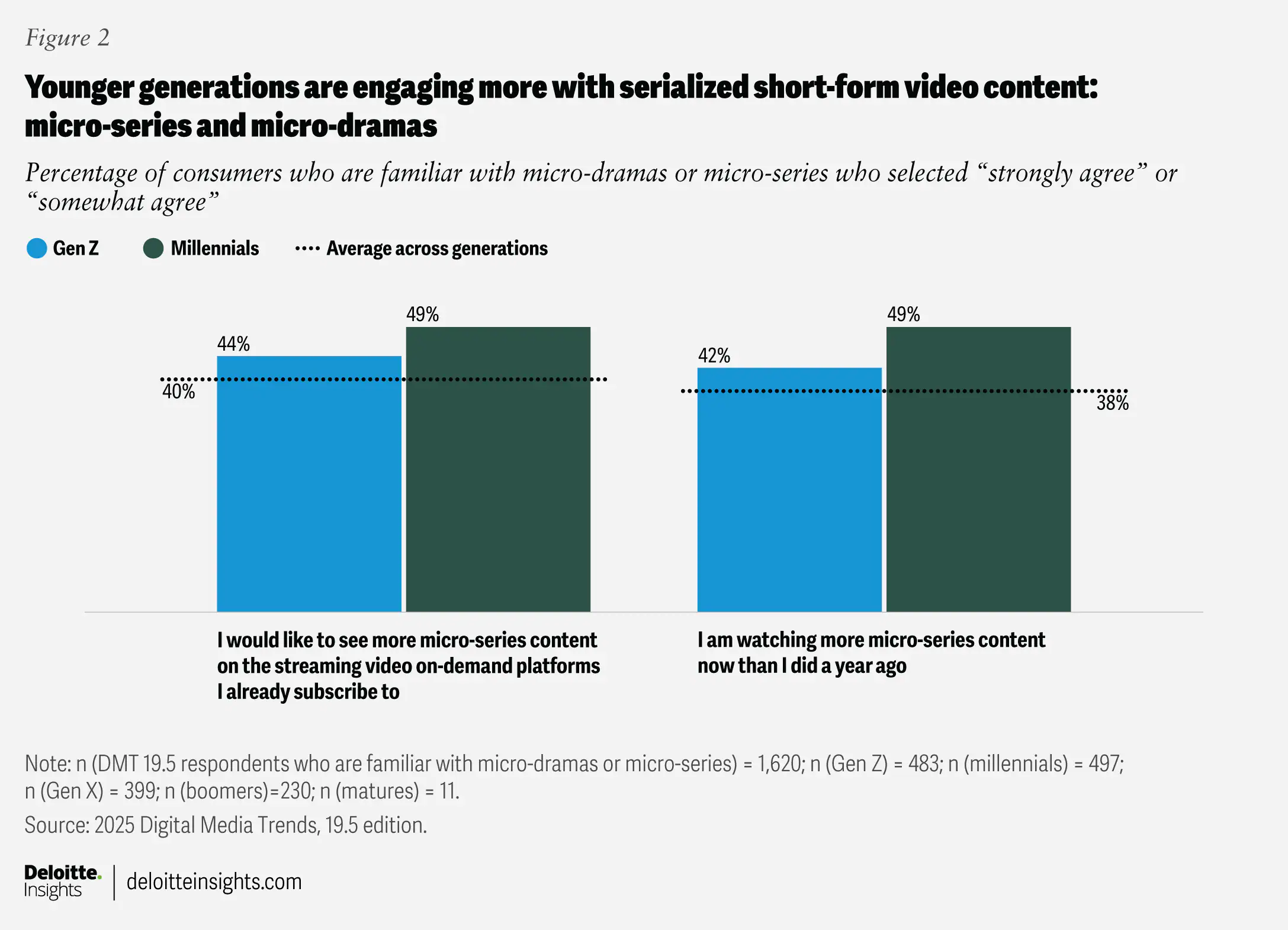
Deloitte's own survey data cuts against the revenue numbers. Its March 2025 US poll found only about 30 percent of Gen Z and millennials were even familiar with micro-series, so the money is arriving well ahead of awareness. DramaBox was one of four companies selected for the Disney Accelerator in July 2025.
Brands shipping their own short drama series
Marketers including Procter and Gamble, Maybelline, Dr Pepper, Marc Jacobs, and Crocs have launched branded microdrama projects in recent months, per Marketing Dive.
Crocs ran "Charmed to Meet You" on ReelShort, built around the Jibbitz charms people use to personalize the shoes, and it drew nearly 10 million views and got a sequel. The follow-up, "Déjà Shoe", was a seven-part shoppable series on TikTok Shop produced in under four weeks. P&G's Native brand ran "The Golden Pear Affair" at 50 parts. JCPenney's five-part micronovela with TelevisaUnivision reported 16 million impressions and 5.6 million video views. Gushers sponsored "Screen Time", 57 episodes, over 150 million views. Sensor Tower measured time spent in short drama apps rising by 5.78 billion hours year over year in 2025.
The same Marketing Dive piece quotes an industry source saying brands and agencies are treating the format like a fad. A brand commissioning 50 parts of its own, as P&G's Native did, shows there is budget and appetite for it, though the numbers these brands publish are views and impressions rather than return.
What it costs to make a short drama
Early duanju were made by teams of around 12 people. By 2025, Chinese short drama crews typically numbered between 60 and 90 people, covering directing, cinematography, lighting, costumes, props, and production management.
Budgets still sit far below film or television. Some successful productions have cost as little as US$50,000. International productions run leaner again, shooting a full season in as little as ten days. By Q1 2025, locally produced titles were 80 percent of the top 20 vertical drama titles by international revenue rather than dubs of Chinese originals.
A $50,000 budget is reachable and cameras are cheap. The expensive part is keeping 60 to 100 episodes inside one world, with the same faces and the same rooms, shot fast enough that the economics still work. The continuity supervisor, the costume department, the standing set, and the script and shotlist discipline that holds it all together exist because a face that changes between episode 31 and episode 32 breaks the series.
Making a short drama without a film crew
Before anything gets shot or rendered, a serialized vertical story needs a world bible, meaning a fixed cast of characters, a fixed set of locations and one visual style that does not drift. A world that drifts cannot be fixed by producing more episodes.
Argil is built around that problem. You bring the idea, shape the world, the characters, and the visual style, then direct it shot by shot as a storyboard before a single frame renders. Characters, locations and styles are reusable, and Argil's homepage makes that the center of the pitch, promising to keep your world on record so every episode comes out right. Its thesis splits the roles plainly, with the human directing and the AI as the crew, and it dismisses the alternative in its own words, calling prompt and receive filmmaking "a slot machine, not an art".
Argil's entry plan is Pro, which starts at $50 per month, with Studio at $1,250 and Enterprise from $2,500 (Argil's own pricing, figures read October 14, 2026). That word "from" is doing real work. Credits are spent when you generate, the amount depends on the model and what you make, and the monthly allowance is a selector on the plan, so $50 is a floor rather than a price. Plan credits refresh monthly and do not stack. Pay-as-you-go credits bought on top do not expire.
No published figure converts credits into finished minutes, so there is no defensible per-episode price for a 60 episode season. A run of episodes is a multi-month commitment at a floor of $50 a month, and credits that do not roll over mean it has to be paced rather than banked.
Produce one episode first, record what it cost in credits per finished minute, then multiply by your episode count before you commit to a season budget. If you cannot name your three recurring locations and your lead's exact look before you render a frame, you are not ready to produce 60 episodes. The world bible plus a directed pilot is the cheapest part to get right, and it is the work an AI film tool does well today.
The same order holds whether you are a creator building an audience or a media team producing serialized explainers. The same goes for a campaign told in episodes, and for a filmmaker testing a world before committing a budget to it. If you want to know what your own short drama will cost before you plan around it, start with the pilot.
FAQ
How long is a short drama episode?
Most short drama episodes run 1 to 2 minutes. Deloitte describes micro-drama apps as typically running 60 to 90 second episodes, and some platforms push toward three minutes. That length comes from the paywall and the feed rather than from the story.
How many episodes does a short drama have?
A short drama series usually runs 20 to 100 episodes, which puts a full season at roughly the length of one or two feature films. Brand productions sit across the same range, from Crocs at five parts to Gushers at 57 episodes.
Are short dramas free to watch?
It depends on the platform and the market. Under IAP, viewers pay roughly $0.30 to $0.50 an episode or $10 to $15 for a full series. Under IAA the content is free and ad-funded, which is standard in Southeast Asia and Latin America. The most common arrangement globally is the IAAP hybrid, where opening episodes are free and a paywall starts after them.
What is the difference between a short film and a short drama?
A short film is one self-contained story, usually 5 to 30 minutes, with an ending. A short drama is a serialized vertical series of 1 to 2 minute episodes that deliberately does not resolve, because each episode ends on a cliffhanger to pull the viewer into the next one.
Where did short dramas come from?
Short dramas came out of China, where the format is called duanju. Its conventions trace back to pay-per-chapter Chinese web fiction from around 2002, with video antecedents on Youku Tudou from 2013. Between 2020 and 2022 it professionalized into standardized 9:16 shooting, production cycles often under two weeks, and pay-per-episode pricing.