Vidnoz AI Video Generator vs Argil: Which Wins in 2026?
Vidnoz vs Argil compared on cloning, editing, pricing, and cadence. See which AI video generator fits ads vs personal brand content in 2026.
- Vidnoz ai video generator vs Argil, scored on 6 buyer dimensions
- Vidnoz wins on price, library size, and language count
- Argil wins on personal clone quality and finished output
- The avatar question decides it: generic presenter or your face
- Cadence is the dividing line between ad tests and personal brand
- Argil ships finished short-form, Vidnoz ships raw avatar clips
Vidnoz AI Video Generator vs Argil: Which Wins in 2026?
You have narrowed your shortlist to 2 AI video tools and you want a straight answer. The vidnoz ai video generator and Argil both make avatar video without a camera, so on the surface they look like the same product at different prices. They are not the same product. Vidnoz is built for fast generic avatar output at volume, while Argil is built around your own cloned face producing content at a daily cadence. By the end of this you will know which one to pay for and why.
Both let you skip filming, and that is roughly where the overlap ends. The rest of this comparison scores them honestly on the 6 dimensions that actually decide the purchase, then gives you a clear verdict.
TL;DR verdict
Pick Vidnoz if you need fast generic avatar output for ads, explainers, or multi-language internal training, and the presenter on screen does not need to be you.
Pick Argil if your face is the asset. You are building a personal brand or a cadence-driven channel, and you want a full editing pipeline built into every output.
If you can only buy one tool for the next 12 months, anchor the decision on one question: is the goal raw volume of avatar video, or is the goal trust and audience growth tied to a real person? Answer that and you have already chosen.
At-a-glance comparison of the vidnoz ai video generator and Argil
Here is the market read across the dimensions buyers ask about, before the full breakdown below. Treat these as the headline differences, not the full case.
- Cloning quality - Vidnoz uses a stock avatar library with an optional custom avatar on paid plans. Argil is built around a personal clone from the first upload.
- Output editing - Vidnoz gives you a light browser editor. Argil sequences captions, b-rolls, and transitions automatically.
- Pricing entry point - Vidnoz Starter runs $26.99/mo and Argil Classic runs $39/mo, so Vidnoz wins on sticker price.
- Language coverage - Vidnoz supports 140+ languages, which is one of its strongest angles. Argil focuses on clone match in the languages creators actually ship in.
- Ideal user - Vidnoz fits the SMB marketer and the L and D team. Argil fits the creator and the founder building a personal brand.
- Best workflow - Vidnoz suits one-off generation. Argil suits a daily posting habit.
If you want to sanity-check where each tool sits against the wider market, our breakdown of how leading AI avatar tools price against each other puts the numbers side by side across HeyGen, Synthesia, and Argil.
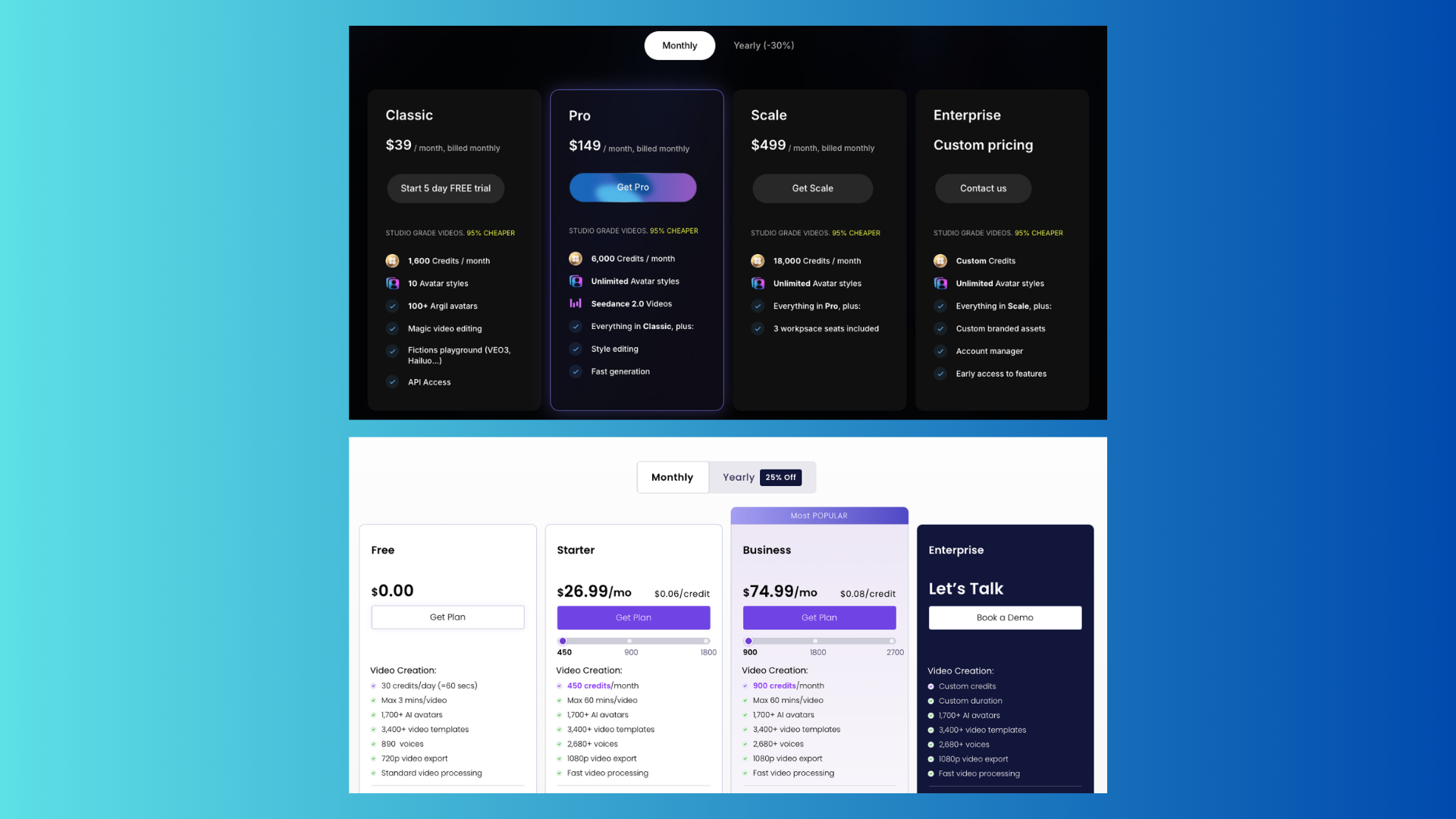
A pricing snapshot of Argil AI and Vidnoz.
Head-to-head on each dimension
Now the real work. Each section below scores both tools on a single dimension and names a winner, with a short note on why the difference matters for the job you are hiring the tool to do.
Cloning quality: template avatars vs personal clones
Vidnoz leans on a large stock library, around 1,900 AI avatars plus 2,000 voices, with an optional custom avatar on paid plans (Vidnoz AI, 2026). The cloned-face quality is fine for ad creative or internal training, but it still reads as AI-generated to a viewer paying attention.
Argil is built the other way around. You upload a 2-minute video of yourself, and that clone becomes the default presenter in every output. The quality is tuned for creator-grade content, where the audience watches because of who is on screen, not despite it.
Winner: Argil for personal-brand use cases, Vidnoz for any job where a believable generic presenter is good enough. Why it matters: if your face is the trust signal, a stock avatar dilutes it. If the avatar is interchangeable, the bigger library wins. This is the same reason creating video content without being on camera only builds an audience when the presenter stays consistent over time.
Output editing: basic editor vs full pipeline
The vidnoz ai video generator includes a light browser editor. You can trim, add text overlays, swap backgrounds, and drop in stock b-roll. It sits closer to a slideshow tool than a creator-grade pipeline, and short-form styling like captions takes extra steps.
Argil bakes the editing into the output. Captions get styled to platform norms while b-rolls and transitions are sequenced for you automatically. What comes out is close to a finished short-form post, not a raw clip waiting on a second pass.
Winner: Argil if you ship short-form daily and want finished output, Vidnoz if you want raw avatar clips to edit elsewhere. Why it matters: editing time eats the entire AI video promise. A tool that hands you a clip you still have to rebuild in CapCut has only moved the work, not removed it. The tool that strips out the most editing wins for anyone posting on a schedule.
Pricing and value at the entry point
On sticker price, Vidnoz is the cheaper door in. The Vidnoz pricing page lists a free tier capped at 3-minute videos with a watermark and 720p export. Paid plans run $26.99/mo for Starter and $74.99/mo for Business, with a custom avatar add-on around $299/year (Vidnoz pricing breakdown, 2026).
Argil starts higher. The Argil pricing page lists Classic at $39/mo, Pro at $149/mo, and Scale at $499/mo, with a 5-day free trial. The Classic plan includes the clone and roughly 25 minutes of finished video a month.
Winner: Vidnoz on sticker price, Argil on cost per shipped video once editing time is counted. Why it matters: a $26.99/mo clip that still needs 30 minutes of editing per post is not cheaper than a $39/mo finished clip when your time has any value. If you want to see where the rest of the field lands, the easiest AI avatar platforms to use compared on price lays out the broader spread.
Language coverage and multi-market output
This is Vidnoz's strongest dimension. The platform supports 140+ languages with voice cloning across them and one-click video translation (Vidnoz AI, 2026). For an SMB shipping the same script across multiple markets, that breadth is genuinely useful.
Argil also supports multiple languages, but the focus is different. The differentiator is whether your cloned voice carries its own accent and tone across languages, not the raw count of languages on offer. Creators who only publish in 1 or 2 markets care more about that match than about a long language list.
Winner: Vidnoz for raw language breadth, Argil for creators who ship in 1 or 2 languages but want their cloned voice to sound like them in each. Pick by whether your problem is many markets or a perfect match in a few.
Ideal user profile
The 2 tools are built for genuinely different people. A Vidnoz user is usually an SMB marketer running paid ad tests, an L and D contributor producing internal training, an agency making multi-language explainers, or a founder testing the medium before committing to a personal clone.
An Argil user is a content creator or personal-brand builder, a real estate agent, a lawyer, a coach, or an SMB founder who wants their own face producing daily short-form video and values cadence over avatar variety.
Winner: not the same job. These 2 profiles barely overlap, which is the whole reason the comparison is worth running. If your work depends on viewers recognizing one person, the personal brands that actually drive business all rely on a consistent face, which points you toward a clone-first tool.
Ad creation versus personal brand cadence
Vidnoz is a strong fit for ad creative iteration. It generates quickly and lets you A/B different scripts cheaply while keeping cost per output low. That is exactly what you want when the viewer is a paid-traffic audience that does not know your brand yet.
Argil is a strong fit for daily personal-brand content. The clone stays consistent across every video while the pipeline ships finished short-form, so the audience builds familiarity with the same face over weeks of posting.
Winner: Vidnoz for ads, Argil for organic personal-brand cadence. These are 2 distinct jobs that happen to share a category, which is why running both at once causes so little friction.
Use case scenarios
To make the call concrete, here is how the choice plays out across the situations buyers actually find themselves in.
- Choose Vidnoz if you run paid ad tests every week, your buyer does not know the brand yet, and you need many variants cheaply.
- Choose Vidnoz if you produce internal training or compliance video and an avatar that looks the part is good enough.
- Choose Argil if you are a creator, founder, agent, or coach and your audience watches because of you. Argil keeps your face on every output without filming.
- Choose Argil if you want one tool that ships finished short-form content rather than raw clips that need a second pass in CapCut or Premiere.
- Hybrid case: large marketing teams sometimes run Vidnoz for ad creative and Argil for the founder's personal-brand channel. Different jobs, different tools, no real conflict.
Final verdict and decision criteria
This is the heart of the comparison. The vidnoz ai video generator and Argil rarely lose to each other on a feature checklist, because they are built for different outcomes. Run your decision through these 5 criteria and the answer will be obvious.
Decision criterion 1: who is the avatar. If the avatar must be you, the call is Argil, because the clone is the whole product rather than a paid add-on. If a believable generic presenter is enough, Vidnoz wins on price and on the size of its library.
Decision criterion 2: what comes out the other end. If you want raw avatar clips to edit later in your own tool, Vidnoz fits. If you want finished short-form ready to post the moment it renders, Argil fits, because the editing pipeline is part of the generation, not a separate step.
Decision criterion 3: cadence. If your goal is 1 or 2 videos a month for ad tests, Vidnoz is plenty. If your goal is daily content on a creator channel, only a personal clone plus a built-in editing pipeline keeps up without you hiring a team.
Decision criterion 4: the value of trust. Personal brands compound when viewers see the same face week after week and start to recognize it. A stock avatar resets that trust on every video, because there is no single person for the audience to bond with.
Decision criterion 5: total cost of ownership. Headline price is a single input. Factor in the editing time after generation and the brand consistency you lose when the avatar keeps changing. Argil tends to win on total cost once editing is counted, while Vidnoz wins on raw output cost when you measure only the subscription.
The buyer who can answer the avatar-and-cadence question has already made the choice. This article exists to make that question explicit, so you stop comparing feature lists and start comparing jobs to be done. If your job is daily, face-first content, Argil is the AI video generator built for it. You can see how a cloned avatar actually builds an audience before you commit, then start your trial.
Frequently asked questions
Is Argil better than Vidnoz for personal brand content?
Yes, for personal brand and creator cadence. Argil is built around your own clone rather than a stock avatar, and it ships finished short-form video. Vidnoz still wins for ad creative tests and internal training where the presenter does not need to be a real person.
Is Vidnoz cheaper than Argil?
On sticker price, generally yes. Vidnoz has a free tier and a $26.99/mo Starter plan, while Argil Classic starts at $39/mo. Once you count editing time, Argil's cost per finished short-form video often lands lower, because the pipeline does the post-production for you.
Can both Vidnoz and Argil clone my face?
Yes. Vidnoz offers a custom avatar on paid plans, while Argil is built around the clone from the first upload. The difference is depth: Argil's clone is tuned for creator-grade output, and Vidnoz's is a solid avatar feature that is not the product's headline.
Which tool has better language coverage?
Vidnoz leads on raw language count with 140+ languages. Argil focuses on the quality of voice and clone match in the languages it supports. Pick by whether you need many markets or a perfect match in 1 or 2.
Can I run both Vidnoz and Argil at the same time?
Yes, and some marketing teams do. Vidnoz handles ad creative iteration while Argil runs the founder's personal-brand channel. They solve different jobs and overlap less than the category implies.
Related Articles
- How to Brand an Avatar That Actually Builds an Audience
- What's the Best AI Video Generator for Commercial Use
Vidnoz vs Argil compared on cloning, editing, pricing, and cadence for AI video