How to Monetize a Podcast With Sponsors: The Complete 2026 Guide
How to monetize a podcast with sponsors: compare CPM, flat fee, and affiliate deals, see realistic 2026 rate benchmarks, and grow your listenership.
https://argil-thumb.vercel.app
Article Highlights
- The full guide to monetize a podcast with sponsors
- Three deal models compared: CPM, flat fee, affiliate
- Realistic 2026 rate benchmarks by placement and niche
- Why host trust beats reach for niche advertisers
- Grow listenership with repurposed short form video
- Argil compounds the reach sponsors pay to reach
How to Monetize a Podcast With Sponsors: The Complete 2026 Guide
Podcast sponsorship means a brand paying to reach your listeners through your voice, priced on one of three models: a CPM per 1,000 downloads, a flat fee per episode, or an affiliate cut of sales. Which model pays you most depends on your download stability and niche, and the whole thing scales with reach. This guide covers every model, real 2026 rates, and how to grow the audience sponsors actually pay for.
Sponsorship is now a serious channel, not a side experiment. U.S. podcast ad revenue reached 4.2 billion dollars in 2026, up 31% year over year according to IAB and PwC data. The money is there. The question every host faces is how to structure a deal that captures a fair slice of it.
What podcast sponsorship really means in 2026
A sponsorship is a direct agreement where a brand pays you to talk about its product to your audience, usually as a host read segment inside an episode. That is different from programmatic ads, which ad networks insert automatically based on listener data with no involvement from you. Direct sponsorships pay more per listener because the host relationship is the product.
The reason niche podcast ads convert is trust, and the effect is measurable. In Nielsen's brand recall study, 71% of listeners recalled the advertised brand after a host read ad versus 62% for a non host read spot, and host read ads produced a 50% higher lift in purchase and recommendation intent. A listener who has followed your show for months treats your recommendation like a friend's, which display and social ads cannot replicate at any price.
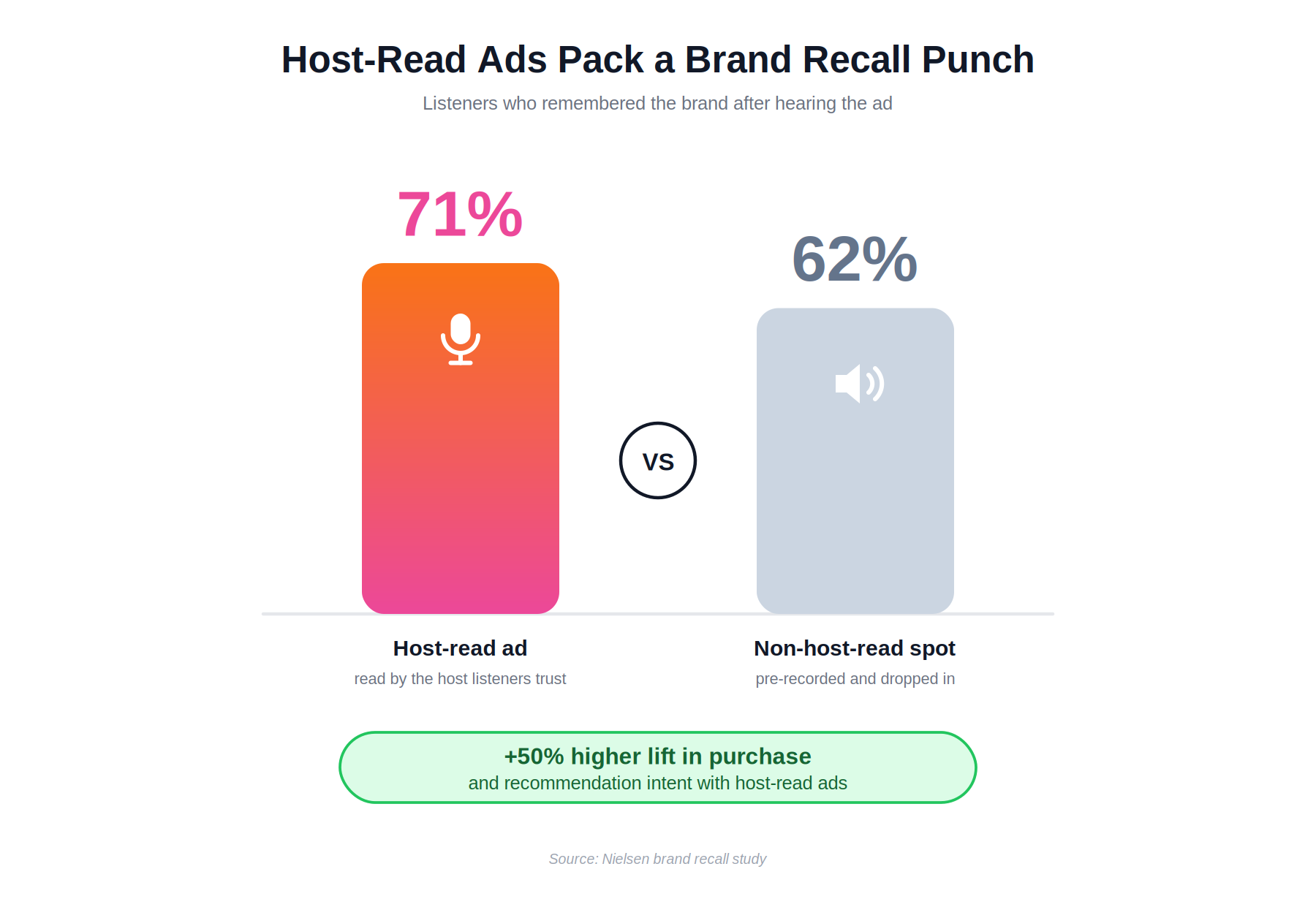
Image generated on the Nielsen study using Claude ai.
Set your expectation before you plan a strategy. Sponsorship income scales with downloads and audience fit, not with how many episodes you have published. A 40 episode back catalog does not raise your rate. Consistent downloads in a defined niche does. You will monetize on one of two tracks: direct deals you negotiate yourself, which pay more and take more work, or marketplace deals through an ad network like Acast or Spotify, which pay less per slot but fill inventory for you. Most growing shows run both, using direct deals for their best sponsors and marketplace fill for the rest.
The main sponsorship deal models
Three models cover almost every podcast sponsorship, and picking the right one for your show size is the difference between leaving money on the table and pricing yourself out of a deal. The rule of thumb: CPM rewards stable download numbers, flat fees protect smaller shows, and affiliate rewards a tight product fit. Here is how each works.
CPM deals
CPM stands for cost per 1,000 downloads, and it is the default pricing model for established shows. The math is clean. A podcast averaging 8,000 downloads per episode at a 30 dollar CPM earns 240 dollars per ad slot, and running two slots across eight monthly episodes brings in nearly 4,000 dollars from a single advertiser. CPM works because it ties your pay directly to reach a sponsor can verify.
CPM suits shows with stable, provable download numbers. If your episodes reliably clear a few thousand downloads in the first 30 days, CPM lets a media buyer compare you against market rates and slot you into a media plan. The catch is that CPM punishes volatility. If one episode tanks, that slot pays less, so you need consistency before you lean on it.
Flat fee deals
A flat fee is a single fixed price per episode or campaign, agreed up front regardless of how the episode downloads. It is the right model for smaller shows and fast growing ones. Smaller shows benefit because a flat fee prices audience quality, a tight niche of buyers, instead of raw volume that CPM would undervalue. Fast growing shows benefit because a flat fee locks in a strong rate before a download spike, protecting you from selling tomorrow's bigger audience at today's CPM.
The negotiating move is to benchmark the flat fee to your median month, then hold firm. A show doing 2,000 downloads in a specialized B2B niche can command a flat fee that a raw CPM calculation would never justify, because the sponsor is buying the exact buyers it wants, not a headcount.
Affiliate and revenue share deals
Affiliate deals pay you a percentage of sales your listeners generate, tracked through a unique code or link. Revenue share is the same idea structured as an ongoing cut. This model rewards a genuine product fit. If a productivity brand sponsors a show for founders and your listeners actually sign up, an affiliate deal can out earn a flat fee on a per episode basis.
The honest limitation is that affiliate income caps out when conversion is low. A great product with a mismatched audience converts poorly, and you earn little no matter how many downloads you have. Treat affiliate as an upside layer on top of a base deal, not your only income, unless you have strong evidence your audience buys what the brand sells. The best setups combine a modest flat fee with an affiliate code, so you get guaranteed income plus performance upside.
Realistic rate benchmarks
Anchor every negotiation to real 2026 numbers so you do not underprice or overreach. Rates split by ad placement first. Pre roll runs roughly 15 to 25 dollars CPM, since it sits at the top of the episode and is easy to skip. Mid roll commands the highest rate, around 25 to 50 dollars CPM, because episode drop off has already happened and the listeners still there are the most engaged. Post roll is cheapest, since many listeners leave before the end. Mid roll carries a 25 to 40 percent premium over pre roll for exactly that engagement reason, per 2026 CPM benchmarks from Acast.
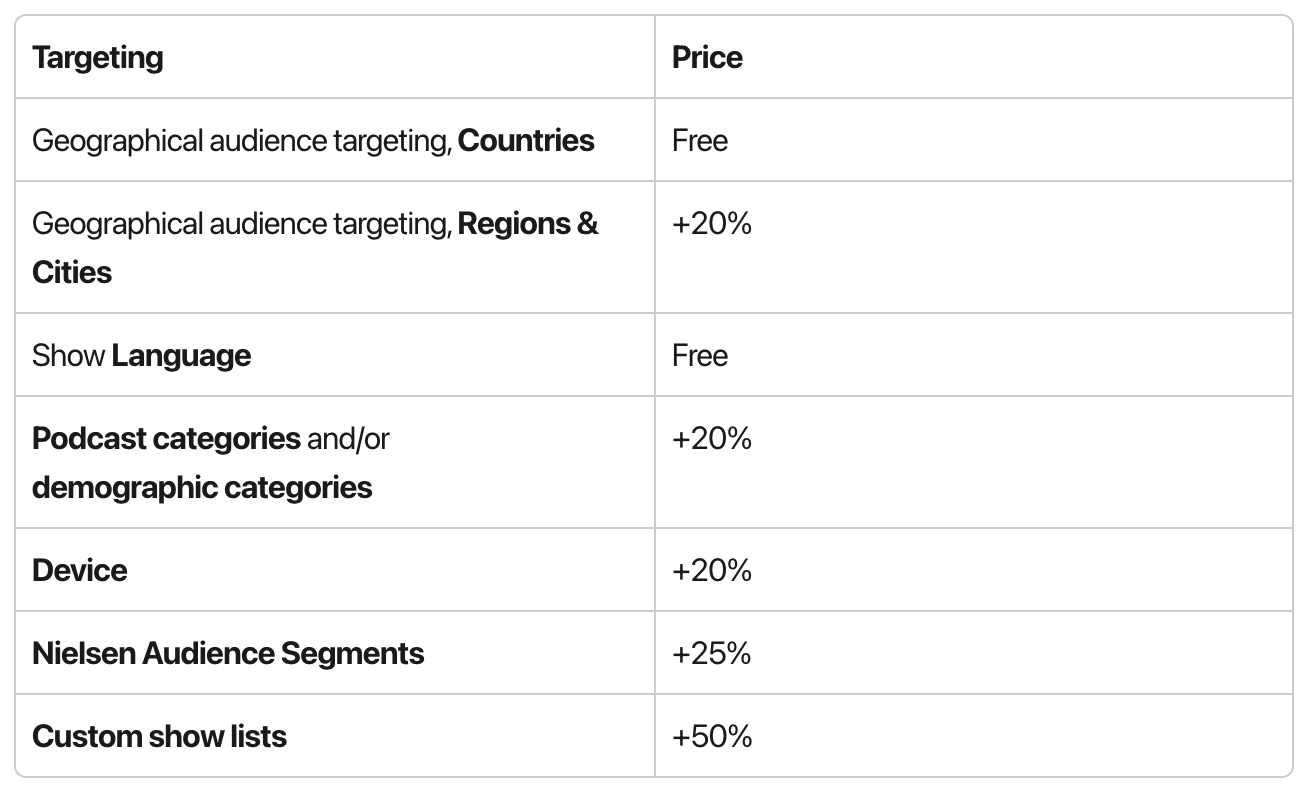
Acast self-serve dynamic pricing breakdown. Image source: Acast.
Download tiers map to flat fee expectations. A show under roughly 1,000 downloads typically starts with micro sponsorships or affiliate deals in the low hundreds per episode. Shows clearing several thousand downloads move into CPM territory where per slot pay runs into the hundreds. The industry standard sponsors judge you on is downloads in the first 30 days, so quote that figure, not lifetime plays.
Niche moves the rate more than size does. Business and finance shows command 40 to 55 dollars CPM and higher, while general entertainment sits closer to 15 to 25 dollars, because advertisers pay a premium to reach decision makers who buy expensive products. A finance show at 3,000 downloads can out earn a comedy show at 15,000 on the same slot. Treat all of these as starting points, not fixed prices. Category exclusivity, granting a sponsor that no competing brand runs on your show, adds another 20 to 40 percent because the advertiser gets uncontested attention.
How to make your show attractive to sponsors
Before a brand pays, it wants proof, and the document that provides it is a media kit. Keep the essentials tight: your average 30 day downloads, listener demographics, a clear niche statement, and your top episodes with their numbers. Present the download figure using one consistent time window so the brand can trust it, since attribution tools on the sponsor side will catch any inflation.
A sharp audience niche beats raw size for the brands worth chasing. A sponsor selling accounting software for agencies would rather reach 1,500 agency owners than 100,000 general listeners, because the fit converts. State your niche in one sentence a buyer can repeat internally, and lead your kit with it. The same niche logic runs through video marketing strategy in 2026, where a defined audience out earns broad reach every time.
Growing listenership: the distribution engine sponsors pay for
Every rate model above moves on one variable: reach. Sponsors pay for downloads, so growing your audience is the lever that raises CPM ceilings, flat fees, and affiliate volume all at once. A host who understands this stops treating growth as separate from monetization and starts treating it as the monetization strategy. Given that 95% of frequent podcast listeners have taken action after hearing an audio ad (Acast, 2026), every new listener you add is a new potential buyer a sponsor will pay to reach.
The channel driving discovery in 2026 is short form video. Clips on YouTube, TikTok, Instagram, and LinkedIn surface your show to people who would never find an audio only feed, and they pull those viewers back to full episodes. The problem is production. Most podcasters sit on hours of strong audio but have no time, no editing budget, and no comfort filming the daily video clips that actually grow reach. A human editor to cut clips runs into the thousands per month, and doing it yourself trades the hours you should spend making episodes.
This is where Argil closes the gap. You record a short video of yourself once to build an AI clone, then repurpose every audio episode into a steady stream of fully edited video clips with no extra filming. Feed an episode script in, get daily clips out, and post them across platforms to feed new listeners back into the show. It is the same repurposing motion that scales short form content for top creators, now available to any podcaster who would rather grow than film. Argil starts at 39 dollars a month with a 5 day free trial, a rounding error against the ad revenue a growing audience brings in.
The logic compounds. Consistent clips grow reach month over month, rising reach lifts downloads, and higher downloads justify a rate increase at renewal. That is the curve that turns a flat sponsorship income into a growing one, and it maps directly to Argil's AI powered video repurposing workflow built for exactly this cadence. It works even if you would rather create video content without being on camera.
Common sponsorship mistakes to avoid
Four mistakes cost hosts money, and all four are avoidable. First, pitching brands the host has never used, which produces a hollow ad read that listeners hear straight through, killing the trust that made your show worth sponsoring. Only pitch products you would recommend unprompted.
Second, underpricing by guessing instead of running CPM math. A host who names a number out of insecurity leaves hundreds per slot on the table. Calculate from your 30 day downloads and the benchmark rates above, then hold your rate.
Third, ignoring audience growth and then wondering why rates stay flat. Sponsors renew shows on an upward curve and quietly drop the ones that plateau, so a stalled download count is a rate ceiling you built yourself. Treat distribution as core, not optional.
Fourth, skipping written deal terms on exclusivity, ad position, and clip usage rights. A handshake deal that does not specify mid roll versus pre roll, or whether the brand can reuse your read in its own ads, is money you gave away without noticing. Put every term in writing before you record.
FAQ
How many downloads do you need to get podcast sponsors?
Most advertisers look for around 5,000 downloads per episode within the first 30 days for a standard CPM deal, though shows in the 200 to 1,000 range regularly land micro sponsorships and affiliate deals through direct pitches. Niche fit often matters more than raw volume for smaller shows.
What is the difference between CPM and flat fee sponsorship?
CPM pays you a rate per 1,000 downloads, so your income rises and falls with each episode's reach and suits shows with stable numbers. A flat fee is one fixed price per episode regardless of downloads, which protects smaller or fast growing shows from volatility and prices audience quality over raw volume.
What is a realistic CPM rate for podcast ads?
For 2026, pre roll runs roughly 15 to 25 dollars CPM, mid roll 25 to 50 dollars, and host read sponsorships 25 to 40 dollars (Acast, 2026). Business and finance shows command 40 to 55 dollars and up, because advertisers pay more to reach high value decision makers.
Are affiliate deals worth it for small podcasts?
Affiliate deals can out earn flat fees for small shows when the product genuinely fits the audience, since pay scales with listener purchases rather than headcount. The risk is that income caps out if conversion is low, so the safest setup pairs a modest flat fee with an affiliate code for guaranteed base pay plus upside.
How do you grow podcast downloads to attract better sponsors?
Repurpose each episode into short form video clips for YouTube, TikTok, Instagram, and LinkedIn, which surface your show to new audiences and pull them back to full episodes. Consistency is the lever, so a tool like Argil that turns episodes into daily clips without filming keeps the cadence sponsors reward with higher rates.
Can repurposing episodes into video clips increase sponsorship income?
Yes, indirectly but reliably. More clips means more reach, more reach means more downloads, and higher downloads justify a rate increase at renewal across every deal model. Sponsors pay for growth, so a steady clip output is one of the most direct ways to raise your sponsorship income over time.
Related Articles
- The Best Clipping Software for Content Creators in 2026
- How Do Custom Matches Work in AI Video: Fully Clone Yourself With Argil
- 8 Real Ways Creators Earn From TikTok Views in 2026
Podcast sponsorship guide: CPM, flat fee, and affiliate deal models for 2026