
Video Marketing in 2026: The Ultimate Guide to Strategy, Tools, and ROI

- 91% of businesses now use video marketing
- Short-form video delivers the highest ROI
- AI has collapsed video production costs
- Platform-specific video marketing strategies
- How to measure video marketing ROI
- Argil simplifies AI video creation at scale
Video Marketing in 2026: The Ultimate Guide to Strategy, Tools, and ROI
Video marketing has gone from "nice to have" to the single most effective content format across every platform, every industry, every audience size, and every budget. The numbers back it up, and the algorithms reward it. The tools to create it have never been more accessible.
This guide covers everything you need to build a video marketing strategy that drives results: what's changed in 2026, what works on each platform, how to measure ROI, and how to build a workflow that doesn't consume your entire week.
What Is Video Marketing in 2026?
Video marketing is the use of video content to promote a brand, product, or service across digital channels. That definition hasn't changed from a few years ago, but everything else about it has.
In 2026, video marketing means sharing short-form clips on LinkedIn and TikTok, AI-generated explainers on YouTube, personalized sales videos in cold outreach, and repurposed podcast clips driving organic traffic. It's not one format or one channel but the connective tissue across your entire go-to-market strategy.
The Evolution from Traditional Video to AI-Native Content
5 years ago, producing a single marketing video meant hiring a videographer, booking a location, scripting, shooting, editing, and publishing. The whole process took weeks and cost 1000s of dollars. Most small businesses couldn't afford it, most founders didn't have time for it, and so video marketing was off the table.
That world is gone. AI-native video creation has reduced the production cycle from weeks to hours. Now, you can record a short training clip of yourself, and AI handles the rest: generating new videos from scripts, adding captions, inserting b-roll, and matching your tone and delivery style. Video marketing used to be reserved for companies with production budgets. Now a solopreneur with a laptop can publish daily video content that looks professional and sounds authentic without burning out or spending 1000s of dollars.
The trends shaping AI video generation in 2026 all point to the same shift: production has stopped being the bottleneck, and knowing what to say has taken its place.
Video Marketing: What Do the Numbers Say?
The data makes the case for video marketing better than any argument. 91% of businesses now use video as a marketing tool, and the average person watches roughly 17 hours of online video per week across devices. That's more than 2 hours a day spent watching video content, and the number keeps climbing as platforms push video-first formats.
Where does that leave businesses that haven't started yet? Mostly, they’re behind, and the gap widens every quarter as competitors build video libraries, train algorithms on their content, and compound audience trust through consistent presence.
Why Video Marketing Outperforms Text and Image Content
You already know video marketing performs well. The question is why, and by how much. Understanding the mechanics behind video's dominance helps you invest in the right formats and avoid wasting effort on approaches that don't move metrics.
Engagement and Retention Data
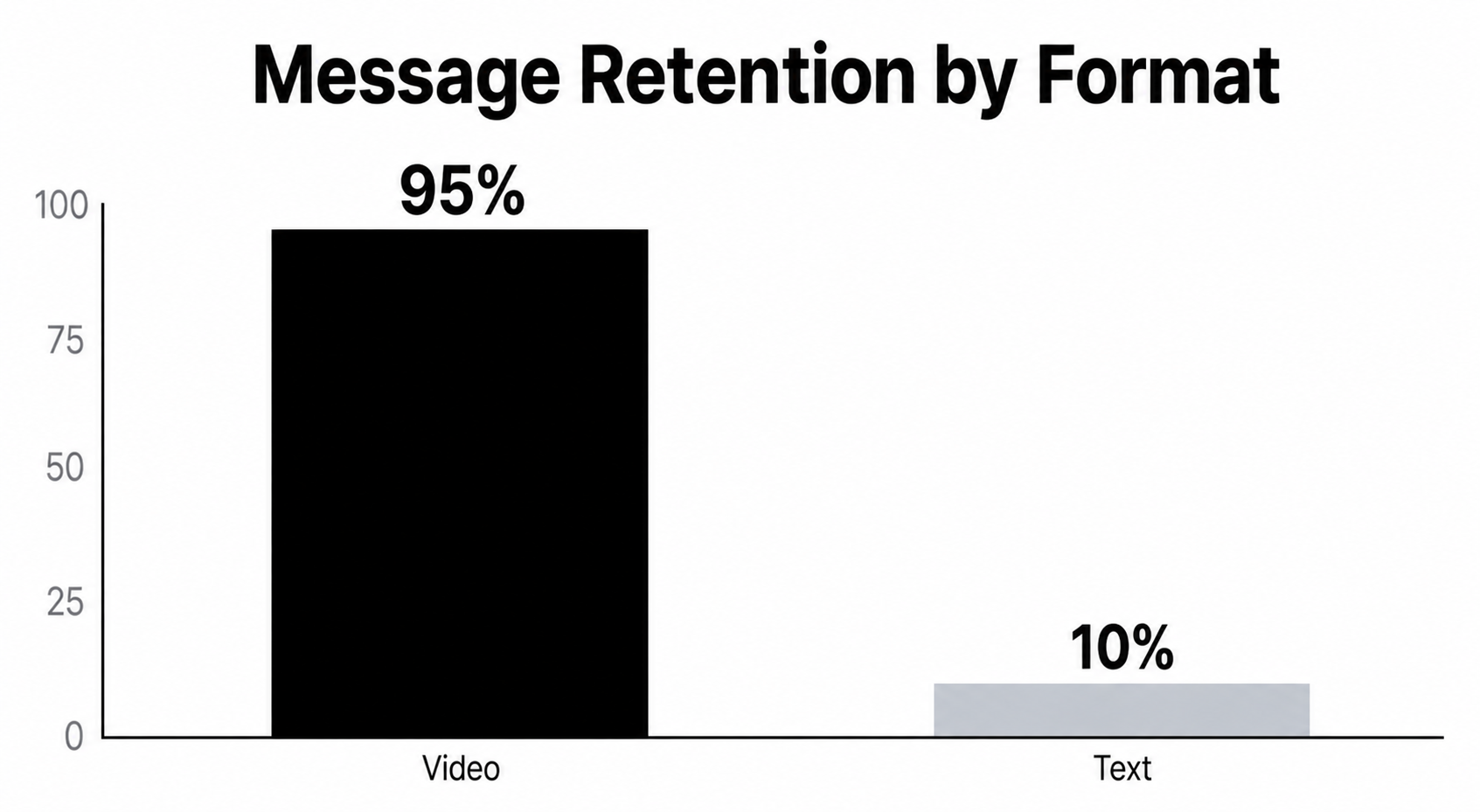
Video holds attention in ways that text and static images simply cannot. People retain 95% of a message when they watch it in a video compared to 10% when reading text.
When it comes to brand websites, landing pages with embedded video convert at 86% higher rates than those without. The reason for this is straightforward: video reduces cognitive load. Instead of reading 3 paragraphs about how a product works, a prospect watches a 45-second demo and gets it immediately.
Algorithm Preferences Across Platforms
Every major platform has restructured its algorithm to prioritize video. LinkedIn's native video posts generate roughly 3x more engagement than text-only posts. TikTok and Instagram are video-first by design. YouTube Shorts competes directly for attention with long-form content.
The algorithmic preference creates a compounding advantage. When your video gets higher initial engagement, the platform shows it to more people. More views mean more engagement. More engagement means more distribution. Businesses that post video consistently build a flywheel that text-only strategies can never match.
Trust and Conversion
Video builds trust faster than any other format. When prospects see a real person explaining a product, demonstrating a workflow, or sharing their perspective, they form a connection that text can't replicate. This is especially true in B2B, where purchase decisions involve multiple stakeholders and long evaluation cycles.
Founders and subject-matter experts who show up on camera establish credibility with their audience in a way that ghost-written blog posts never will. The camera captures nuance, conviction, and expertise. Your audience can tell when someone actually knows what they're talking about. Video marketing turns that expertise into a scalable trust signal.
For anyone building a personal brand through video, the playbook is clear: becoming a content creator in 2026 requires showing up consistently, and AI makes that possible without filming every day.
The AI Revolution in Video Production
AI has rewritten the economics of video marketing. Production that used to take a week and a budget now happens in an afternoon, and the people doing it aren't agencies anymore.
This section covers the practical reality of AI video production in 2026.
How AI Has Collapsed Production Costs
Traditional video production costs between $1,000 and $5,000 per finished minute, depending on quality and complexity. AI-powered tools have dropped that to a fraction. A solo founder can now produce 10 to 20 short-form videos per week at essentially zero marginal cost after the initial setup.
The cost collapse matters because it changes the math on content strategy. When each video costs 1000s to produce, you publish 1 per month and hope it performs. When each video costs next to nothing, you publish daily, test different hooks, and let the data tell you what works. Volume becomes a strategic advantage instead of a budget constraint.
AI Avatars and Digital Twins
AI avatars, sometimes called digital twins or AI clones, are the most significant development in video marketing since the smartphone. You record a short training video of yourself. The AI learns your appearance, voice, and mannerisms. From that point forward, you can generate new videos by writing a script and letting the AI produce the video as your digital clone.
Avatars remove the single hardest constraint in video production, which is how much time the founder or expert has to be on camera. A real estate agent can film walkthroughs of every listing without driving to a single one. A SaaS founder can ship a product update video the day the feature ships. The consultants we work with are the most aggressive use case though, they're sending personalized one-to-one videos at the volume of a cold email sequence, which would be physically impossible without an avatar.
The key distinction is that AI avatars work best when the person behind them has genuine expertise. The AI handles production. The human provides the substance, the insight, and the strategic thinking that makes the content worth watching. Creating video content without being on camera is no longer a limitation.
What AI Can and Cannot Do (Yet)
AI video tools in 2026 are genuinely impressive, but they have clear boundaries. Here's where they excel and where they fall short.
What AI handles well:
- Generating talking-head videos from scripts using a trained avatar
- Adding captions, b-roll, and transitions automatically
- Repurposing written content (articles, newsletters, LinkedIn posts) into video format
- A/B testing different hooks and intros from a single script
- Translating videos into multiple languages with lip sync
What still needs a human:
- Developing the strategic angle and messaging
- Writing scripts that resonate with a specific audience
- Making creative decisions about tone, pacing, and emphasis
- Quality control on final output
- Understanding which topics and formats will perform for your audience
AI removes the production barrier, but it can't tell you what to actually say or who to say it to. The teams getting real results from AI video are the ones with strong domain expertise and a clear point of view, who treat AI as a way to scale their output rather than generate it from scratch.
Video Marketing Strategies by Platform
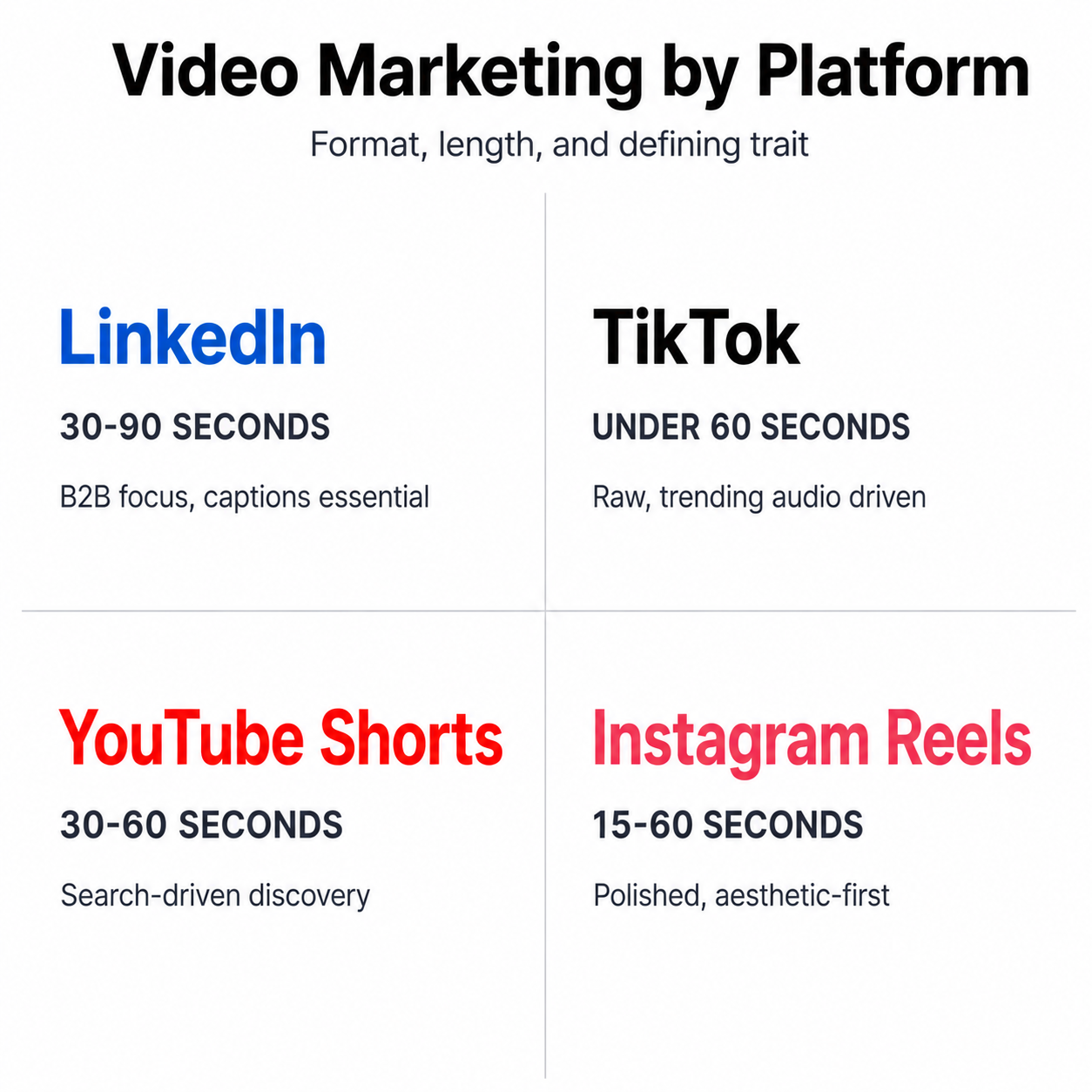
Each platform has its own culture, algorithm, and audience expectations. A video that performs well on LinkedIn will flop on TikTok if you post it without adaptation. Here's what works on each platform in 2026.
LinkedIn Video Marketing Strategy
LinkedIn has become the strongest platform for B2B video marketing. The algorithm actively promotes native video, and the audience is primed to engage with professional content.
What works on LinkedIn:
- Videos between 30 and 90 seconds that deliver one clear insight
- First-person perspective from a founder, executive, or practitioner
- Hook in the first 3 seconds that states the value proposition of watching
- Captions always on (most LinkedIn browsing happens with sound off)
- Educational content that addresses a specific pain point
What to avoid:
- Overly polished corporate videos that feel like ads
- Videos longer than 2 minutes (engagement drops sharply)
- Reposting TikTok content with watermarks
- Generic motivational content without substance
The biggest opportunity on LinkedIn is consistency. Most professionals post video sporadically, if at all. Posting 3 to 5 videos per week, even short ones, puts you in a different category entirely. Building a personal brand that drives business through video is one of the highest-ROI activities a founder can invest in.
TikTok Video Strategy
TikTok rewards raw, fast-paced content that hooks viewers in the first second. The platform's algorithm is uniquely democratic: a brand-new account can go viral if the content resonates.
What works on TikTok:
- Videos under 60 seconds with a strong pattern interrupt in the opening
- Trending audio clips paired with relevant industry commentary
- Behind-the-scenes content that humanizes a brand
- Direct address to camera with energy and personality
- Educational content framed as "things I wish I knew" or "mistakes to avoid"
For B2B brands, TikTok is underutilized. The audience skews younger, but decision-makers and influencers are active there. The video marketing content that performs best positions professional expertise in an entertaining, accessible format.
YouTube Shorts Strategy
YouTube Shorts sits at the intersection of short-form virality and YouTube's long-term discovery engine. A Short that performs well can drive subscribers to your channel, where they'll find longer content and eventually convert.
What works on YouTube Shorts:
- 30 to 60-second clips that tease a deeper topic covered in a longer video
- Clear, bold text overlays
- Strong hooks that create curiosity gaps
- Consistent posting schedule (daily if possible)
The strategic advantage of Shorts is YouTube's search functionality. Unlike TikTok, where content has a short shelf life, YouTube Shorts can continue generating views for months through search and suggested video placement.
Instagram Reels Strategy
Reels remain Instagram's primary growth driver. The format mirrors TikTok in length and style, but the audience and context differ. Instagram users expect slightly higher production value and a more curated aesthetic.
Keep Reels between 15 and 60 seconds. Use clean visuals and on-screen text. Align content with your brand's visual identity. Cross-post from TikTok if the content fits, but remove watermarks and adjust captions for the Instagram audience.
Measuring Video Marketing ROI
Video marketing without measuring its impact is a waste of resources. The good news is that video marketing ROI is more trackable than ever. The only challenge is knowing which metrics actually matter.
Metrics That Actually Matter
Most marketers track views and likes. Those are vanity metrics, because they tell you almost nothing about business impact. Here are the metrics that connect video marketing to revenue:
- Watch time and completion rate: How much of your video do people actually watch? A video with 10,000 views but a 15% completion rate delivered less value than one with 2,000 views and 80% completion.
- Click-through rate: What percentage of viewers take the next action? This could be clicking a link, visiting your profile, or navigating to your website.
- Engagement rate: Comments and shares matter more than likes. They indicate that the content provoked thought or resonated enough to pass along.
- Lead attribution: Can you trace a lead back to a specific video? UTM parameters, landing page tracking, and CRM integration make this possible.
- Cost per lead from video: Total video production cost divided by leads generated. This is the number that tells you whether video marketing is working as an acquisition channel.
Building a Video Marketing Dashboard
A simple dashboard keeps you focused on what matters. Set up tracking across 3 layers:
- Production metrics: Videos published per week, average production time, cost per video
- Distribution metrics: Views, impressions, engagement rate, completion rate by platform
- Business metrics: Leads generated, pipeline influenced, deals where video played a role
Most analytics tools (LinkedIn Analytics, YouTube Studio, TikTok Analytics) provide platform-specific data. Pull the business metrics from your CRM. Review the dashboard weekly and adjust your content strategy based on what the data shows, not what you assume.
Connecting Video Marketing to Revenue
The connection between video marketing and revenue isn't always direct, especially in B2B where sales cycles are long. But you can build a clear attribution model.
Start by tagging every video with its purpose: awareness, consideration, or conversion. Track how prospects interact with video content throughout the buyer journey. Use UTM parameters on every link. Ask new customers how they found you, and note when video comes up.
Over time, patterns surface. You'll notice that 1 or 2 topics consistently pull qualified leads while the others mostly only collect views, and that demo requests tend to cluster around a specific format rather than being spread evenly across what you publish. With those signals in hand, video stops being a publishing exercise and becomes a measurable acquisition channel.
Video Marketing Tools and Workflow
The tools you use matter less than the workflow you build around them. A great workflow makes video marketing sustainable. A bad one turns it into a bottleneck that burns out your team.
The Modern Video Marketing Stack
A functional video marketing stack in 2026 includes 4 layers:
- Creation: The tool that actually produces your videos. This could be a camera and editing software, an AI video generator like Argil, or a combination of all of them.
- Distribution: Scheduling tools that publish across platforms. Buffer, Hootsuite, or native scheduling within each platform.
- Analytics: Platform-native analytics plus a centralized dashboard for cross-platform comparison.
- Repurposing: Tools that convert 1 piece of content into multiple formats. A long-form video becomes Shorts, Reels, LinkedIn clips, and audio snippets.
The stack doesn't need to be expensive. For a solo founder or small team, an AI video creation tool plus native platform scheduling covers 80% of what you need.
Argil: AI Video Generation for Solopreneurs and SMBs

Argil is an AI video creation platform built for people who need to produce consistent video content without spending hours in front of a camera. The workflow is simple: you upload a 2-minute training video of yourself, and Argil creates an AI clone that generates fully-edited short-form videos from any script you provide.
What sets Argil apart from other AI video tools is the complete editing pipeline. Captions, b-roll, and transitions are built in. You don't need a separate editing tool or a video editor on your team. Write a script, choose your avatar, and the platform delivers a finished video ready to publish.
There are so many practical use cases for video marketing:
- A founder records one training clip and produces 20 videos per week for LinkedIn, TikTok, and YouTube Shorts
- A consultant repurposes newsletter content into video format by pasting the text as a script
- A real estate agent creates property explainer videos without visiting every site
- A marketing team A/B tests different hooks by generating multiple versions from a single script
Argil is designed for experts who have something worth saying but don't have the time or tools to manage a full video production process. The AI handles the production. You bring the expertise, the strategy, and the perspective that makes the content valuable.
Building a Repeatable Video Workflow
Sustainability matters more than perfection. A video marketing workflow that you can run every week without burning out will produce better results over 12 months than an ambitious plan you abandon after month 2.
Here's a workflow that works for teams of 1 to 5:
- Batch your scripts: Write 5 to 10 video scripts in one sitting. Each script should deliver one clear idea in under 90 seconds of speaking time.
- Generate or record: Use an AI tool to generate the videos, or batch-record them in 1 session.
- Edit and format: Add captions, trim dead space, and format for each platform's specifications.
- Schedule and publish: Distribute across platforms on a consistent schedule. Aim for at least 3 posts per week.
- Review and iterate: Check your dashboard weekly. Double down on topics and formats that drive engagement. Cut what doesn't work.
The entire workflow can take 2 to 3 hours per week with the right tools. That's a small investment for a channel that compounds over time and drives measurable business results.
Frequently Asked Questions
What is video marketing and why does it matter?
Video marketing is the practice of using video content to promote products, services, or brands across digital channels. It matters because video consistently outperforms text and image content in engagement, retention, and conversion. With 91% of businesses using video as a marketing tool in 2026, it's no longer optional for companies that want to compete.
How much does video marketing cost?
Costs range dramatically. Traditional production runs $1,000 to $5,000+ per finished minute. AI-powered video tools bring that down to under $100 per month for unlimited videos. A solopreneur can run a full video marketing operation for less than the cost of a single professionally produced video.
What's the best video length for marketing?
It depends on the platform. For LinkedIn, TikTok, Instagram Reels, and YouTube Shorts, keep videos between 30 and 90 seconds. Short-form video under 60 seconds tends to achieve more engagement than longer formats. For YouTube long-form, 8 to 15 minutes is the sweet spot for educational content.
Which platforms are best for video marketing?
LinkedIn is the strongest B2B platform for video marketing. TikTok offers the widest organic reach. YouTube provides the best long-term discoverability. Instagram Reels work well for brand-building. The best approach is to start with one platform where your audience is most active and expand from there.
Can I do video marketing without showing my face?
Yes. AI avatar tools let you create videos using a digital clone trained on a short recording. Screen recordings, animated explainers, and text-overlay videos are other options. That said, face-to-camera content builds trust fastest, even if the face is an AI-generated version of you.
How do I measure video marketing success?
Track completion rate, click-through rate, engagement rate (comments and shares, not just likes), and lead attribution. Connect these to your CRM to measure cost per lead from video and pipeline influence. Review metrics weekly and adjust your strategy based on what the data shows.
How often should I post video content?
Consistency matters more than volume. 3 videos per week is a strong starting point. If you can sustain daily posting, the compounding effect accelerates significantly. The key is building a workflow that's sustainable for your team size and resources.
Related Articles
- What's New in AI Video Generation? Key Trends and Tools to Watch in 2026
- How to Become a Content Creator in 2026
- Personal Brand Examples That Actually Drive Business
Video marketing strategies, tools, and ROI benchmarks for 2026