How to Monetize a Podcast With Sponsors: A 7 Step Guide
How to monetize a podcast with sponsors step by step: build a media kit, set CPM rates, pitch brands, and grow downloads for bigger deals.
https://argil-thumb.vercel.app
Article Highlights
- How to monetize a podcast with sponsors, step by step
- Sponsors pay for 30 day downloads, not follower counts
- Build a one page media kit brands trust in two minutes
- Set CPM and flat rates using real 2026 benchmarks
- Pitch brands your audience already buys from
- Argil turns each episode into daily short form clips
How to Monetize a Podcast With Sponsors: A 7 Step Guide
To monetize a podcast with sponsors, package your first 30 day downloads into a one page media kit, price ad slots on a CPM of 1,000 downloads, and pitch brands your listeners already buy from. The step most hosts botch is leading with follower counts. Sponsors buy downloads and audience fit, so that is what you sell.
That distinction decides everything that follows. A show with 800 engaged downloads in a tight niche closes deals that a show with 40,000 scattered social followers cannot. This guide walks the exact sequence: what sponsors check, how to build the kit, how to price, who to pitch, how to structure the read, and how to grow downloads so every renewal pays more.
Step 1: Understand what sponsors actually pay for
Sponsors buy attention, and in podcasting attention is measured in downloads per episode inside the first 30 days. That window is the industry standard advertisers use in every rate conversation, so it is the only download number that matters when you pitch. A million lifetime plays across three years does not move a media buyer. Consistent downloads in the first month does.
Before a brand replies to a pitch, it checks three numbers. First, average downloads in the first 30 days, because that sets the reach it is buying. Second, audience niche fit, because a finance brand wants finance listeners, not raw volume. Third, host trust, since the host reads the ad and the endorsement only works if listeners believe it. The trust number is not soft. Acast reports that 80% of listeners trust recommendations from hosts they currently follow, and 64% of listeners pay full attention to podcast ads (Acast, 2026). That is why brands pay a premium for your voice over a programmatic slot.
Set your expectations by size. Buzzsprout's platform data shows that an episode downloaded 412 times in its first 7 days sits in the top 10% of all podcasts, and 1,015 downloads puts you in the top 5% (Buzzsprout, 2026). Most advertisers want to see roughly 5,000 downloads per episode before they commit to a standard CPM deal, per benchmarks from The Podcast Host. Below that, you are not shut out. Shows in the 200 to 1,000 download range routinely land micro sponsorships and affiliate deals through direct pitches. The lever is knowing which deal your size supports, so you price from reality instead of hope.
Here is the operator call most guides hedge on. Do not chase a bigger follower count before you monetize. Chase downloads in a defined niche and pitch early, even at 500 downloads, because a specialized audience of 500 buyers is worth more to the right brand than 50,000 general listeners are to a broad one. Trust and fit close deals that scale cannot. The same logic drives every personal brand that actually converts: depth in a niche beats reach across a crowd.
Step 2: Build a media kit that closes
A media kit is the one document a brand reads before it decides, so it has to earn a yes in under two minutes. Keep it to a single page. Cramming five pages of design signals that you are hiding thin numbers. The kit that closes is honest, specific, and fast to skim.
Five sections do the work. Lead with download numbers stated as a 30 day average per episode, because that is the figure the buyer is comparing against every other show. Follow with listener demographics: age band, top countries, and the roles or industries your audience works in. Add your top three episodes with their download counts, which proves your ceiling. Then a short audience problems section naming the exact pains your listeners have, so the brand sees where its product fits. Close with past brand results if you have them, listed as the brand name and one outcome sentence.
Present the download figure with a clean 30 day window and never inflate it. If you average 1,200 downloads in 30 days, write 1,200. Brands run attribution on the back end now, and a number that does not hold up ends the relationship and the referral. The honest figure, paired with a sharp niche, beats a padded one every time.
What to include when you have no sponsor history
No past deals is not a blocker, it is a formatting choice. Replace the results section with proof of engagement: screenshots of listener replies, a review or two, and one line of email or community numbers if you have them. State your niche in a single sentence a brand can repeat internally, for example "a weekly show for early stage SaaS founders on hiring their first sales rep." Then include a sample ad read script written for a specific brand, so the buyer hears exactly how their product would sound in your voice before they risk a dollar. That script does more selling than any stat when you are starting out.
Step 3: Set your CPM and flat rates
CPM means cost per 1,000 downloads, and it is how nearly every podcast ad is priced. The math is direct. Take your average 30 day downloads, divide by 1,000, and multiply by your CPM rate. A show with 5,000 downloads at a 25 dollar CPM earns 125 dollars per ad slot. Two slots an episode across four episodes a month is 1,000 dollars in monthly sponsorship from a single advertiser.
Anchor your rate to real 2026 benchmarks so you neither underprice nor scare off buyers. Host read sponsorships run 25 to 40 dollars CPM, and pre recorded network ads run 15 to 30 dollars CPM (Acast, 2026). Placement matters as much as the rate. Pre roll sits at the low end, around 15 to 25 dollars CPM, because it is easy to skip. Mid roll commands the highest rate, roughly 25 to 50 dollars CPM, because drop off has already happened and the listeners still there are your most engaged. Post roll is the cheapest since many listeners have left. Niche multiplies all of it. Business and finance shows command 40 to 55 dollars CPM and up, because advertisers pay more to reach decision makers.
Switch to a flat fee when your download counts are still volatile. A flat fee is one fixed price per episode regardless of downloads, and it suits smaller or fast growing shows for two reasons. It prices your audience quality instead of raw volume, and it removes the risk of a soft episode dragging your pay down. If a brand offers CPM and you download unpredictably, counter with a flat rate benchmarked to your median month. You can copy this starting formula: (average 30 day downloads divided by 1,000) times your CPM band, then add 20 to 40 percent if you grant the sponsor category exclusivity, since that uncontested mindshare is worth the premium.
Step 4: Find and pitch the right brands
The fastest way to a yes is pitching brands your audience already buys from. List the tools, products, and services your listeners mention, use, or ask you about. Those brands convert because the fit is obvious to the buyer and the endorsement will sound real coming from you. A generic pitch to a brand with no audience overlap is a wasted send.
Find the right human, not a generic inbox. Look for the partnerships, influencer, or marketing contact on LinkedIn or the company site, and pitch that person directly. A cold pitch that lands has four moving parts. Open with a relevance line naming why your audience and their product overlap. Add one proof point, a download number or a niche stat, not a paragraph of them. State the offer plainly: the ad type, the placement, and the rate. Close with a single clear next step, a link to book a 15 minute call. No brand reads a five paragraph cold email, so every extra sentence lowers your reply rate.
Never pitch a brand whose product you have not used. The host read ad only converts because listeners trust that you mean it, and a hollow endorsement for a product you have never touched burns the trust you spent years building. If you would not recommend it to a friend, do not read it to your audience. That discipline is why niche shows out convert big general ones on the same CPM.
A pitch email skeleton readers can copy
Subject line: name the brand and the audience overlap, for example "1,200 SaaS founders hear this show every week." Body: two sentences of proof (your 30 day downloads and your niche), one sentence offer (mid roll host read, four episodes, your rate), one sentence with a booking link. That is the whole email. Brevity reads as confidence, and confidence closes.
Step 5: Structure the ad read and the deal terms
Host read ads out convert produced spots for niche shows, and the data backs it. In Nielsen's research, 71% of listeners recalled the brand after a host read ad versus 62% for a non host read spot, and Acast reports host read ads outperform producer read ads on purchase rate by around 31% (Acast, 2026). That gap is your negotiating edge. It is also why you should default to reading ads yourself rather than dropping in a brand supplied clip.
Lock the deal terms in writing before you record. Four terms matter most. Number of episodes, so both sides know the run length. Ad position, since mid roll costs more than pre roll and the contract should say which you are selling. Exclusivity window, meaning whether you agree not to run a competing brand for a set period, which is worth a 20 to 40 percent premium. And usage rights for any clips, because if the brand wants to reuse your read in its own ads, that is additional value you should price.
Write the read from a simple formula so it sounds like you and still sells. Open with a personal hook that ties the product to your own experience. Name the problem it solves and how it fixed it for you. Give an honest endorsement, including a limit if there is one, since honesty is what makes the recommendation land. Close with a clear offer and a code, so the brand can attribute the sale back to your show and renew on proof.
Step 6: Grow downloads so sponsors pay more, using Argil
Every rate model above moves on one lever: downloads. More downloads means a higher CPM ceiling and bigger flat fees, so audience growth is the real monetization engine, not a nice to have. U.S. podcast ad revenue hit 4.2 billion dollars in 2026 (IAB, 2026), and that money flows to the shows that keep growing reach, because sponsors renew on an upward curve and cut shows that plateau.
The growth channel in 2026 is short form video. Clips on YouTube, TikTok, Instagram, and LinkedIn pull new listeners back to the full episode, and video podcasting is where discovery now happens. The bottleneck is brutal though. Most podcasters have hours of great audio and zero time, budget, or on camera comfort to film and edit the daily clips that actually move downloads. Hiring an editor runs into the thousands per month, and doing it yourself eats the hours you should spend making episodes.
That gap is where Argil fits. Record a 2 minute video of yourself once to build an AI clone, then turn every episode script into fully edited short form clips without filming again. The workflow is simple: pull the highlights from your episode audio, generate a batch of daily AI video clips from those scripts, and post them to drive new listeners back to the full show. It is the same content repurposing motion that top creators use, applied to podcasting, and it works even if you are not comfortable on camera. Argil starts at 39 dollars a month on the Classic plan, with a 5 day free trial, which is a fraction of what a single editor costs.
The payoff shows up at renewal. A steady clip output compounds downloads month over month, and that rising curve is exactly what justifies a rate increase when your sponsor contract comes up. You are not just filling ad slots, you are building the growth story that lets you charge more for them next quarter. For the deeper version of this play, our guide to clipping software for creators breaks down the full repurposing stack, and if you want to think about direct listener income too, our breakdown of how creators earn from views covers the platform payout side.
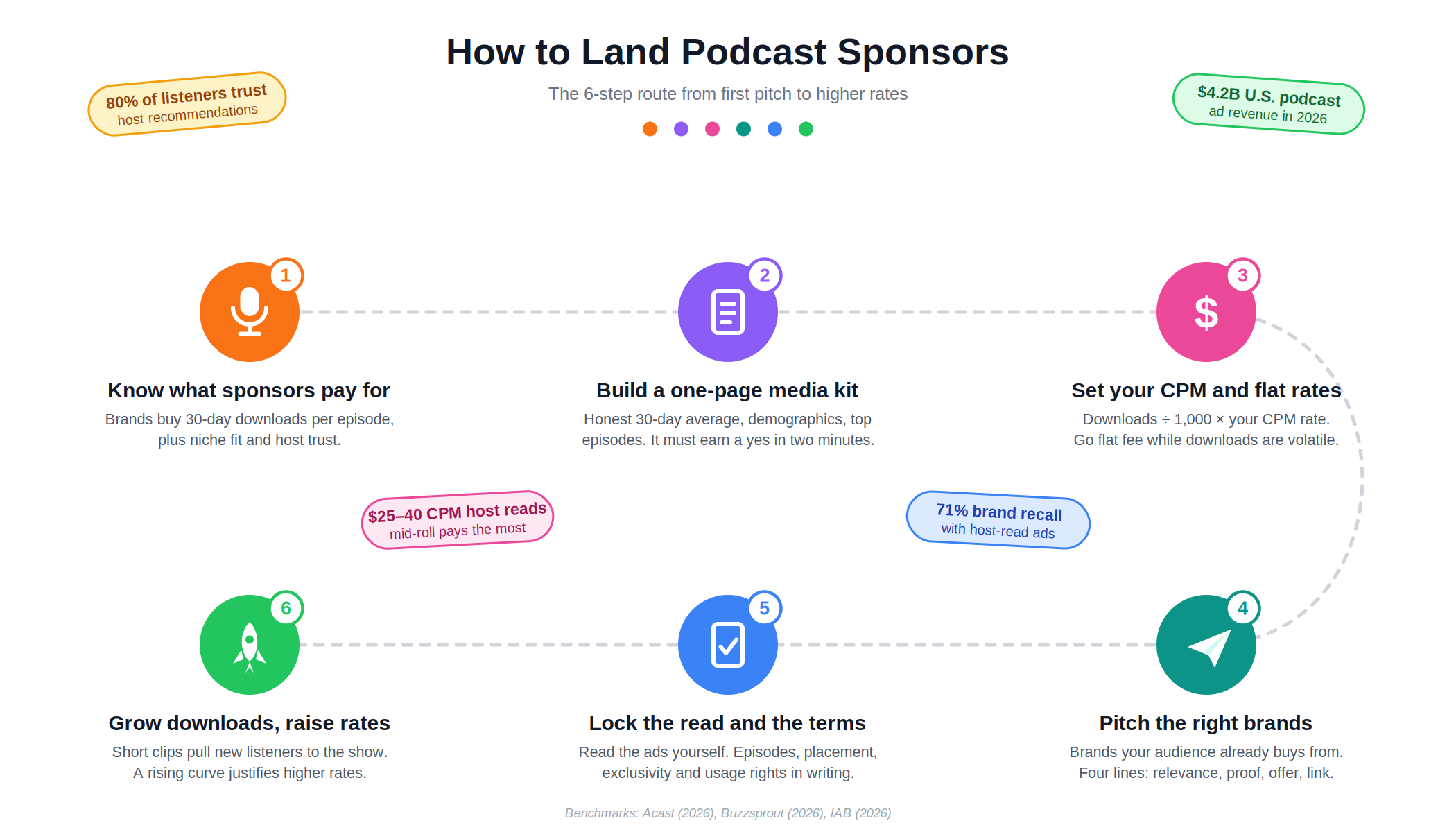
6 steps to land podcast sponsor. Image generated using Claude.ai.
FAQ
How many downloads do I need before I can get sponsors?
Most advertisers want around 5,000 downloads per episode in the first 30 days for a standard CPM deal, per The Podcast Host benchmarks. Below that you can still land micro sponsorships and affiliate deals with direct pitches, especially in the 200 to 1,000 download range where niche fit matters more than volume.
What is a good CPM rate for a small podcast?
For 2026, host read sponsorships run 25 to 40 dollars CPM and pre recorded ads run 15 to 30 dollars CPM (Acast, 2026). Small shows in high value niches like business or finance can command 40 dollars CPM and up, because advertisers pay more to reach decision makers.
How do I make a media kit if I have no sponsor history?
Replace past brand results with proof of engagement: listener reply screenshots, reviews, and a one sentence niche statement. Add a sample ad read script written for a specific brand so the buyer hears how their product would sound in your voice. Lead with your honest 30 day download average.
Should I charge a flat fee or a CPM rate?
Use CPM when your download numbers are stable and provable, since it lets sponsors compare you to market rates. Switch to a flat fee when your downloads are still volatile, because it prices your audience quality instead of raw volume and protects your pay from a soft episode.
How do I find brands that fit my podcast audience?
List the products your listeners already buy, use, or ask you about, then find the partnerships or marketing contact directly rather than a generic inbox. Pitch a relevance line, one proof point, a clear offer, and a booking link. Never pitch a brand whose product you have not personally used, because the host read will sound hollow.
Related Articles
- Faceless Reels: 7 Methods to Create Viral Content Without Showing Your Face
- MP3 vs MP4 in 2026: Which Content Format Works Better
- How to Come Up With YouTube Video Ideas: 6-Step System
How to monetize a podcast with sponsors: media kit, CPM rates, and audience growth