How to Come Up With YouTube Video Ideas: 6-Step System
A 6-step system to find, validate, and multiply YouTube video ideas that actually get views. Mine trends, close competitor gaps, validate before you film.

Article Highlights
- 6-step system to never run out of ideas
- Mine YouTube autocomplete and Google Trends
- Find competitor gaps via comment mining
- Validate every idea before you film it
- Multiply one idea into 5 video formats
- Argil removes the production bottleneck
How to Come Up With YouTube Video Ideas: 6-Step System
Most YouTube advice assumes you already know what to make and jumps to picking a niche, filming consistently, and optimizing thumbnails. The hard part sits upstream of all of that. Coming up with YouTube video ideas that have search demand, beat competition, and justify production cost is a research problem in creative clothing. This article is the process creators use to generate validated ideas week after week.
The system is 6 steps. Steps 1 to 3 find ideas. Step 4 validates them. Step 5 multiplies them across formats. Step 6 removes the production bottleneck that turns a great idea bank into a graveyard of unshot videos. If you want a pre-built list instead of a system, our AI influencer generator breakdown covers tools that expand what a solo creator can produce.
Introduction: Why Most Creators Run Out of YouTube Video Ideas
Most creators recognize the loop: opening a blank notes app, uploading inconsistently, publishing videos that go nowhere. The instinct is to label that a creativity problem, but it is closer to a research and validation gap dressed up as a blank page. Retention benchmarks from industry researchers show the average YouTube video retains only 23.7 percent of its viewers, so standing out is less about being original and more about being specific enough to own a question no one else has answered well.

Most creators know the cycle: blank notes, inconsistent posting, videos that go nowhere. It’s not a creativity problem—it’s usually a research and validation gap in disguise.
The rest of this article is a repeatable 6-step system, from topic research to production. Work through it in order once. Repeat steps 1 to 4 weekly after that.
Step 1: Trending Topics in Your Niche
Trending topics compound. Riding existing search momentum means the algorithm already knows the category and the audience is already looking, so you are positioning in front of demand instead of building it from scratch. A topic that already has search volume is easier to rank for than one you are trying to invent.
Four specific mining methods give you most of what you need:
- YouTube autocomplete. Type your niche keyword and capture every suggestion. These are real queries real people are typing.
- YouTube's Trending tab filtered by category. Sort by the niche closest to yours and note the formats hitting the top in the past week.
- Google Trends. Compare 2 to 3 related topics and check whether interest is rising, flat, or falling. A rising topic is an opportunity. A falling one is a trap.
- Reddit and Quora. Search the same keyword in niche subreddits and track which questions are getting 50+ upvotes or long comment threads. Those are validated topics with zero existing YouTube coverage most of the time.
A practical example: a personal finance channel types "how to save money" and captures every autocomplete variation. "How to save money fast." "How to save money on groceries." "How to save money with a low income." Each is a candidate video. A 10-minute exercise produces 15 to 20 ideas with built-in search demand.
Avoid chasing trends that already peaked 6 months ago. Pull every candidate topic up in Google Trends on a 12-month view first; topics already at the top of their curve are saturated, while topics still in the rising phase are the sweet spot. An overview of the 5 best AI avatar generators covers tools creators are using once they have topic momentum and need to publish at volume.
Using YouTube Search Suggest as a Free Keyword Tool
Exact process: incognito window (removes personalization), type your seed keyword, pause after each word to capture suggestions, repeat with modifiers "how," "why," "what," "best." Incognito reflects general search behavior, which is what you want.
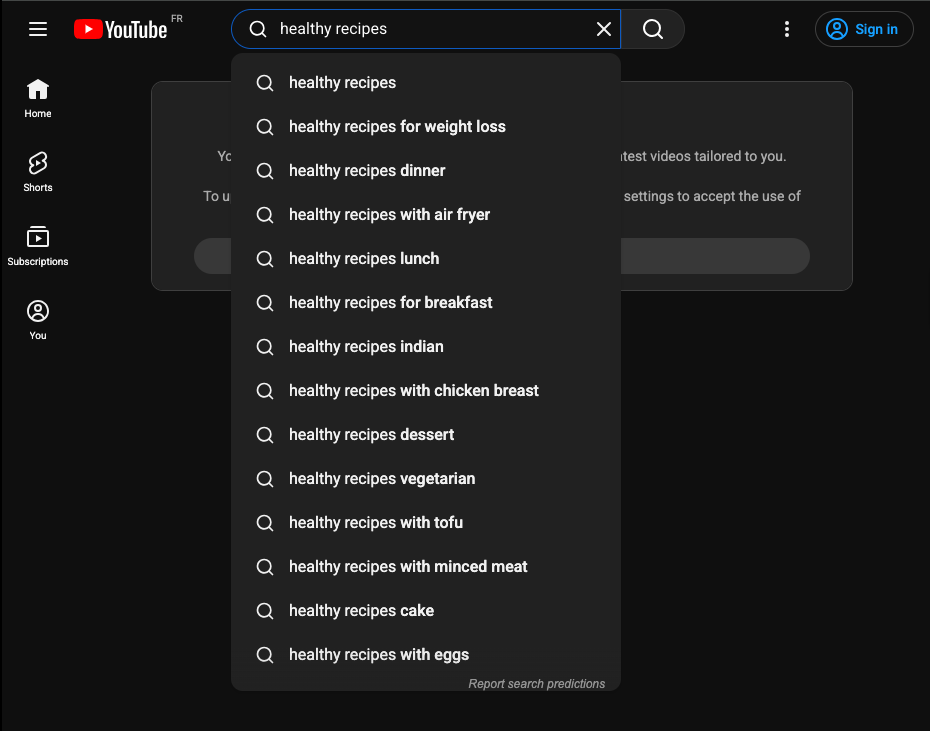
YouTube search suggestions can be a great way to come up with your next content idea.
Also search that keyword on YouTube's Videos tab filtered to the past month. The videos getting views right now tell you what the algorithm is currently rewarding in your niche. If results skew heavily to Shorts, short-form is winning that query; if they skew to 15+ minute uploads, watch-time is winning it. That is actionable signal without pulling a trends report.
Tools That Surface Trends Before They Peak
Two low-cost options handle this well. vidIQ's Max plan at $39/mo (billed annually) includes trend alerts and scores topics on search volume vs competition. TubeBuddy is the other standard pick; its keyword explorer shows weighted monthly search and competition scores in similar format. Either one cuts hours off weekly research.
Free alternative for audience research: SparkToro has a free tier with 5 audience reports per month, showing what your target audience reads and talks about across the web. Useful for finding the exact language your audience uses, which feeds into title and hook writing.
Step 2: Find Competitor Gaps and Weak Spots
A high-view video on a weak channel is an invitation. Demand exists but the execution is thin, and the job is to find those videos and cover the same topic with more depth, more specificity, or from an angle the original missed entirely.
Process: identify 5 to 8 channels in your niche with similar subscriber counts and sort each one by "Most Popular." The videos that massively outperform channel average are the breakout topics worth your attention. For each one, ask whether the topic is still relevant today and what would make a better version for the same search query.
Look for the angle gap, not just the topic gap. If competitors all cover "how to invest $1000" as a list piece ("5 ways to invest $1000"), the angle gap might be a story version: "I invested $1000 6 months ago, what happened." The search base is the same, the hook is different, and the upload is still fresh. Background on the digital creator model has more on why execution beats topic choice once the category is set.
Social Blade is useful for timing. If a topic drove a subscriber spike on another channel, it is likely to do the same for yours, especially if you post your version inside the same 2 to 4 week window so you catch the same search spike.
The Comment Mining Method
Comment sections are the most underused idea source on YouTube. Follow-up questions, specific situations the original ignored, and complaints about what the video missed all signal the same thing: demand exists but the existing result did not fully solve the viewer's problem.
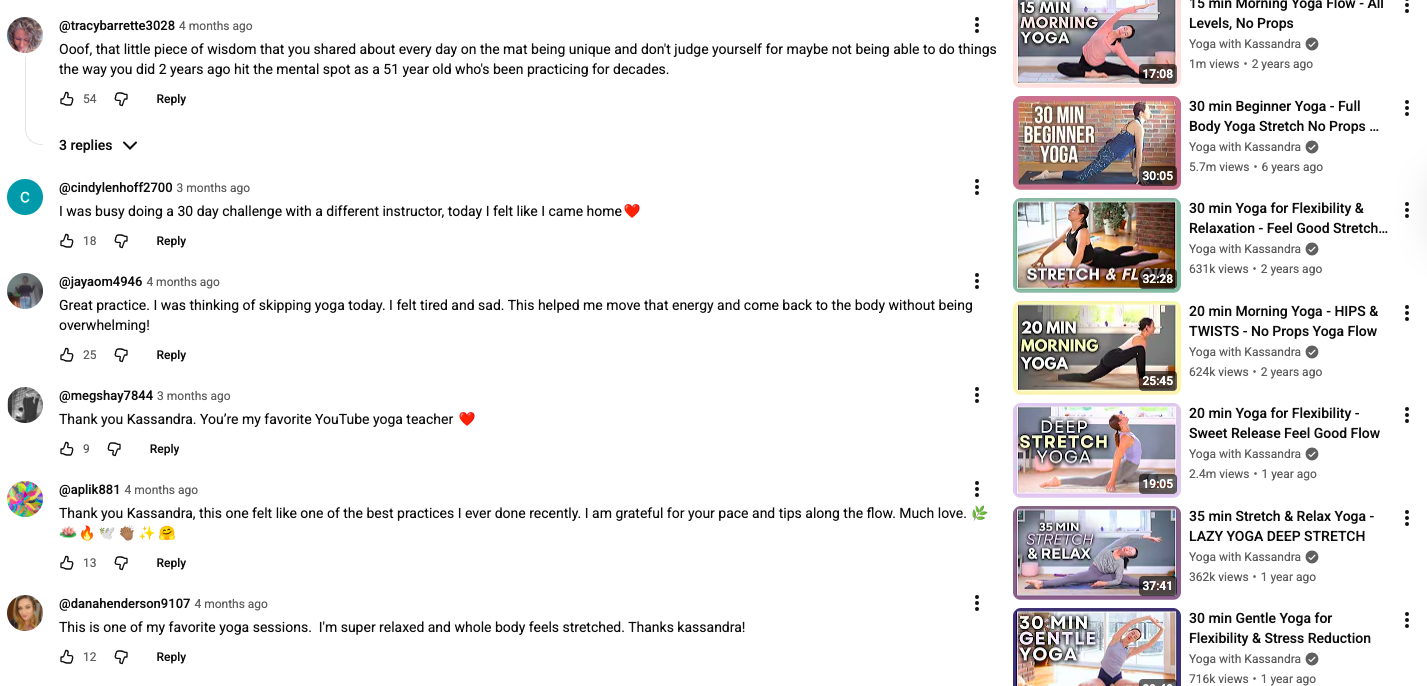
The YouTube comment section can be an absolute gold mine for fresh content.
Process: go to the top 3 videos on your target topic, filter comments by "Top," and any comment with 50+ likes that asks a question is a validated next video idea. "Great video but what about X" with 200 likes means a real audience wants the X video and the top existing result did not cover it. Mining 3 top videos usually produces 5 to 10 ideas in an hour.
Step 3: Use AI Tools to Generate Ideas at Scale
AI is a brainstorming multiplier on top of the research in steps 1 and 2, not a substitute for it. Feed it the keywords you pulled from autocomplete plus the competitor topics and comment questions you mined, and it will generate variations at roughly 10x the manual speed. Without real inputs, you get the same generic list every other creator gets from a cold prompt.
A specific prompt framework for ChatGPT or Claude:
"I make YouTube videos about [niche]. My target viewer is [age, goal, pain, experience level]. Here are 5 topics that perform well in my niche: [list from step 1]. Here are 3 questions my audience is asking in competitor comments: [list from step 2]. Generate 20 video title ideas from different angles, each with a specific hook and a sentence on why it would work for my audience."
Generic inputs produce generic ideas. Data-fed inputs produce ideas that do not appear on any other creator's list.
Use AI for title testing before filming. Generate 5 variations, paste them into PickFu (pay-as-you-go starts at $1 per response) or post a community tab poll, pick the winner. A/B testing titles before production costs almost nothing and prevents filming a great video under a weak title.
Prompt Templates That Produce Usable Ideas
Three ready-to-use templates:
- The Gap Filler. Takes a competitor topic and generates 10 underserved angles. Prompt: "Top competitor video: [title, view count]. Generate 10 video angles competing for the same search term from a different point of view."
- The Audience Segment. Takes one topic and splits it across 5 viewer personas: beginner, advanced, broke, time-constrained, skeptical. One idea becomes 5 videos.
- The Format Shift. Takes a topic proven in tutorial format and generates 4 variants: story, myth-bust, ranking, documentary.
Gap Filler example: input "Top competitor: '30-minute full body workout,' 2M views." Output: "30-minute workout for people with a bad back." "30-minute workout for parents training before 6am." "30-minute workout in a hotel room, zero equipment." Same search base, specific sub-audience the original did not speak to.
Step 4: Validate Your Best Ideas Before You Film
Producing a YouTube video is expensive: even a lean workflow runs 6 to 10 hours per upload, and filming before validating is the biggest source of wasted production time on this platform. The 3 fast checks below take 30 minutes combined and dramatically improve your hit rate.
Check 1, search volume. Paste your title into vidIQ or TubeBuddy. A new channel should be looking for 1,000+ monthly searches; a growing channel should target 10,000+. Anything under 500 is a passion project rather than a growth video.
Check 2, competition audit. Search your title on YouTube and look at who owns the top 3 results. Channels with 1M+ subscribers in those slots usually mean ranking is unlikely without an existing audience of your own. Smaller channels in those slots means the category is catchable, and weak views relative to subscriber count means the existing content is not satisfying intent, so there is real room for a better answer.
Check 3, seasonal timing. Run the topic in Google Trends, 5-year view. Some topics spike annually (tax season, back to school, holidays). If you are 2 months ahead of the spike, you have filming time. Behind the peak, hold for next year. Timing a seasonal topic correctly can double its view count.
Decision framework: 2 out of 3 checks passing is the green light to produce. If all 3 fail, file the idea and move on. Speed beats perfectionism here, because the goal is a validated backlog of 20+ ideas so you always have the next upload ready without going back to research mode.
Building a Validated Idea Backlog
Run this weekly and you build a compounding asset. A simple Notion table works fine, tracking each idea across topic, search volume, competition, seasonal timing, and a status column moving from idea to validated to scripted to filmed. Run the 3 checks on every idea before it moves to "validated" and only produce from validated.
Set a weekly rhythm. 45 minutes every Monday on mining and validation, and 5 to 10 new ideas added each week. Once the backlog is full, the consistency problem mostly solves itself, because the next upload becomes whichever validated idea ranks highest rather than whichever video happens to be done.
Step 5: Turn One Idea into Multiple Videos Across Formats
The efficiency insight most creators miss: one validated idea can generate 3 to 5 distinct videos by changing format while keeping the topic fixed. That multiplies output without multiplying research time and lets you test which format resonates most with your audience for that category.
The 5 format variations to apply to any single idea:
- Tutorial. Step-by-step how-to.
- Story/Experiment. "I tried this for 30 days."
- Myth-bust. "Everyone is wrong about X."
- Beginner explainer. "X explained in 5 minutes."
- Advanced take. "X for people who already know the basics."
One topic produces 5 videos with a fraction of the script work, because the research only happens once. The viewer discovery surface quintuples too, since each format reaches a different audience through different algorithm signals.

One good idea can become 3 to 5 videos by changing the format. More output, less research, and a faster way to see what your audience likes.
Short-form to long-form is the other lever. Publish a 60-second Short on the topic first, and if it gets traction, make the full-length version. The Short ends up acting as free market research: when it does not land, you saved yourself a full production cycle.
Batching compounds. Once 5 validated ideas share the same format, script and film them in one session. Same mental mode, same setup, 30 to 40 percent less time per video.
The Short-to-Long Content Ladder
Shorts (under 60 sec) test the hook. Mid-length (5 to 8 min) delivers core value. Long-form (15 to 20+ min) captures search and builds watch-time credit. One core idea lives at all 3 levels. Creators who publish at only one leave the others empty. How to make faceless Reels and Shorts covers the faceless variant.
Step 6: Test More Ideas Faster with AI Video Creation
Production is the real reason creators do not test more ideas. When a single video eats a full day, you cannot afford to bet on uncertain ideas; when one takes an hour, you can. Cutting production time is the mechanism that lets the rest of this system compound.
Argil removes that bottleneck. You upload a 2-minute reference video, the platform builds an AI video clone, and from there you write scripts while Argil generates fully-edited short-form videos in your voice and likeness. A creator with a 10-idea backlog can test all 10 in a week instead of 10 weeks, which is roughly 10x more data on what resonates, which titles convert, and which hooks hold past the 15-second mark.
The compounding effect is the piece most creators miss. Testing more ideas surfaces winners faster, and those winners get pushed harder with stronger thumbnails, Shorts repurposing, and follow-up videos that build on what worked. A channel testing 10 ideas a week instead of 2 typically lands roughly 5x the subscriber growth over 6 to 12 months. This look at UGC video production tools covers the production side of the same workflow.
Practical workflow: validate 5 ideas using steps 1 to 4, write 5 short scripts at 300 to 500 words each, drop them into Argil, publish across 2 weeks, and review analytics at day 14. Double down on the top 2 ideas with long-form versions, drop the bottom 2, and iterate on the middle one. Run that loop monthly so the research system keeps feeding ideas in while Argil moves them out the door without the production tax.
Common Mistakes That Kill Good Video Ideas
5 common mistakes, each with the fix:
- Picking too-broad topics. "How to lose weight" vs "how to lose weight after 40 with no gym." Fix: always attach a qualifier (audience, constraint, timeframe, context).
- Optimizing for your interests, not your audience's search behavior. Fix: run every idea through the 3-check validation before committing.
- Ignoring the thumbnail and title pairing. A great topic with a weak title underperforms regardless of rank. Fix: design thumbnail and title during idea validation, not after filming.
- Only creating evergreen or only trending. Evergreen compounds over 12+ months, trending gives subscriber spikes. Fix: 70/30 split evergreen to trending.
- Waiting until an idea is "good enough." The algorithm rewards consistency, not perfection. Fix: apply the 2-out-of-3 rule and produce. Feedback from published videos is worth more than the polish on ideas in your notes.
FAQ
How do you come up with YouTube video ideas consistently?
Run a 45-minute weekly research ritual: YouTube autocomplete mining, Google Trends checks, competitor comment scanning. Add 5 to 10 validated ideas to a running backlog each week. Consistency stops being a willpower problem and becomes a scheduled research system. The backlog stays ahead of your publishing cadence.
What are the best YouTube video ideas for a new channel?
Focus on low-competition, specific topics. The strongest options are niche autocomplete searches, keywords where the top results sit on small or mid-sized channels, and story or experiment formats that build personality alongside content. Specificity beats volume for the first 1,000 subscribers.
How do I know if a YouTube video idea will get views?
Run the 3-check validation: search volume (1,000+ monthly for a new channel), competition (top results from small or mid channels), seasonal timing (rising or stable in Google Trends). Two out of three passing is the threshold. No system predicts views perfectly, but this one consistently beats instinct-only selection.
Can AI generate good YouTube video ideas?
AI is a multiplier on validated ideas, not cold ideation. Feed it real data: trending keywords, competitor topics, comment questions. It produces 20 angles in 2 minutes. Without real inputs, it produces the same generic list every creator gets. Output quality depends almost entirely on input quality.
How many video ideas should I have before starting a channel?
At least 20 validated ideas. That is a 10-week runway at 2 videos per week without going back to research mode. Launching with a thin backlog is the single biggest predictor of a channel going dormant within 90 days.
What types of YouTube videos get the most views?
Tutorials and how-tos do well because intent is high and retention holds, but the formats that consistently pull views also include personal experiments ("I did X for 30 days"), listicles with specific numbers in the title, myth-busting content, and reaction or commentary that attaches real domain expertise. The constant across all of them is specificity in the title and a clear payoff promised in the thumbnail.
Related Articles
- How to lip sync a video with AI in 2026, step-by-step guide
- What is B-roll, the complete guide for video creators in 2026
- What is aspect ratio and which ones are best for vertical and horizontal video
A 6-step system to generate YouTube video ideas with validated search demand, then test them fast with AI video production.