AI Filmmaking: What It Is and How It Actually Works
AI filmmaking is directing, not prompting. What it is, how an AI film gets made shot by shot, and the three consistency problems nobody writes about.
Article Highlights
- AI filmmaking is directing, not prompt-to-video
- A film is a thousand decisions the machine cannot make
- Kling caps a shot at 15 seconds; a minute needs 8-15
- AI filmmaking's hard part is consistency across shots
- Reference images beat re-describing a character
- Argil keeps cast, sets and look on record, Pro from $50/mo
AI Filmmaking: What It Is and How It Actually Works
AI filmmaking is the practice of directing a film that a machine produces. A person decides the world, the characters, the shot order and the cut. The software renders, animates, lights and edits. The storyboard sits at the center, and a one minute film runs to 8 to 15 separate shots, each approved before anything gets rendered.
What is AI filmmaking?
AI filmmaking is a production craft, and the definition worth having is built out of the decisions rather than out of what the software does. Argil's thesis essay, written by Brivael Le Pogam and published on September 23, 2026, states it as "The human is the director. AI is the crew." A film, the essay argues, is "a thousand decisions: what the world looks like, who the characters are, where the camera goes, what to cut, what to leave unsaid. Those decisions are the work."
Most published definitions describe the other half. invideo's step-by-step workflow on the same term opens by saying AI filmmaking "uses artificial intelligence to help develop scripts, create visual references," then carries on through generating footage and editing. Each of those is something the software does. None of it is a decision, and a film is nothing but decisions.
Two directors can run the identical model on the identical script and come back with films that are not comparable, because one held on a face for four seconds and the other cut away. Nothing in the model made that call.
The practical order is fixed before anything renders: the world and the cast first, then the shots, then approval on each one. Argil's thesis draws the same line on the writing side. "AI will not tell your story for you."
AI filmmaking versus prompt-to-video
Prompt-to-video is one step. A sentence goes in, one take comes out, and that take carries no shot order and no cut. AI filmmaking is the opposite shape: a storyboard of separate shots, each one approved before it renders, with a director deciding the cut between them.
OpenAI's Sora video generation guide states that sora-2 and sora-2-pro "support 16- and 20-second generations," and that a finished clip can then be extended, where "each extension can add up to 20 seconds" and "a single video can be extended up to six times, for a maximum total length of 120 seconds." Argil's thesis describes the same arrangement from the other end, calling a film that arrives from one typed sentence "a slot machine, not an art."
Argil's thesis essay puts the commercial consequence in one line, "When execution becomes abundant, judgment becomes scarce." The movie generator category sells one input and a finished output. Reaching OpenAI's 120 second ceiling takes six extension calls and six separate prompts describing how the scene continues.
How an AI film actually gets made
AI filmmaking runs in four stages, in this order. Argil's live homepage names the same sequence as Brief, Board, Shoot, Edit, and the thesis spells it out as "Idea, storyboard, iteration, film: a process where you make the choices and the machine does the labor."
1. Start with the idea
Argil's worked example on its homepage is a 30 second animated film called A Name for the Future. The brief is one sentence about a traveler who arrives in New York in 1901 with a small working motor and a message for Nikola Tesla.
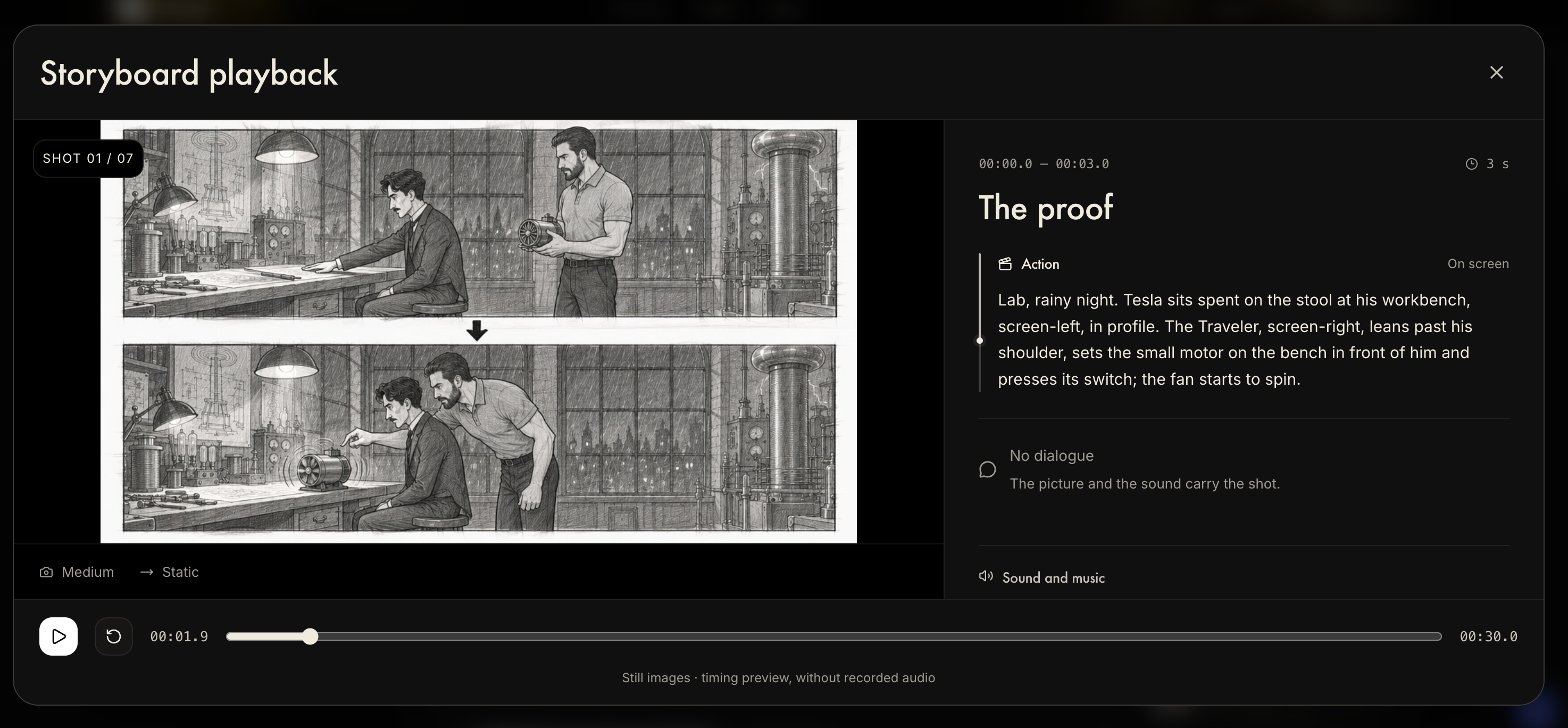
From that sentence the example fixes the cast as Briva, Nikola Tesla and Elon, the visual style as "Ink & brass", the format at 16:9, the resolution at 1080p and the duration at 30 seconds, all before a frame exists. If you are starting from a written script instead, our guide on whether AI can write a movie script from an idea covers the handoff.
2. Break the idea into shots
Count the shots before generating anything. A schedule and a credit budget both run on shot count.
Kling's short film guide puts a minute at "roughly 8 to 15 shots," which works out to roughly 4 to 7.5 seconds of footage each. Argil's 30 second example is 7 shots, about 4.3 seconds each, at the fast-cutting end of Kling's range. A three minute film is therefore 30 to 45 separate decisions about framing, action and camera, each of which can come back wrong and need doing again.
Our idea to script to video workflow guide walks the same breakdown shot by shot, numbering each one with its purpose, framing, action and camera move.
3. Iterate on the board
A storyboard panel can be redrawn for nothing. A re-rendered sequence spends credits again, which is why the Board stage sits between the Brief and the Shoot in Argil's sequence. Catching a bad composition, a wrong camera angle or a miscast character on the board, before it renders, is the whole point of the stage.
Argil's pricing FAQ states that credits are spent on generation and that how many depends on the model and on what you are generating. On the Pro plan, which starts at $50 per month, that makes a long project a monthly allowance rather than a balance you draw down. The FAQ is explicit about the ones you do not spend. "Plan credits refresh each month and do not stack. If you need more, you can buy extra pay-as-you-go credits in your workspace. Those extra credits do not expire."
4. Shoot it, then cut it
The approved board renders into shots, and those shots still have to be assembled in order.
Runway's resource on multi-shot AI video is direct about the method. It tells you to describe "one shot at a time rather than asking for the whole sequence in a single prompt," because a long prompt asking for several shots overloads the model and the subject, the location or the tone shifts between them. It also recommends carrying the last frame of one shot into the next.

In Argil's four stage sequence this is the Edit stage. A close-up that looked strong on its own can break the scene it sits inside. The connective material that holds a sequence together rarely appears on the board at all. That is what b-roll has always been for.
What is hard about AI filmmaking right now
Consistency in AI filmmaking is three separate problems that get discussed as one. Runway and Kling both document drift between adjacent shots. Session memory, whether a tool still knows your characters tomorrow, and the gap between one generation and a finished sequence are the two no vendor documentation covers.
Characters and locations drift between shots
Model vendors Runway and Kling both document a fix for character and location drift. Runway's instruction is to "use a reference image for the character and feed it into every relevant shot," and to "establish one reference image for the location and reuse it across every shot in the sequence." Kling says the same thing about faces, noting that reusing a reference image is "far more reliable than re-describing the same person each time."
Re-describing a character in prose on every generation produces the drift Runway and Kling both warn about, because each prose description is a fresh instruction that drops the previous shot's result. One approved reference image per character and per location removes that failure mode. Image-to-video tools that start from a fixed reference frame carry the same pixels into the next shot; a text prompt carries only a new description each time.
The tool forgets between sessions
Finish for the day, come back tomorrow, and most tools have no idea who your characters were. The Runway and Kling guidance both stop at drift between adjacent shots, and neither one says what happens once a session closes.
Argil's homepage names it in four words. "Models forget. Agents start from zero." Its answer is to hold the production rather than the conversation, keeping the cast, the sets, the board and the timeline in one place the page sums up as "every department of a studio. One system." Argil's own terms of service hedge on exactly this point. User Avatars "may present anomalies and malfunctions" and are not guaranteed to be "a perfect representation" of anyone, which is the same consistency problem stated as a legal disclaimer instead of a feature.
Run that test yourself before you pay for Argil, Runway, Kling or any other AI filmmaking tool. Generate a character, close the session, come back the next day, and put that same character in a new scene. No vendor, Argil included, has published the result of that test. The terms-of-service disclaimer above is the most anyone has said about it on the record.
OpenAI's Sora documentation states the limit plainly. "Extensions currently accept only a source video and prompt. They don't support characters or image references." Extensions are the only route past a single 20 second generation, and the same page caps one video at two characters.
How many generations a one minute film takes
Kling publishes a ceiling of "up to 15 seconds per shot" alongside its guidance of 8 to 15 shots a minute. No published ceiling turns a one minute film into a single generation. Argil's 30 second worked example is seven separate ones.
Argil names Seedance for video and Nano Banana for image on its homepage, and both are components the board calls rather than choices made once for a whole film. Kling is also candid that "consistency has limits, so many shorts lean on mood, place and objects."
Argil's homepage lists Grok, Claude and ChatGPT under a "Your agents" heading and marks that integration "Soon," meaning Argil does not yet let an outside AI agent operate the board on a director's behalf.
Who AI filmmaking is for, and what it costs
Argil draws the scope broadly. The thesis sets the mission as giving "anyone the power to make films, series and animation, with the human in the director's chair." In practice the work starts when a story needs more than one shot.
Argil's self-serve Pro plan starts at $50 per month. Studio, labeled "Done with you," is $1,250 per month. Enterprise starts at $2,500 per month. Treat Pro as a floor, since credits are consumed by generation and vary by model and output.
The Animation Guild publishes the CVL Economics study it commissioned, which surveyed 300 entertainment executives and managers between November 17 and December 22, 2023. It found that about 21.4% of US film, television and animation jobs, roughly 118,500 of them, were likely to be consolidated, replaced or eliminated by 2026. That forecast was made at the end of 2023 and the year it pointed at, 2026, is the current one. Three-quarters of those executives said generative AI had already supported eliminating, reducing or consolidating jobs in their own division.
Cartoon Brew's analysis of the same CVL Economics study reports that 38% of respondents said their firms would use generative AI for 2D concept art and storyboards. A separate question in the same study found only 15% expected storyboard artists, animators and illustrators to face displacement by 2026. The two numbers answer different questions, which tasks get automated and whose job that threatens, and the study never claims they agree.
Enterprise pricing starts at $2,500 a month, the top of Argil's three published tiers.
Frequently asked questions
How do I make an AI film from a script?
Break the script into numbered shots first, recording for each one its purpose, framing, action and camera movement. Runway's guidance is to describe one shot at a time rather than asking for the whole sequence in one prompt, and to fix a reference image for every character and location before generating. Argil's 30 second example on its homepage is a 7 shot board, so a 90 second script plans at roughly 20 shots. Generating the whole script in one pass is what produces drift.
Can one person make a short film with AI?
Yes. A one minute film is roughly 8 to 15 shots by Kling's estimate, so a solo director is making between 8 and 15 sets of framing and camera calls, plus the cut. The software handles the labor that used to need a crew.
Is AI filmmaking the same as typing a prompt and getting a video?
No. A prompt returns a single take, which has no shot order and no cut. AI filmmaking runs idea, storyboard, iteration, film, with a human approving the board before anything renders. Argil's thesis calls the prompt-and-receive version "a slot machine, not an art."
How much does AI filmmaking cost?
Argil's Pro plan starts at $50 per month, Studio is $1,250 per month, and Enterprise starts at $2,500 per month. Costs scale with generation, so the real driver is shot count and not runtime. Credits refresh monthly and do not carry over, which makes a multi-shot series a recurring cost.
Direct your first one
Pick one story that needs more than one shot and break it into a numbered board before you generate a frame. You can start with Argil and keep the cast, the sets and the look on record from the first session, which is the part that makes episode two possible.
Related Articles
- What's the best AI video generator for commercial use in 2026
- Framing and head position setup for video shots
- How to make AI history content that goes viral