Brand Storytelling Video: How to Plan One People Actually Remember
A brand storytelling video needs a real protagonist and a problem before the product. Here is how to structure one as a series people actually follow.
Article Highlights
- The video that gets remembered has a person and a problem, not just a product
- A short series beats one hero film for building a returning audience
- Keep the same host across every episode of the story
- Most demand for this topic is global, not US, so write and film for that reader
- Structure: origin, a hard decision, a customer win, what comes next
- An AI clone makes a consistent presenter realistic without a new shoot each time
A brand storytelling video turns your company's origin, a hard decision, or a customer's result into a short film that makes people care before they buy. The highest-performing brand stories right now are told as a short series with one consistent host, not as a single polished ad.
What Makes a Brand Storytelling Video Work
Every brand storytelling video that holds attention shares the same 3 things, and most company videos are missing at least one.
- A real protagonist. A founder, an early employee, or a customer, not a voiceover talking about "our mission."
- A problem before the product. The viewer needs to feel the stakes before they see the solution, or the video reads as an ad.
- One clear takeaway. Not 5. A viewer who can't repeat your point 10 seconds after the video ends won't repeat it to anyone else either.
Most guides on this topic, including the 2 most-cited company-story guides from Clipchamp and Mark Campbell Productions (sources below), stop here: pick a protagonist, structure a classic story arc, keep it under 2 minutes. That advice is correct and also incomplete, because it treats the brand story as one video instead of a format you can run on repeat.
Step 1: Define the One Thing You Want Remembered
Before any script, write down the single sentence you want a stranger to repeat about your company after watching. Not a feature, not a tagline. A real claim a human would say out loud: "They almost shut down before this worked," or "The founder built the first version for her own problem."
If you can't write that sentence in under 15 words, you don't have a story yet. You have a list of things that are true about your company, which is a different video and a worse one.
A useful test: read your one sentence out loud to someone outside the company with no context. If their response is a question, "wait, what happened?", you have a story. If they just nod along, you have a fact, and facts belong on a product page, not in a brand video.
Step 2: Structure It as a Series, Not a One-Off
This is the part the generic guides skip, and it's the highest-leverage change you can make to a brand storytelling video plan.
A single 90-second hero film gets watched once, maybe shared once, and then it's done. There's no reason to come back to it. A short series built around the same company story, cut into 3 to 6 episodes instead of one, gives a viewer a reason to follow instead of just watch: origin story, a hard decision that could have ended the company, a specific customer's result, and where the company is headed next.
The 2 pages that currently rank and get cited most for this topic, Clipchamp's and Mark Campbell's, both stop at "make one good video." Neither names the series structure as the actual lever, which is the gap this format closes. A viewer who watches episode one of your founder's story and sees "part 2" is a different kind of lead than someone who watched a single ad once and moved on, for the same reason a TV show builds a bigger audience over a season than a single film does over one night.
Step 3: Keep the Same Host Across Every Episode
A series only reads as a series if the same person shows up every time. Switching narrators between episodes, or alternating between a founder video and a generic voiceover, breaks the one thing that made episode two worth watching. The viewer already knows this person from episode one, and a different face resets that trust back to zero.
This is also the step most companies fail at without ever noticing, not because they don't understand it, but because re-booking the same founder or employee for a 4th and 5th shoot gets harder every time their calendar fills up. An AI clone turns the founder into a recurring presenter instead of a one-time booking: once the clone exists, a weekly format can run again without rebuilding it or re-recording the founder from scratch each time, so a busy week doesn't force a different presenter or a missed episode.
Step 4: Script for the Global Reader, Not the US One
Search demand for brand storytelling video runs roughly 10 times higher globally than it does in the US alone, which changes what belongs in the script. Skip US-specific idioms, regional pop-culture references, and examples that only land for an American audience. Anchor the story on a problem that reads the same in Lagos, Lisbon and Lahore: time, cost, or trust, not a culturally specific pain point.
This also affects casting and location choices if you're filming live. A story set in one country's specific business culture narrows who it lands for. A story about a universal operational problem, told by a consistent host, travels further.
Concretely: a founder story about "almost missing payroll before our first enterprise deal closed" works in nearly any market, because the fear of missing payroll is not a US-specific fear. A story that leans on a reference only an American viewer would get, a specific sitcom, a regional holiday, a local sports team, costs you the 10 global viewers to win one domestic one.
Step 5: Shoot, Edit and Publish on a Cadence
Once the structure and the host are locked, production is the part most teams already know how to do.
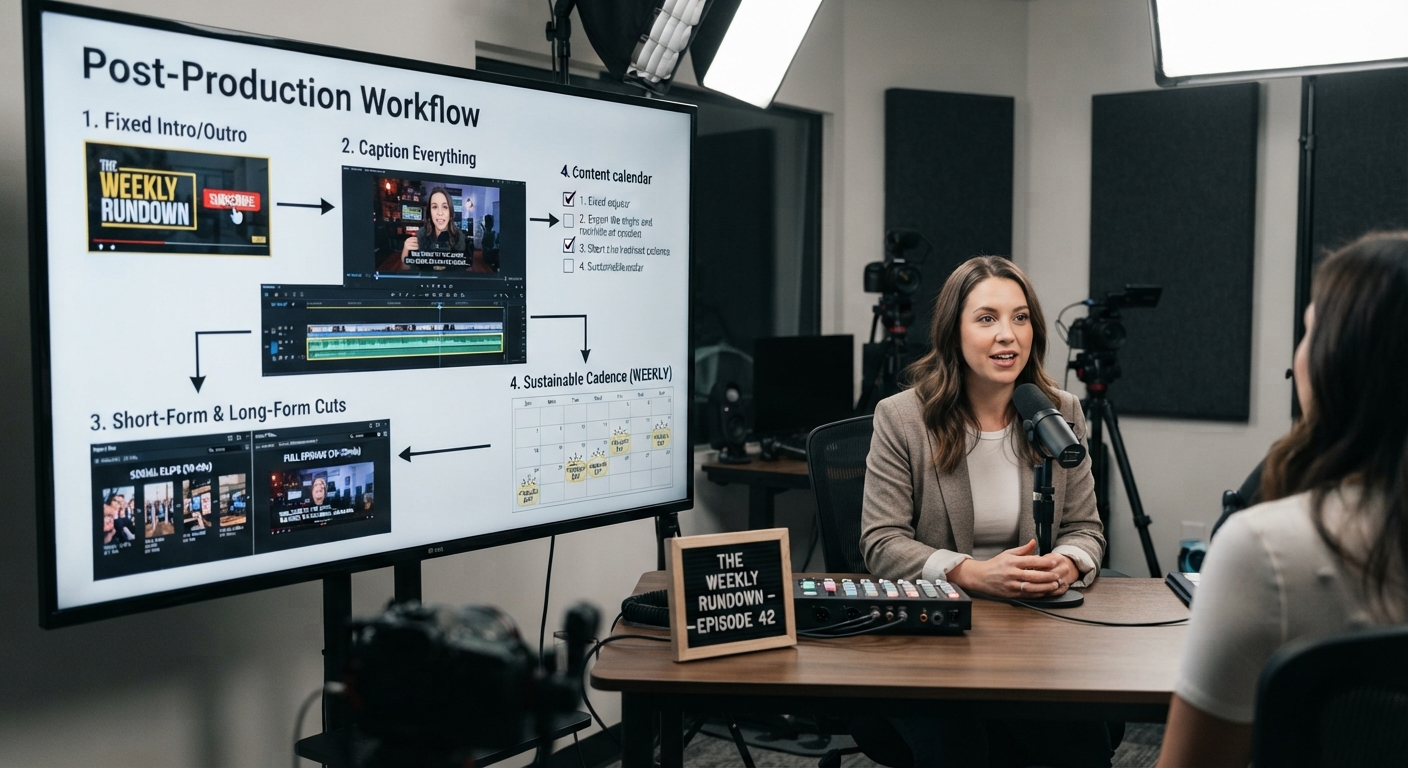
- Keep a fixed intro and outro across every episode so a returning viewer recognizes it instantly.
- Caption everything. Most of this content is watched muted on autoplay, especially on LinkedIn and Instagram.
- Cut a short-form version of each episode for social and a slightly longer cut for the website or YouTube.
- Publish on a cadence you can actually sustain. Weekly beats "whenever the next one is ready." An irregular series reads as abandoned faster than a late single video ever would.
Consistency of the visual identity matters here as much as the schedule. Building branding consistency through video without a high production budget covers the production side of this in more depth if the cadence is the part you're worried about.
Examples Worth Studying
Clipchamp's company-story guide and Mark Campbell Productions' brand video guide are both worth reading for the classic single-video structure: real people, a clear arc, under 2 minutes. Use them for the arc of episode one. Neither extends that arc into a series, which is the open space worth taking if you're planning more than one video.
For the audience-building side once the series is running, how to brand an avatar that actually builds an audience and the broader personal brand examples that actually drive business both cover what happens after episode one lands, not just how to make it.
FAQ
How long should a brand storytelling video be?
It depends on where it's published. A single social-first episode works best under 90 seconds. A pillar version for your website or YouTube can run 2 to 4 minutes. Longer than that, and you're better off cutting it into 2 episodes rather than one long one.
Does every brand need a storytelling video?
No. It works when there's a real founder story, a hard decision, or a specific customer result behind it. A straight feature list dressed up with music and a voiceover isn't a story, it's a product demo wearing a story's clothes, and viewers can tell the difference.
What's the difference between a brand story video and a product demo?
A brand story centers a person and a problem, with the product entering as the resolution. A product demo centers the product and its features from the first second. Both have a place, but they answer different questions and shouldn't be scripted the same way.
Should a brand storytelling video use one video or a series?
A series, if you have more than one real story to tell about the company (origin, a hard decision, a customer result, what's next). A single video is the right call only when there's genuinely one story and no plan to make more.
Related Articles
- How to Build an Audience on TikTok With a Minimal Budget
- Brand Storytelling: What It Is and How to Make It a Series
- Faceless Reels: 7 Methods for Viral Content (2026)
Brand storytelling video structure, the series approach most guides skip, and scripting for a global audience