Microdrama Marketing: What It Costs Brands and What Works
Microdrama is a vertical series told in 60 to 90 second episodes. What Crocs, P&G and Dr Pepper shipped, what a series costs, what brands get wrong.
Article Highlights
- Microdrama episodes run 60 to 90 seconds, shot vertical
- In-app micro-series revenue forecast at $7.8bn for 2026
- Crocs, P&G, Dr Pepper and Marc Jacobs all shipped series
- Most US microdramas cost $150,000 to $300,000 to produce
- SAG-AFTRA caps covered vertical budgets at $300,000
- Argil keeps characters and sets consistent across episodes
A microdrama is a scripted series told in vertical episodes of roughly 60 to 90 seconds, often dozens or hundreds of them, built to be watched on a phone and monetized by charging viewers to unlock the next episode. Brands now commission them as campaigns, and a US production typically runs $150,000 to $300,000.
What is a microdrama
Brands are copying a format that was built to be paid for by its own viewers. Drama apps give away the first few chapters and then charge to unlock the rest, sometimes as a micro-payment per episode, and Deloitte notes platforms experimenting with exactly that pricing. A drama app recoups its production budget from viewers, chapter by chapter. A 60-episode series pays for itself one unlock at a time. A brand's series never does.
A branded microdrama has no such revenue. Nobody is going to pay $0.40 to find out whether the couple gets together in a series about sneakers, so the production cost sits entirely on the marketing budget. The chapter count, the hook placement, and the willingness to run 50 episodes were all designed for a business model the brand version does not have. Every chapter a brand ships is a chapter a drama app would have charged a viewer to unlock.
Deloitte's 2026 TMT Predictions describes microdramas as series of potentially hundreds of 60 to 90 second serialized episodes, each one ending somewhere that makes stopping feel expensive. A short film resolves. A microdrama chapter does not, forty times in a row.
Microdrama is shot at 9:16, vertical, for a phone held upright, the same frame a video shot gets ranked on when it goes to Shorts instead of YouTube proper.
The vocabulary comes from China, where the format is called duanju. Deloitte cites Chinese media reporting roughly 662 million micro-drama users nationwide as of 2024. Nothing in the US or Europe is close to that yet.
The production mechanics, the chapter structure, and the platform rules sit in the companion piece on how vertical series get made. This article is about the money.
Why brands are spending on microdrama right now
Deloitte forecasts in-app revenue for micro-series content at US$3.8 billion for 2025, more than doubling to US$7.8 billion in 2026. The same Deloitte report expects the US share of global revenue to fall from half to 40%. Other markets are only now starting to monetize views they already have.
YouTube's own blog, posted September 23, 2026, reported that microdramas on the platform passed 6.5 billion views in the first half of 2026, with watch time growing more than 50% year over year and views of microdrama content on TV alone up more than 90%. YouTube's same September post announced Shorts Series. It groups Shorts into seasons and episodes, with custom thumbnails and sequential playback.
Before Shorts Series, a branded vertical series meant sending viewers off-platform to ReelShort or DramaBox, away from the pixel and the product page the brand actually wants them to reach. The episode plumbing now sits inside platforms where brands already hold accounts, already run pixels, and already know what a view costs them. What to shoot a series with is a different decision from where to publish it, and eight AI video generators built for commercial use are compared separately.
DramaBox was one of four companies in Disney's 2025 Accelerator class, announced July 28, 2025, and Disney's own newsroom describes it as a leading vertical microdrama platform and production company. The other three were Animaj, Haddy, and LIMINAL Space.
The six branded microdramas with published numbers
Crocs shipped twice in one year and changed route in between. "Charmed to Meet You" launched on ReelShort in February and Marketing Dive reported it drew nearly 10 million views plus a sequel. The audience was already on ReelShort, paying to watch vertical fiction, and it stayed there.
Crocs' second series went somewhere else entirely. "Déjà Shoe," seven parts, premiered on TikTok Shop in June with SuperOrdinary, developed and produced in under four weeks. On TikTok Shop, the traffic is Crocs' own, and so is the job of getting anyone to episode two, the same burden a dynamic ad creative carries to make its first frame earn the click.
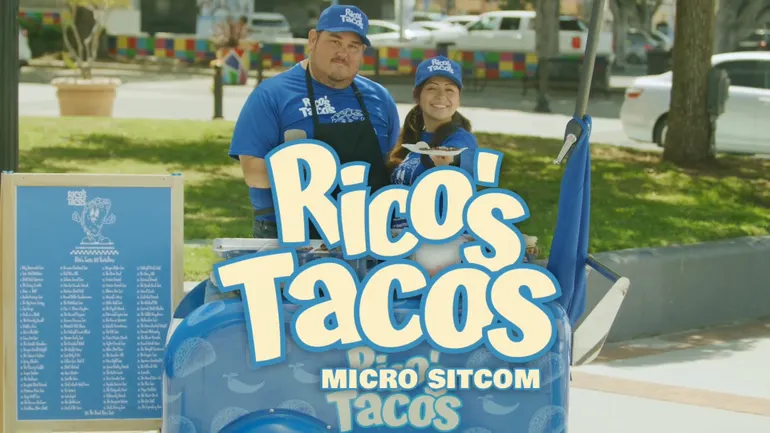
Procter & Gamble is running two shapes at once. "Rico's Tacos" plays across Albertsons' YouTube, social, and in-store screens. Separately its Native brand is making "The Golden Pear Affair," a 50-part series with Dentsu and Pixie USA, the longest episode count in this set outside the Gushers sponsorship.
JCPenney went with a five-part micronovela, "El amigo de mi novio es millonario," made with TelevisaUnivision. It drove over 16 million impressions and 5.6 million video views, the clearest published efficiency pair in the set. Five episodes, and both numbers are public.
Dr Pepper launched "It's a Pepper Fling" on May 15, 2026, four episodes dropping weekly on the brand's own TikTok account, created with Deutsch and produced by Omnicom Production. The series promoted the limited return of Creamy Coconut, a flavor that, per Marketing Dive's reporting, had already generated over 6.3 million social impressions and nearly 5,000 mentions since January, with 97% of the online conversation asking for it back.
Marc Jacobs took the luxury route with "The Scene," written by and starring Rachel Sennott, built around the Scene Bag from the pre-fall 2026 collection, with cameos from Francesca Scorsese and Sandra Bernhard. The brand called it the first installment of an ongoing series. No view figures have been published.
General Mills put Gushers inside someone else's show, the first brand inside "Screen Time," a 57-episode thriller with over 150 million views.
What a microdrama costs
The live-action rate card
TheWrap reported on October 19, 2026 that most microdramas cost between $150,000 and $300,000, and that SAG-AFTRA's Verticals Agreement caps covered productions at $300,000 with shooting limited to 30 consecutive days.
Under SAG-AFTRA's Verticals Agreement, per TheWrap's reporting, lead performers get a minimum $250 for an eight-hour day or $468.75 for twelve. Other performers get $164 for eight hours and $307.50 for twelve. Overtime runs at 1.5 times rate for hours nine and ten and double time from hour eleven, and producers pay pension and health contributions on top of salary.
The baseline SAG day-player rate for a television series is $1,246, which TheWrap gives under the union's 2026 television agreement. A lead in a vertical series makes $250.
One caveat on sourcing. SAG-AFTRA's site blocks automated access, so these terms are taken from TheWrap's reporting rather than from the contract text, and the union is the place to confirm them before you sign anything.
Marketing Dive notes that a conventional commercial shoot can cost millions of dollars while microdrama productions carry a smaller price tag. $200,000 buys 60 episodes of microdrama, or it buys one 30-second spot from a corporate video production company.
Run the arithmetic on the published numbers and the unit cost gets clearer, with the caveat that this is division rather than a quoted rate. A 60-episode series at 90 seconds an episode is 90 minutes of finished footage. At the $300,000 cap that is about $5,000 an episode and roughly $3,300 a finished minute. At the $150,000 end of TheWrap's range it halves, to around $2,500 an episode. A single broadcast spot can absorb a seven-figure budget for 30 seconds of footage. Thirty consecutive shooting days. One location block, one cast availability window, no second attempt at a scene that does not work.
What the AI route costs
Brands that get this far usually ask for a per-episode price on the AI route. There is not one to give.
Argil's published plans read Pro from $50 per month, Studio at $1,250 per month labeled "Done with you," and Enterprise from $2,500 per month. Credits are spent on generation, the cost depends on the model and on what you generate, and plan credits refresh monthly without stacking. No published figure converts credits into finished minutes of video.
So Argil's $50 is an entry price for the Pro plan and nothing more. A run of episodes on the AI route is a multi-month commitment you budget monthly and reassess as you go, and no AI video vendor publishes a credit-to-minutes conversion, so a per-episode quote on the AI route is not coming from a published number. Argil's own terms of service name what goes wrong on this route directly: a generated avatar "may present anomalies and malfunctions" and is not guaranteed to be "a perfect representation" of anyone in it. The same terms state that purchased credits are final and non-refundable, even when the generated result diverges from what you asked for. A bad take on the live-action route costs a reshoot day. A bad take on the AI route costs the credits already spent, no refund, no guarantee the next attempt comes out right either. The AI route carries a consent cost too. Business Insider reported in July 2026 that GoodShort released an AI remake of actor Evan Gambardella's paid role in "Mafia King's Contract Groom," built on his likeness, that paid him nothing on top of the original fee. SAG-AFTRA's 2026 agreements now require consent for a digital replica, but that protection does not reach nonunion performers, so whoever's face trains your avatar needs a signed release before the first render, not after.
If the series is the campaign, with media behind it and a launch date, budget for the live-action tier and accept the 30-day shoot. If the series is a test of whether your audience will watch chapter two at all, use the AI route. Killing it after four episodes costs a month of a subscription, not a signed cast and a booked location, though no brand in this set has published what happens when that route goes wrong, so treat the saved risk as unproven rather than guaranteed. The common mistake is commissioning the expensive version of a format the brand has never validated with its own audience, then reading a disappointing episode-three retention number as a verdict on microdrama when it is really a verdict on the script.
Where branded microdramas go wrong
"A brand could have made 'Hot Ones' a million times. They didn't. But they want to advertise in it." That is Ian Schafer, co-founder and president of Ensemble, a division of Hoorae, talking to Marketing Dive about who commissions what.
Schafer holds both halves at once in that same Marketing Dive interview. "The power of this format to drive commerce might be better than any format that's ever come before," he said, while also warning that "there's almost too much content made for too few people."
Matt O'Rourke, chief creative officer at Via, put the brand side of it to Marketing Dive as well. "If I look at what brands are doing in microdramas right now, it really feels like they're renting the format," he said. "It doesn't feel like there's any real plan there." He also said brands and agencies are treating it like a fad while he does not think the audience is going anywhere.
Set the measurement up before episode one. Marketing Dive's reporting argues that closer attention should be paid to repeat views and binge-watching habits than to quick-hit benchmarks, and a brand team that only instruments impressions cannot tell a watched series from a seen one.
Set up per-chapter completion tracking before episode one airs. Most campaign dashboards do not record it by default. On episode one, a low completion rate usually traces to one cause: the product showed up before the hook did, and a viewer who senses an ad in the opening seconds never reaches it.
Two numbers measure episode-to-episode retention, and almost no dashboard carries either by default. The first is the share of viewers who watch more than one episode in a single sitting. The second is the spike in return viewing on the earliest chapters whenever a later episode comes out and new viewers go back to the start. A series holds that second number above zero every time a new episode ships; a playlist does not.
JCPenney's 16 million impressions against 5.6 million video views only becomes interpretable once impressions and views are split out separately, the way JCPenney's own release reported them. A brand reporting on impressions alone would have called that series a hit or a miss without knowing which.
Pick an episode count at one end or the other. The brands with published numbers either stayed short, four for Dr Pepper, five for JCPenney, seven for Crocs' Déjà Shoe, or went long, 50 for P&G's Native series, 57 for the Gushers-sponsored thriller. Nobody in this set shipped twelve, or sixteen, or twenty.
A brand that cannot commit to a second season should buy the sponsorship. Gushers reached into a 57-episode series with over 150 million views without writing a line of script, and a team with one quarter of budget and no appetite for a renewal decision is better off there than at the start of its own show.
One practical rule holds regardless of who shoots it. Approve every episode's storyboard before a single frame renders, and get every approval for the season done inside its first month. A redraw costs nothing. A reshoot, live action or AI, costs the render too.
Getting from an idea to a usable script comes before a single frame renders, whether the crew is people or a model.
Start with Argil if you want to direct the series yourself. Storyboard the first three episodes before you spend anything on media.
The microdrama genres brands pick
Crocs made a rom-com. JCPenney's was a micronovela, P&G's Native series is a 50-episode microsoap, and Dr Pepper built four episodes of light comedy on a flirtation. Marc Jacobs made a luxury scene piece with Rachel Sennott.
Romance, soap, and thriller have been load-tested in vertical form by hundreds of millions of viewers on ReelShort and DramaBox. A first branded microdrama already asks an audience to accept two unfamiliar things, a brand telling a story and a story told 90 seconds at a time. None of the six risked a third.
Of the six, the one thriller came from a sponsorship rather than a brand-written script, General Mills riding inside someone else's show instead of building its own.
FAQ
What is a microdrama?
A microdrama is a scripted, serialized drama shot vertically for phones, with episodes of roughly 60 to 90 seconds and series that can run to dozens or hundreds of chapters. The format originated in China, where it is called duanju, and reached Western audiences through apps including ReelShort and DramaBox before YouTube and TikTok built episodic features for it.
How long is a microdrama episode?
Most microdrama episodes run 60 to 90 seconds, according to Deloitte's 2026 TMT Predictions, which describes series of potentially hundreds of serialized episodes. Branded microdramas have mostly stayed between four and seven episodes, and the longest documented runs are 50 for P&G's Native series and 57 for the Gushers-sponsored thriller.
How much does it cost to make a microdrama?
TheWrap reports that most microdramas cost between $150,000 and $300,000 to produce in the US, and SAG-AFTRA's Verticals Agreement caps covered productions at $300,000 with a maximum 30 consecutive shooting days. Producing a microdrama with AI instead of a crew has no published per-episode price. Credits are consumed by generation, and no vendor publishes a credit-to-minutes conversion.
Are microdramas worth it for brands?
No brand in this set has published a return-on-spend figure for a microdrama, only reach. Crocs' "Charmed to Meet You" drew nearly 10 million views on ReelShort and got a sequel, and JCPenney's five-part micronovela drove over 16 million impressions and 5.6 million video views. Treat the format as a reach and attention play that you instrument for repeat views, and do not budget it against a performance target it has no published benchmark for.
Where do people watch microdramas?
Dedicated vertical drama apps including ReelShort and DramaBox carry most of the paid viewing, with episodes unlocked by micro-payment or subscription. The free side has moved onto YouTube, where microdramas passed 6.5 billion views in the first half of 2026 with watch time up more than 50% year over year, and onto TikTok, where brands including Dr Pepper and Crocs have published series on their own accounts.
Related Articles
- Sketch to Video AI: 6 Best Tools Ranked
- Best Commercial Generator: 8 AI Tools for SMBs
- 12 Best AI Tools for More TikTok Views
Microdrama marketing costs, branded vertical series examples, and what brands get wrong