Can ChatGPT Make Videos? What It Can and Cannot Do
Can ChatGPT make videos? No. ChatGPT writes scripts, hooks and captions but cannot render a video file. See what it does, and how to finish the video.

Article Highlights
- ChatGPT cannot make videos, it writes the script
- What ChatGPT can do for video creation instead
- Sora shut down in April 2026, ending OpenAI video
- Writing the script is the smallest part of making a video
- Two render routes, generative scenes or a real presenter
- Argil turns a ChatGPT script into a video with your face
No. ChatGPT cannot make videos. It generates scripts, hooks, scene outlines, captions, and prompts for video tools, all as text. OpenAI's video product Sora closed its app in April 2026, so there is no video generation inside ChatGPT. To get a file that plays, you take the ChatGPT script to a separate video platform.
Can ChatGPT make videos? The direct answer
ChatGPT is a text and image model. There is no timeline, no render queue, no export button that produces an MP4. Ask it for a video and you get a script, a shot list, or a description of a video.
Some of the confusion comes from reading OpenAI the company as ChatGPT the product. Some of it comes from the growing set of video apps that call the OpenAI API to draft your voiceover and get read as ChatGPT itself. Those apps render the footage with their own engine. The GPT part only writes the words. That is the part you could have done in a chat window anyway.

Sora is the single biggest source of the mix up. It was OpenAI's dedicated text to video model, running on its own website and app, never inside ChatGPT as a native feature. That route closed in April 2026, as The Decoder reported.
What ChatGPT can actually do for video
ChatGPT is a strong pre-production tool. Give it a real brief and the output is genuinely usable.
Full scripts written to a spec
Tell it the audience, the runtime in seconds, the tone, and the single idea, and you get a usable spoken script. This is the genuine time saver, and it works on almost any topic you can describe precisely.
Hook variants at volume
Ask for one script and 10 different opening lines, then pick. We work on the assumption that the opening seconds carry most of the decision to keep watching, and hooks are the cheapest thing in the production chain to iterate on. Generating 10 takes a minute.
Scene by scene outlines
ChatGPT will map what appears on screen against each line of narration. You get a shot list before you open any video tool. Our guide to turning ideas into scripts and then into videos walks through that handoff in detail.
Captions, titles, and descriptions
The distribution layer around the video. Platform specific titles, chapter markers, on screen caption text, and the post copy that carries the video into a feed.
Prompts for video tools
Turning a rough idea into the structured prompt a text to video engine expects is a real skill, and ChatGPT is good at it.
All of it depends on the brief you feed it. Generic prompts return generic scripts. The prompt structure later in this article matters more than which model you use.
What ChatGPT cannot do, and where the handoff breaks
Everything below has to be solved somewhere else, and none of it gets solved by prompting better.
No render
Text in, text out, with no export step anywhere in the session.
The presenter is still missing
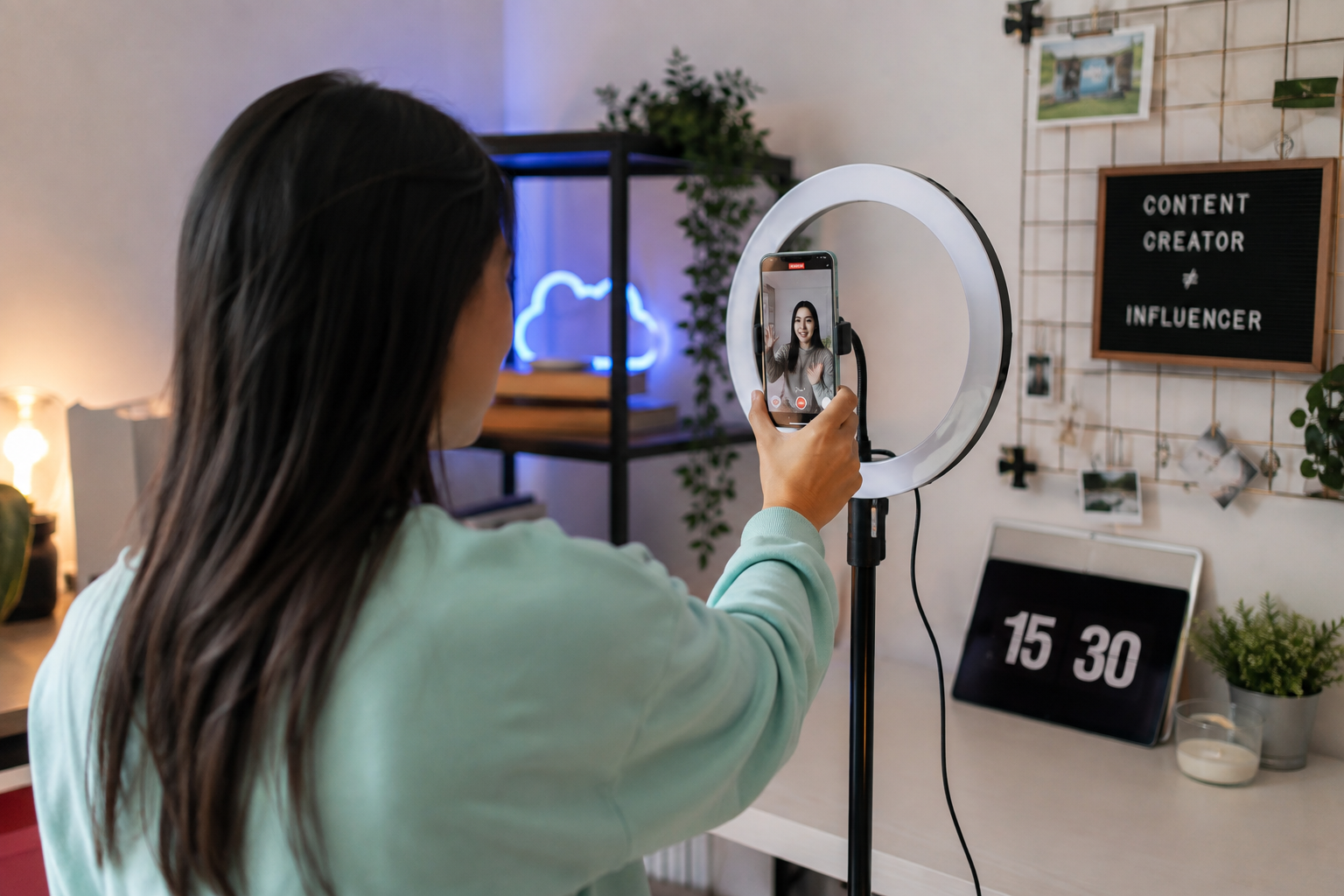
ChatGPT has no face and no voice. For a founder, a creator, a real estate agent, or anyone whose audience follows a person rather than a logo, the script still needs a presenter attached to it before anything can be posted. This is the step people underestimate, because a finished script reads like a finished job on the page. Somebody still has to say the words on camera, and until that is solved you have a document, not a video.
No edit
Captions, cuts, transitions, b roll, pacing, music. A raw talking head take is not a publishable short, and none of that editing work happens in a chat window.
Same brief, different script every time
Ask ChatGPT for the same video twice and you get 2 different scripts. Brand video runs the other way, on an identical face, identical lower thirds and an identical intro every single week.
The script is roughly the first 20% of the job, and it is the only 20% ChatGPT touches. In our own weekly publishing, the week stalls at filming, then at re filming because the lighting changed, then at editing, then at doing it again next Tuesday when you would rather be working. Writing the words has never been the part that stalls it. If your constraint is ideas, ChatGPT on its own is enough. If nothing publishes until you sit in front of a camera, you need a render layer, and no amount of prompting substitutes for one.
The format that performs best makes this harder, not easier. Wistia analyzed more than 13 million videos and 79 million hours of viewing data for its 2026 State of Video Report, and found engagement rate climbs the shorter a video gets, with sub one minute video the strongest band of all. Short, frequent video is what wins, and a manual filming workflow punishes exactly that cadence.
What happened to Sora, and why it matters for your workflow
Many of the pages still ranking for this question were written while Sora was live, so they tell you to route your finished script into a model that no longer accepts one.
OpenAI announced the shutdown in March 2026. The Sora web and app experience went dark on 26 April 2026, and the API sunsets on 24 September 2026.
The Decoder put Sora's running cost at roughly $1 million a day against about $2.1 million in total in app revenue across the product's life, with daily users peaking near 1 million before falling below 500,000. Those are reported figures rather than an OpenAI disclosure, and on those numbers the cost of serving the generation ran far ahead of what the product brought in. That is an economics problem, and it is not unique to OpenAI.
Do not build a content system on top of a single generation model, however good it looks this quarter. Own the two layers that are actually yours, the script and the presenter, and treat the rendering engine as a component you can swap. When the Sora app closed, we had to move our render step to another tool. The script process and the presenter setup carried over untouched.
The 2026 workflow, ChatGPT for the script and a video engine for the finish
The working pattern is a handoff.
- Brief ChatGPT with the audience, the runtime, the tone, and one idea.
- Get the script plus 10 hook variants, and choose the hook.
- Get the scene list, so you know what is on screen for each line.
- Take the script into a render tool and produce the footage.
- Apply captions, cuts, and b roll, then publish.
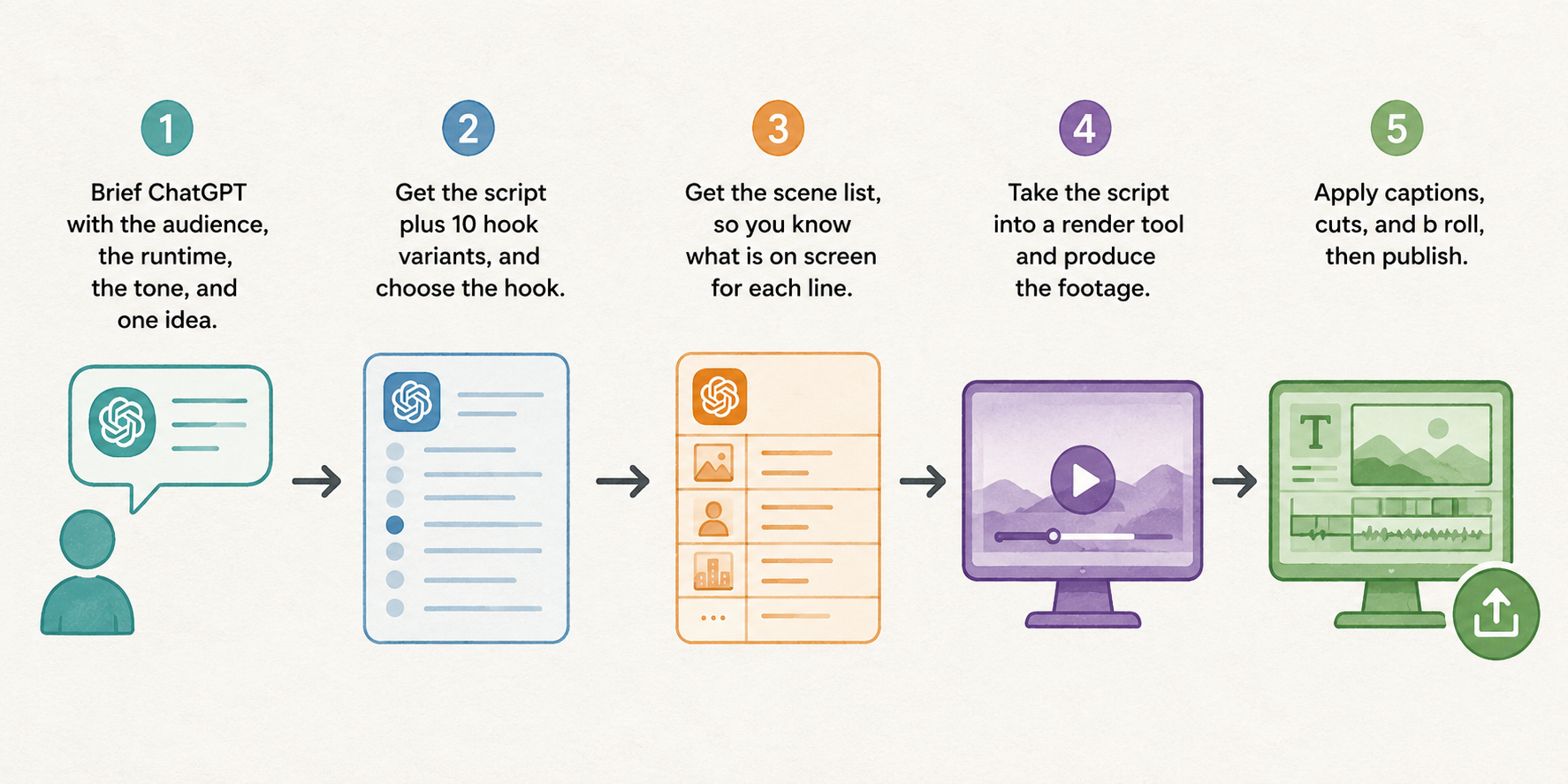
Step 4 is where people lose weeks, because there are two different render routes and they are not interchangeable.
Generative scene video
Text to video engines such as Runway and Pika generate footage from a description. What comes back is a scene, so this route covers product visuals, b roll, illustrative sequences, and abstract motion. Nobody in the frame is a specific repeatable person. These tools mostly end up with marketers producing visual material to cut around a voiceover, rather than with anyone whose audience is following a face.
Presenter led video
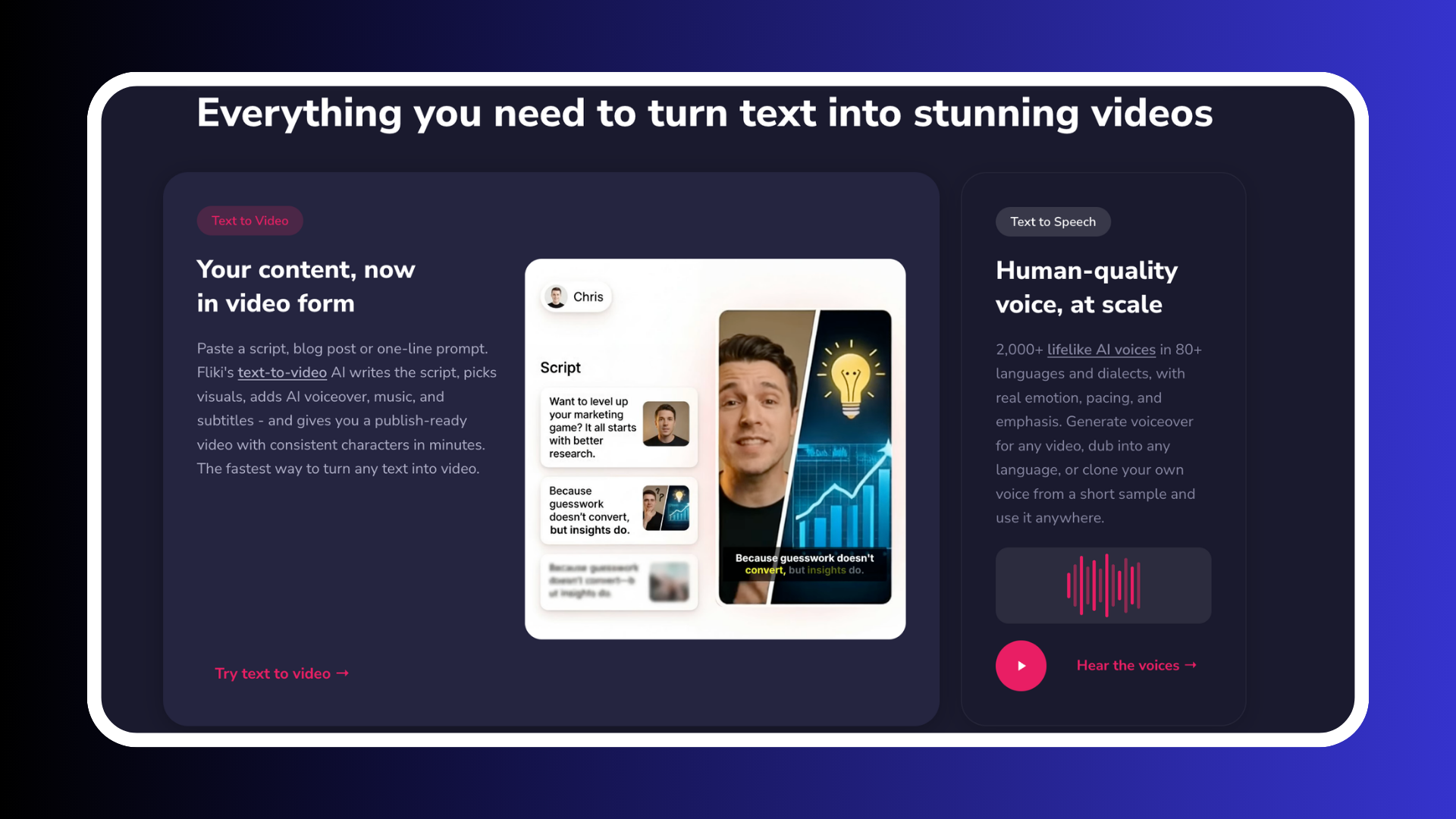
AI avatar and clone platforms such as Argil, HeyGen, and Synthesia take a script and return a person delivering it. Right for founder content, personal brand video, LinkedIn, sales follow ups, and course material. That is most of what small companies actually publish. Wrong when a talking head would just sit in front of the thing the viewer came to look at.
Pick the route on whether a person has to be recognizable in the finished video, and pick it before you pay for either one.
The presenter route also changes the economics of a cadence. Once a clone exists, the marginal cost of each extra video that month is a script and a render, not another filming session. That is the whole reason a weekly cadence becomes survivable, and it is the same logic behind repurposing written content into short form video rather than producing every piece from scratch.
Turning a ChatGPT script into a finished video with your own face
If the reason you are not publishing weekly is that filming sits in the way, that is the gap Argil was built for. You record roughly 2 minutes of yourself once to train a clone, then paste a script and get back an edited video with your own face and voice, captions applied, b roll placed, and transitions cut.
The pricing sits where the rest of the presenter category sits. Argil's Classic plan runs $39 per month for 1,600 video credits, around 25 minutes of video, after a 5 day free trial. For comparison, HeyGen's Creator plan is $29 per month for 600 credits and Synthesia's Starter plan is $29 per month for 10 minutes of video, with its Creator tier at $89. Entry pricing across the category clusters between $29 and $89, so the choice comes down to output volume and whether the platform actually clones you rather than handing you a stock presenter.
Argil is the wrong tool for some people. If your video is scene based product footage with no presenter in it, use a generative engine instead. If you publish once a quarter, filming it yourself is fine and cheaper. The case for a clone platform holds when you are publishing weekly or more, with your own face on it, and the filming step is the reason you keep missing weeks.
How to prompt ChatGPT for a script a video tool can use
The gap between a useless script and a usable one is almost entirely in the brief. Put these in it.
- Audience and the specific problem they have right now
- Target runtime in seconds, not minutes
- The single idea the video argues, stated in one sentence
- The hook format you want, and how many variants
- The call to action, verbatim
- The constraint that it must be speakable aloud in one take
Ask for a spoken script rather than an article, because unprompted, ChatGPT writes prose with clause structures no human can say out loud without running out of breath. Naming that constraint fixes it immediately. Ask for the hooks in their own message too, because bundled into the script request it hands you one opening line and moves on. Our AI script generator walkthrough covers the same brief structure applied across languages.
FAQ
Can ChatGPT make videos?
No. ChatGPT produces text, including scripts, hooks, scene outlines, and captions, but it cannot render a video file. To turn a ChatGPT script into a finished video you pass it to a separate platform, either a generative text to video engine or an AI presenter tool such as Argil.
Can ChatGPT make YouTube videos or Reels?
ChatGPT can write the script, the hook variants, the title, the description, and the on screen captions for a YouTube video or an Instagram Reel. It cannot produce the video itself. The render step still happens in a video tool, and for a talking head Reel that means an avatar platform or a camera.
Does ChatGPT still have Sora?
No, and it never did. Sora ran as a separate OpenAI product with its own site and app. OpenAI discontinued that web and app experience on 26 April 2026, and the Sora API sunsets on 24 September 2026. No OpenAI video generation is available inside ChatGPT.
What AI can make videos from text?
Generative scene engines such as Runway and Pika create footage from a text description, so they suit b roll and product visuals. Presenter led platforms such as Argil, HeyGen, and Synthesia turn a script into a person delivering it on camera, the right route for founder content and personal brand video.
Is ChatGPT free for writing video scripts?
Yes. ChatGPT's free tier will write scripts, hooks, and captions, and for scripting work most people never hit a wall that requires a paid plan. The cost in an AI video workflow sits in the render layer, where presenter platforms start around $29 to $39 per month.
Related Articles
- 7 Best AI Video Generators for Content Creators
- Context Aware AI Avatars for Blog Publishers, Turning Articles Into Videos
- Can AI Write a Movie Script From an Idea in 2026
Can ChatGPT make videos, what the model writes and what a video platform has to finish