12 Internet Advertising Platforms Compared for 2026
Compare 12 internet advertising platforms by audience size, CPM, and creative spec for 2026, and pick a 3-platform shortlist to test.
Article Highlights
- 12 internet advertising platforms ranked by audience and CPM
- CPM ranges for every major advertising platform in 2026
- Creative specs and the video that wins per platform
- A 4-question framework to pick your 3-platform shortlist
- Lowest-CPM platforms versus highest-converting platforms
- Argil renders native video for all 12 platforms at once
12 Internet Advertising Platforms Compared for 2026
Twelve internet advertising platforms cover roughly 95% of paid digital ad spend in 2026, and the difference between a profitable account and a drained one usually comes down to picking the wrong 3. Treat this as a buyer's reference you can skim. Note the audience size, CPM range, and creative spec for each, and walk away with a shortlist of platforms worth testing this quarter for your specific situation.
Before you scan, hold four inputs in your head: your monthly budget, your primary objective of awareness or conversion, your target audience type whether B2B or DTC or creator, and your creative production capacity, meaning how much native-format video you can actually ship. That last input quietly decides more than the first three, and we will come back to why at the end.
For each platform you will get the same four data points: monthly or daily active users, the 2026 CPM range, the dominant creative format that wins, and one example use case. One pattern runs through all 12. Every major platform now indexes on short-form video under 30 seconds in a platform-native vertical or square format, and producing that video has become the genuine bottleneck. The auction side runs itself now, so the creative is where the real work has moved.
1. Google Ads
The default for high-intent capture. Search, Performance Max, and YouTube live under one roof, which makes it the first platform almost everyone should buy.
- Audience: Google handles roughly 8.5 billion searches a day in 2026, per Demand Sage's search statistics, the largest pool of active buyer intent anywhere.
- CPM range: Google Display averages about $3.12 CPM, with search priced on clicks at roughly $5.42 average CPC, per WordStream's 2026 Google Ads benchmarks.
- Creative formats: responsive search ads, image ads, video (6s bumper, 15s skippable, 30s+), and Performance Max asset groups in square, vertical, and landscape video.
- What wins: high-intent keyword capture on search, founder-led talking-head video on YouTube preroll, and native-feeling UGC video for Performance Max.
- Example campaign: a local plumber spends $2,000 a month on local search plus PMax, but the video creative requirement stalls the launch for 4 weeks while they figure out how to produce it.

Google Ads is the default for high-intent capture.
When Google Ads is the wrong fit
Skip it for a net-new category with zero existing search volume, since there is no demand to harvest. Skip it for impulse-buy ICPs that do not research, such as DTC apparel and accessories under $50. And skip it on a budget under $1,000 a month with no existing creative library to draw from.
2. Meta Ads (Facebook and Instagram)
The default for DTC and SMB. Reach, lookalikes, broad targeting, and Advantage+ creative make it the workhorse of consumer paid media.
Image source: Meta Ads
- Audience: Facebook carries about 3.07 billion monthly active users and Instagram reached 3 billion in late 2025, per Get Panto's Meta statistics roundup.
- CPM range: US Meta CPMs run roughly $14 to $23 in 2026, with Reels and Stories placements about 10% to 30% cheaper than Feed, per AdAmigo's Meta CPM benchmarks.
- Creative formats: square 1:1, vertical 9:16 for Reels and Stories, carousels, and video up to 60 seconds for Reels.
- What wins: vertical UGC-style video under 15 seconds, a fast hook inside the first 1.5 seconds, and a founder or customer talking head over polished brand footage.
- Example campaign: a DTC skincare brand ships 30 creative variations a week, and the top 3 end up carrying 80% of the spend.
3. TikTok Ads
The default for under-35 reach and creative-led discovery. Spark Ads, TopView, and In-Feed give it a discovery engine no other platform matches.
- Audience: TikTok passed 1.9 billion monthly active users in early 2026, per Business of Apps.
- CPM range: the all-in TikTok CPM benchmark sits near $13 in 2026, per Trendtrack's TikTok versus Meta data.
- Creative formats: 9:16 vertical only, 9 to 60 seconds, native sound-on, captions burned in.
- What wins: creator-style content that does not look like an ad, with the hook landing in the first second. Spark Ads boosting an organic creator video routinely outperforms a studio-shot ad on CPA.
- Example campaign: a B2B SaaS founder posts 5 TikToks a week, boosts the best one as a Spark Ad, and watches cost per lead fall well below their LinkedIn number. Our breakdown of how to make ads for TikTok with AI covers the production side.
4. LinkedIn Ads
The default for B2B and high-ACV deals. Sponsored Content, Message Ads, and Conversation Ads let you target by job title and company size with a precision no consumer platform offers.
- Audience: LinkedIn reaches a deep base of professional decision-makers, and you pay a premium for that filter.
- CPM range: the LinkedIn median CPM runs about $31, climbing to $55 to $150 for narrow B2B and enterprise targeting, which is 4 to 8 times Meta, per Meet Lea's LinkedIn benchmarks.
- Creative formats: single image, document ads, native video where 1:1 square performs best at 6 to 30 seconds, and conversation ads.
- What wins: founder-led talking-head video with captions, document carousels with a strong cover slide, and hyper-targeting by title plus headcount.
- Example campaign: a B2B vendor targeting Heads of People at companies over 200 employees runs founder explainer videos and books meetings at several times the rate of their static ads.
Why LinkedIn rewards founder video specifically
The algorithm rewards in-feed dwell time, and a founder's face holds attention longer than a logo. B2B buyers want to see who they would be buying from before they book the call. And because most competitors still ship static carousels, video earns differential reach almost by default. Our guide to LinkedIn video content for busy CEOs goes deeper on the format.
5. YouTube Ads
The default for long-form storytelling, high-trust verticals, and a Shorts inventory that overlaps with TikTok.
- Audience: YouTube has about 2.72 billion monthly logged-in users in 2026, per Demand Sage's YouTube stats.
- CPM range: rates vary by ad type, with skippable in-stream and Shorts at the lower end and bumpers and masthead commanding more, broadly tracking the connected TV band of $15 to $65 for premium video.
- Creative formats: 6s bumper, 15s non-skippable, 30s+ skippable in-stream, vertical Shorts under 60 seconds, and masthead.
- What wins: the hook landing in the first 5 seconds at the skip point, a founder or expert carrying authority, and one clear call to action.
- Example campaign: a legal tech vendor runs 15-second skippable preroll against competitor brand searches and lands acquisitions well under their LinkedIn cost.
6. Reddit Ads
The default for community-led discovery and high-intent niche reach across developers, gamers, finance, and legal.
- Audience: Reddit averages about 121.4 million daily active users and 1.36 billion monthly, per Demand Sage's Reddit statistics.
- CPM range: Reddit CPMs run roughly $3.50 to $15 in 2026, among the cheaper inventory available, per Benly's Reddit Ads cost benchmarks.
- Creative formats: image, video up to 60 seconds, conversation ads, and promoted posts built to look like organic submissions.
- What wins: ads that read like a Redditor wrote them, with a subreddit-targeted niche tone and zero corporate polish.
- Example campaign: a B2B dev tool runs promoted posts in r/devops, and an organic-style talking-head video clears the studio ad by a wide margin.
7. Pinterest Ads
The default for DTC discovery in lifestyle, home, beauty, and wedding verticals where the user is actively planning a purchase.
- Audience: Pinterest reached a record 631 million monthly active users in early 2026, per Sprout Social's Pinterest statistics.
- CPM range: Pinterest runs roughly $3.50 to $9 CPM depending on objective, often around half of Instagram for awareness, per Trackbee's Pinterest Ads cost guide.
- Creative formats: static pin at 2:3 vertical, video pin at 9:16, and multi-page idea pins.
- What wins: aspirational visuals, search-intent keywords on the pin title and description, and short vertical video idea pins.
- Example campaign: a DTC home goods brand seeds idea pins into seasonal trends and earns a strong return on ad spend ahead of the buying season.
8. Snapchat Ads
The default for Gen Z reach under 25 and augmented-reality brand experiences.
- Audience: Snap reported 483 million global daily active users in its Q1 2026 investor letter, per Business of Apps.
- CPM range: Snap inventory generally prices below the major feeds, making it efficient for broad young-audience reach.
- Creative formats: 9:16 vertical video at 3 to 10 seconds for snap ads, AR lenses, story ads, and collection ads.
- What wins: fast vertical video with native sound, and AR lens campaigns built for product try-on in apparel and beauty.
- Example campaign: a DTC sunglasses brand runs an AR try-on lens and sees click-to-shop rates multiply against its static ads.
9. Microsoft Ads (Bing)
The default for B2B desktop reach and PPC overflow when Google CPCs get expensive.
- Audience: Bing holds about 5% of global search and closer to 10% in the US, per Backlinko's Bing usage stats, skewing toward older, higher-income desktop users.
- CPM range: Microsoft CPCs typically run 30% to 40% below Google for comparable keywords, per Backlinko's Bing data.
- Creative formats: responsive search ads, image ads, and native units across MSN and Outlook inventory.
- What wins: the same keywords that work on Google, imported as a campaign, with LinkedIn profile targeting layered on top.
- Example campaign: a B2B SaaS imports its Google Search campaigns to Microsoft Ads and picks up meaningful incremental volume at a noticeably lower cost per click.
10. Amazon Ads
The default for any brand selling a physical product, and increasingly relevant for off-Amazon DTC through its demand-side platform.
- Audience: Amazon's ad surface now includes Prime Video, whose ad-supported tier passed 315 million monthly viewers, per eMarketer.
- CPM range: Sponsored Products price on high-intent search clicks, while Sponsored Brands video and DSP inventory price on impressions in the mid-tier video band.
- Creative formats: Sponsored Products as text plus image in search results, Sponsored Brands video at 6 to 45 seconds, DSP video for off-Amazon, and Prime Video ads.
- What wins: high-intent keyword bidding on Sponsored Products and vertical short-form video for Sponsored Brands.
- Example campaign: a DTC kitchen brand runs Sponsored Brands video at the top of category search and doubles its click-through rate against a static banner.
11. X Ads (formerly Twitter)
The default for B2B thought-leadership amplification and real-time, event-tied campaigns.
- Audience: X discloses roughly 250 million daily active users, though reporting has been opaque since 2023, per Backlinko's X user statistics.
- CPM range: CPMs fell sharply after the 2023 advertiser exodus and remain among the lower-priced inventory, which can favor patient buyers.
- Creative formats: promoted posts as text, image, or video up to 2:20, takeover ads, and conversation buttons.
- What wins: native-feeling promoted posts that read like an organic thread, with founder-led short video beating brand-account content.
- Example campaign: a B2B founder promotes a customer-story thread and collects qualified replies at a fraction of their LinkedIn cost per lead.
12. Programmatic display and CTV networks
The default for upper-funnel reach beyond the walled gardens. The Trade Desk, DV360, and StackAdapt for smaller buyers.
- Audience: The Trade Desk alone reaches more than 185 million households streaming premium content worldwide, per its connected TV product page.
- CPM range: CTV inventory runs roughly $15 to $65 CPM depending on targeting and content quality, with display and native priced far lower.
- Creative formats: display banners in IAB standard sizes, native units, 15s and 30s CTV video, and audio for podcast networks.
- What wins: CTV video for upper-funnel brand-building, native units for content discovery, and CRM-imported lookalike audiences.
- Example campaign: a B2B SaaS targets its account list across The Trade Desk, runs 15-second founder video on CTV and laptop display, and lifts brand search measurably over 8 weeks.
Which platform to pick (decision framework)
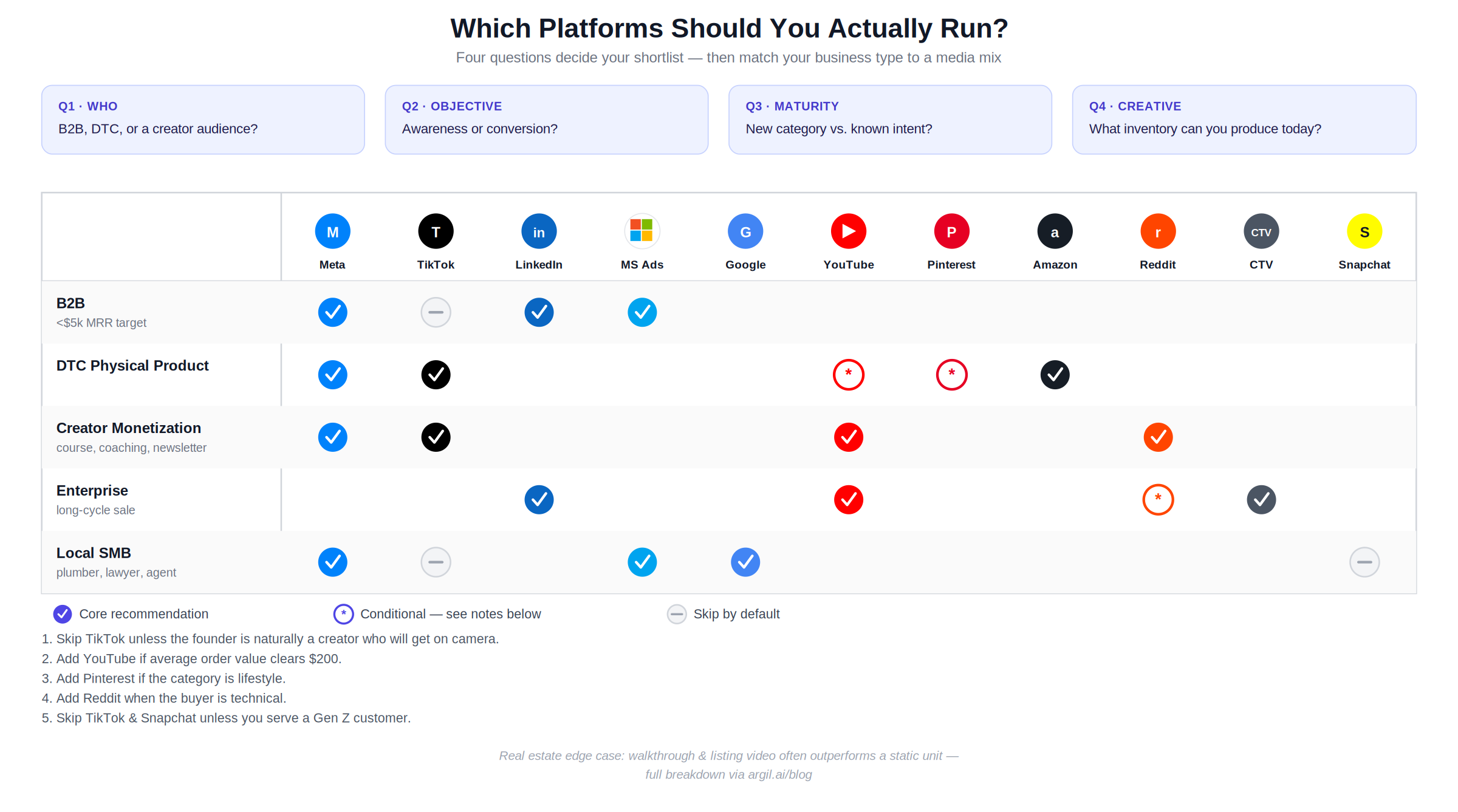
Social Media Platform Ad Matrix. Image generated using Claude ai.
Four questions decide your shortlist. Start with who the buyer is, whether B2B or DTC or a creator audience, then what the objective is between awareness and conversion. From there, weigh how mature the offer is, a new category versus known intent, and finish with what creative inventory you can actually produce today.
For B2B under a 5k MRR target, run LinkedIn plus Microsoft Ads plus retargeting on Meta. Skip TikTok unless the founder is naturally a creator who will get on camera.
For a DTC physical product, run Meta plus TikTok plus Amazon. Add Pinterest if the category is lifestyle, and YouTube if the average order value clears $200.
For creator monetization, a course or coaching or newsletter, run YouTube plus Meta plus TikTok, with Reddit for the niche communities your buyers actually live in.
For an enterprise long-cycle sale, run LinkedIn plus programmatic CTV plus targeted YouTube preroll, and add Reddit when the buyer is technical.
For a local SMB, a plumber or lawyer or real estate agent, run Google Local Services plus Meta plus Microsoft Ads. Skip TikTok and Snapchat unless you serve a Gen Z customer. Real estate is a useful edge case here, since walkthrough and listing video carries the offer better than a static unit, a pattern we cover in how real estate agents create viral UGC video.
The creative bottleneck nobody talks about
Scan all 12 platforms and the same pattern shows up everywhere. Every one now rewards short-form vertical video, native sound, and a real human face. The bidding mechanics are commoditized, so creative output is what actually separates the accounts that work from the ones that stall.
The number that decides it: top-performing accounts ship between 8 and 30 creative variations per platform per week, while most SMBs ship 1 to 2 a month. That gap comes down to production cost rather than strategy. Filming, editing, and recutting for every aspect ratio is what eats the time and caps the output.
Producing native-format video for each platform, vertical for TikTok and Reels and Shorts and Snap, square for LinkedIn and the Meta feed, horizontal for YouTube and CTV, used to demand 4 to 5 production days per concept. That timeline made genuine multi-platform testing impossible for any team under 10 people. Getting the formats right matters more than most buyers realize, which is why our primer on aspect ratios for vertical and horizontal video is required reading before you brief anything.
This is where the AI video layer earns its place. Argil lets a marketer record a 2-minute clone setup once, then generate fully-edited founder-voice video creatives in every aspect ratio straight from scripts. The cost of testing a hook drops from a production day to a prompt. Argil starts at $39 a month, against HeyGen's entry Creator tier, so the price of entering this game is a rounding error next to a single day of traditional production.
Across these 12 platforms the use cases line up cleanly. You want vertical 9:16 hooks for TikTok, Reels, Shorts, and Snap, square 1:1 founder explainers for LinkedIn and the Meta feed, and 15-second preroll bumpers for YouTube and CTV, with native-tone promoted posts for Reddit and X. One clone covers every platform.
The workflow is the payoff. Pick 3 platforms from this list using the framework above, write 10 hook variations per platform, generate them all with Argil, ship them in the same week, kill the bottom 60% on Friday, and double down on the top 2 the following week. A cadence that once needed a full production team now fits inside an afternoon for a marketer with taste.
Frequently asked questions
What are the most important internet advertising platforms in 2026?
Google, Meta, TikTok, LinkedIn, and YouTube cover roughly 80% of digital ad spend and are non-negotiable for most advertisers. The remaining 20%, Reddit, Pinterest, Snap, Microsoft, Amazon, X, and programmatic, matters intensely for specific verticals and audiences. Which of those you add depends entirely on your ICP, not on a generic ranking.
Which advertising platform has the lowest CPM in 2026?
Microsoft Ads, where clicks run 30% to 40% below Google, along with Reddit and Pinterest, tend to carry the lowest costs. But CPM alone is a weak metric. Cost per acquired customer and lifetime value are the only numbers that decide whether cheap inventory is actually cheap.
Should B2B companies advertise on TikTok?
Yes, conditionally. If the founder will get on camera and the buyer is under 40, which describes most modern B2B buyers, Spark Ads boosting organic founder content can beat LinkedIn on cost per lead. If the founder refuses to be on camera, skip it and stay on LinkedIn.
What is the right ad spend split across platforms?
Start with 70% on the platform where your ICP is most active, 20% on a discovery platform such as TikTok or Reels or YouTube Shorts, and 10% on an experimental third platform. Rebalance monthly based on cost per acquisition, not on the platform's own reported attribution.
How much creative do I need per platform per week?
For active accounts, 8 to 30 variations per platform per week. Top performers carry the spend and the bottom 60% gets killed early. The bottleneck is production cost, not strategy, and AI video tools bring the cost of a variation down by roughly 90% so a small team can keep that pace.
Do I need different creative for each platform?
Yes, for aspect ratio and length. Vertical 9:16 for TikTok, Reels, Shorts, and Snap. Square 1:1 for LinkedIn and the Meta feed. Horizontal 16:9 for YouTube long-form and CTV. The script can stay the same. The render has to be platform-native or it underperforms by 30% to 50%.
Which platform is best for SMB founders with limited budget?
Under $2,000 a month, run Meta plus Google Search plus one vertical-specific platform, TikTok for consumer, LinkedIn for B2B, Reddit for technical. Hold that for 90 days before adding a fourth. Concentration beats spread at this budget, full stop.
Related Articles
- How to repurpose blog content into short-form videos, platform by platform
- B2B Facebook ad graphics for physical products
- Top 10 video hooks that stop the scroll in 2025
Compare the internet advertising platforms worth your 2026 budget.