27 Blogging Tips for 2026: What Actually Works Now
27 blogging tips for 2026 built for AI Overviews, GEO, video repurposing, and creator-economy distribution. Real CTR data, real workflow.

Article Highlights
- 27 blogging tips built for AI Overviews and zero-click search
- Real CTR data: top results lost 58% of clicks to AI Overviews
- Writing, SEO, GEO, distribution, video, and monetization in one list
- First-hand experience signals are now load-bearing for E-E-A-T
- Repurpose every post into 5-10 short videos, not just one
- Argil turns a single blog post into a month of short-form video
27 Blogging Tips for 2026: What Actually Works Now
Most blogging tips you read still belong in 2018. They tell you to use H2s and write meta descriptions, hunt down low-competition keywords, and post 3 times a week. None of that is wrong, but none of it accounts for the fact that the search environment a blogger publishes into looks nothing like it did 2 years ago.
Google AI Overviews now answer the top of the funnel before a reader ever clicks. According to Ahrefs research published in February 2026, the presence of an AI Overview correlates with a 58% lower clickthrough rate for the top-ranking page. Seer Interactive's Q4 2025 study found organic CTR on AI Overview queries fell 61%. Brand-cited pages dropped from 2.52% CTR in October to 0.76% in November.
Some old advice still works, some is dead, and a few new tactics, especially video repurposing and generative engine optimization, are doing the heavy lifting for the blogs that grew through 2025 and into 2026.
The 27 tips are organized into five blocks. The video section is where most bloggers leave the biggest gains on the table, so plan to spend extra time there.
Why most blogging tips you read are out of date
The blog SEO playbook from 2022 was familiar: rank for an informational query, then monetize the click through ads or affiliates. That model assumed Google sent you a click in exchange for ranking. AI Overviews and Perplexity broke the exchange by citing a passage and answering the user inside the result, so many readers never click through.
Distinctive points of view and original data still earn traffic in 2026, alongside named expert authorship and content built to travel across platforms. The newer levers are generative engine optimization, llms.txt files, and treating every post as the source for a video distribution layer.
Writers who pivoted hardest to first-person experience and short-form video distribution are the ones who recovered blog traffic. The rest are still writing 4,000-word posts hoping the algorithm rewards effort, which it doesn't. The 2026 content marketing playbook looks closer to a creator playbook than to the SEO-first model that defined the 2010s.
Writing tips (1-7)
The biggest writing shift is that prose now serves two readers: the human skim-reader and the AI summarizer. Both want the same thing, which is the answer first and the nuance after.
Tips 1-3: Make every post defensibly distinctive
Tip 1. Lead with a contrarian claim or a piece of original data. AI-summarizable filler does not earn citations from generative engines. If your post sounds like every other post on the topic, it gets blended into the AI Overview and never sends you a click.
Tip 2. Use named expert sources, not "studies show." Generative engines cite passages with attribution; vague references get skipped. When you quote a person, link to where they said it.
Tip 3. Add a "we did this and here is what happened" section to every post. First-hand experience is now load-bearing for E-E-A-T. Google's December 2025 update extended E-E-A-T weighting beyond YMYL into all competitive queries, which means experience signals carry weight across almost every blog topic. Bloggers who want to go deeper here should read our breakdown of how to become a content creator in 2026, where the experience-first frame is built in from the start.
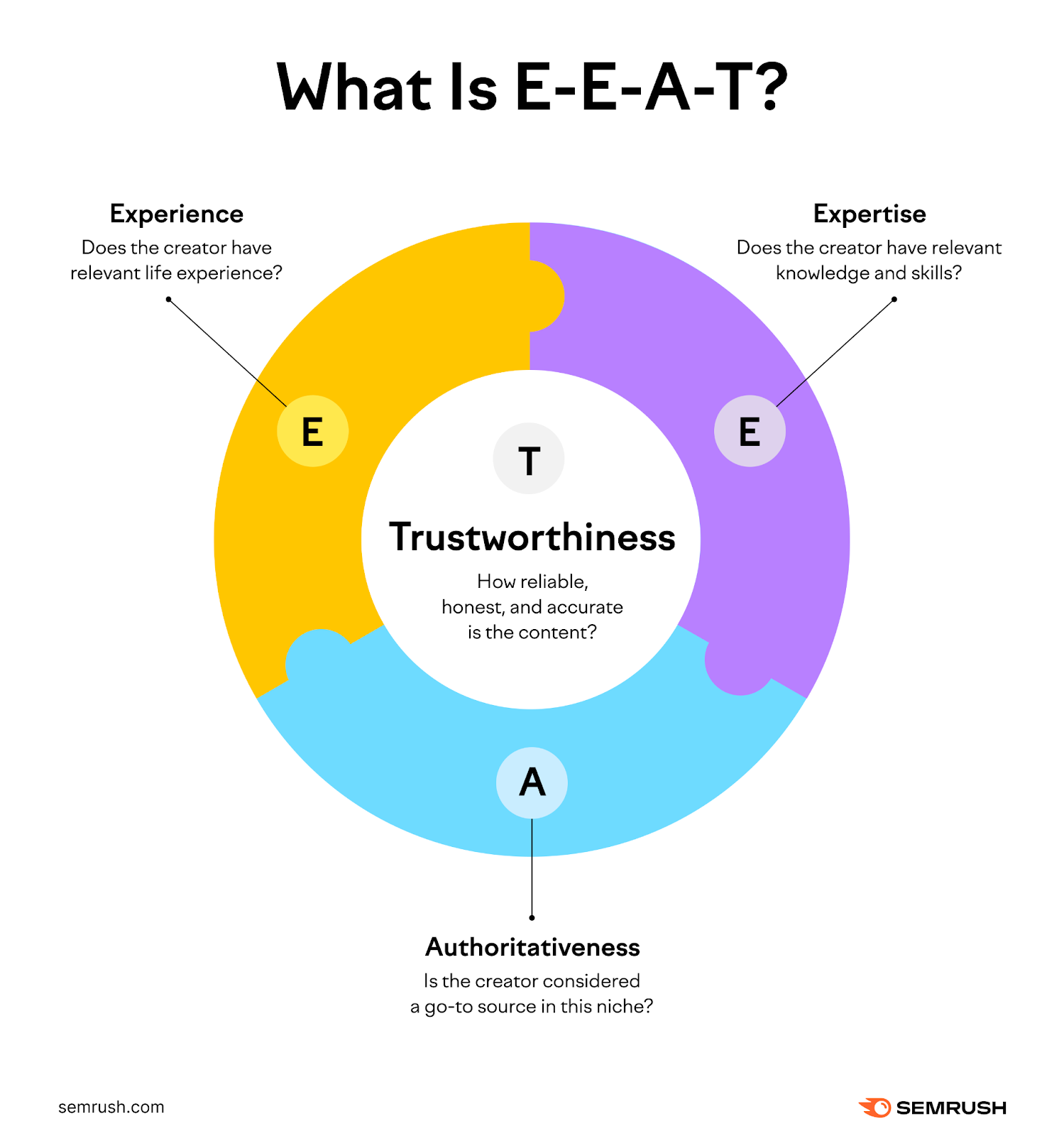
Google’s December 2025 update made experience signals matter across almost every competitive search query. Image source: Semrush
Tips 4-7: Write for retention, not word count
Tip 4. Strip filler intros and lead with the answer. Most bloggers spend their first 200 words context-setting; cut them and add nuance after the lede.
Tip 5. Use short paragraphs (1-3 sentences) and clear subheadings. Both are now readability and AI-citation requirements. AI engines lift passages, and a passage hidden inside a 200-word paragraph is harder to lift cleanly than a passage that lives on its own line.
Tip 6. Include a TL;DR at the top. AI search answer-engines often grab this directly. The TL;DR is also doing the job a meta description used to do, which is summarizing your post for a reader who is one click from leaving.
Tip 7. Stop writing at the natural endpoint. A 2,500-word post that finishes is better than a 4,000-word post that pads. Word count minimums were a 2019 idea and they did not survive AI Overviews.
SEO and GEO tips (8-14)
Search optimization is now two jobs. The first is the SEO you already know, and the second is GEO, which is optimizing for AI engines that cite passages instead of sending clicks. Both jobs share principles, but their tactics diverge.
Tips 8-10: Search optimization that still moves traffic in 2026
Tip 8. Target topics that AI Overviews struggle with. Comparison queries ("X vs Y") and "how I actually did this" first-person queries are still mostly clicked through, because users do not trust an AI summary to weigh tradeoffs they care about.
Tip 9. Build internal linking depth around your money topics. Topical authority still ranks; isolated pages do not. A cluster of 8 deeply linked posts on one subject outperforms 8 unrelated posts every time.
Tip 10. Stop chasing zero-volume long-tails. With AI summarization, the bottom 80% of long-tail queries no longer drive clicks. They get answered inside the AI Overview and never come back to you.
Tips 11-14: Generative engine optimization
Tip 11. Add an llms.txt file to your blog root summarizing your most citable passages. The file is a directory of what your site offers AI crawlers, similar to robots.txt but for citation rather than indexation.
Tip 12. Write Q&A blocks that match the way people prompt. Full questions, not "top 5" headers. When someone types "is blogging still worth it," they want an answer keyed to that exact phrasing, and AI engines reward sites that match the prompt structure.
Tip 13. Make your author bio rich enough for citation systems. That means a named human with a specific role, plus a link to LinkedIn and prior publications. Generic "by Admin" bios get cited zero times.
Tip 14. Track AI citations from Perplexity, ChatGPT, and Google AI Overviews the way you used to track backlinks. They are the new traffic source, and they need their own measurement layer because Google Search Console does not report them.
Distribution tips (15-19)
Most blogs that grew over the last 2 years did not grow because of Google. They grew because the writer built a parallel distribution channel. Email and short-form video did most of the work.
Tip 15. Stop relying on Google as the primary traffic source. The blogs that grew in 2025 and 2026 either built newsletter audiences or distributed via short-form video. The ones that stayed Google-only lost 30 to 70% of their traffic during the AI Overviews rollout.
Tip 16. Email-first distribution. Every post becomes a newsletter. Your readers read the newsletter even when SERP traffic dries up, which means your audience compounds independent of search algorithm changes.
Tip 17. Cross-publish curated excerpts to LinkedIn and X. Native posts beat link drops every time. A LinkedIn post that pulls one strong claim from your blog and develops it earns more reach than the same post with a link in the first sentence. The bloggers building real audience on LinkedIn are typically building a personal brand around their writing, not posting headline link bait.
Tip 18. Build a Reddit and forum strategy. Genuine participation in 2-3 niche subreddits compounds faster than another 5,000 words of new content. The posts that rank on Google for high-intent queries today are increasingly Reddit threads, not blogs.
Tip 19. Optimize the article for shareability with pull-quote-friendly statements and screenshot-worthy paragraphs. If a sentence cannot stand on its own when ripped out of the article, it cannot travel.

Most blogs that grew in the last 2 years didn’t rely on Google alone, they grew through email and short-form video.
Video repurposing tips (20-24): where the modern blog actually grows
According to Wistia's State of Video Report, short-form videos earn roughly 2.5 times more engagement than long-form content on social platforms, and 66% of consumers say short-form video is the content type they find most engaging. The implication for bloggers is that a written post without a video plan leaves most of its 2026 distribution untapped.
Why video is now load-bearing for bloggers
Tip 20. Treat every blog post as a video script. The blog is the durable artifact; the video is what gets distribution today. Writing a post without thinking about how it will become 5-10 videos is leaving your distribution upside on the table.
Tip 21. Aim for 5-10 short-form videos per blog post. Every claim and every example becomes a separate hook, so a 2,500-word post with a few named examples and a few contrarian claims gives you at least 7 natural video hooks. If filming yourself is the bottleneck, faceless reel methods will get you started before you commit to an AI clone.
How to repurpose at speed without becoming a YouTuber
Tip 22. AI clone tools collapse the production cost. Argil trains an AI clone of you on a single 2-minute video, then generates fully edited videos from scripts or directly from blog URLs. The clone learns your face and voice well enough that the videos look like you filmed them.
Tip 23. Workflow: paste the blog URL into Argil's article-to-video converter, get a video version of you talking through the article in roughly 2 minutes. The same blog post becomes 5-10 videos with this method, with captions and B-roll built into the export. Argil starts at $39/month, which is roughly the cost of one freelance edit. For comparison, HeyGen's Creator plan runs $29/month with 30-minute video caps and Synthesia's Starter plan runs $29/month for 10 minutes.
Tip 24. The distribution stack for repurposed video runs across TikTok and Instagram Reels on the short-form side, plus YouTube Shorts and LinkedIn video. One post and one filming session (the original 2-minute clone training) becomes 50+ video assets per month. The math compounds fast: four blog posts a month at 10 videos each equals 480 video assets a year from one writer. The TikTok side of the stack is its own subject; if you are starting from zero there, our walkthrough of how to go viral on TikTok in 2026 covers the ground rules.
Monetization tips (25-27)
Monetization in 2026 looks different too, because the audience itself is changing. Display ads are losing ground while affiliate revenue concentrates in a few categories. Writer-owned products take what is left.
Tip 25. Affiliate revenue still scales asymmetrically. One ranking buyer-intent post pays for years. Prioritize software and education affiliates over physical products. Software affiliates often pay 20 to 40% recurring; physical-product affiliates pay 4 to 10% one time.
Tip 26. Build a small paid product (a course or template) tied to your highest-traffic post. The conversion rate is far higher than ads for the same audience, and you own the product instead of renting revenue from an ad network.
Tip 27. Stop running display ads if your audience is professional. They cap your ceiling on premium sponsorships and look low-rent next to the rest of your stack. The serious blogs in 2026 have moved off ad networks entirely, replacing them with newsletter sponsorships at 5 to 20 times higher CPM.
What we left out, and why
These four pieces of advice still show up in most blogging tips lists. They were valid once and they are not anymore.
- Keyword density and exact-match keywords. Dead in 2017, still cited in old listicles.
- Domain authority chasing as a primary metric. Topical authority and citation patterns matter more in 2026.
- Word count minimums. The right length is the length that finishes the argument, not 2,500 words for everything.
- Posting frequency for blogs. One excellent post per week beats three thin posts. Volume moved to video, not blog.
The 2026 blogger's stack
The right tool list is short. Anything more than this is overhead.
- Writing. Notion or Roam for drafting; Claude or ChatGPT for hook iteration and audit passes.
- SEO and GEO. Ahrefs or SEMrush for keyword research; manual passes for AI citation tracking; an llms.txt file added to the site root.
- Distribution. ConvertKit or Beehiiv for newsletter; native posting on LinkedIn, X, Reddit; Argil for video repurposing.
- Monetization. A single affiliate stack tied to the niche; one paid product owned by you.
FAQ
Is blogging still worth it in 2026?
Yes, but only if you treat the blog as the durable source artifact and build distribution layers around it. Bloggers who depend solely on Google for traffic are losing 30 to 70%. Bloggers who pair posts with email and short-form video are still growing.
How long should a blog post be in 2026?
Long enough to make the argument and not a word longer. 1,500 to 2,500 words covers most informational topics. The "longer ranks better" rule did not survive AI Overviews, which now summarize your 4,000-word post in three sentences.
What is generative engine optimization (GEO)?
GEO is the practice of structuring content so AI engines like ChatGPT and Perplexity cite it. Tactics include named-source attribution and Q&A blocks that match prompt syntax, plus llms.txt files and rich author bios.
Should bloggers post videos to social media?
Yes. According to Wistia's 2026 video report, short-form video earns roughly 2.5 times the engagement of long-form on social platforms. The most efficient path is repurposing existing blog posts into 5-10 short-form videos using an AI clone tool.
How do you make money from blogging in 2026?
Software and education affiliates do most of the heavy lifting, with owned digital products like courses or templates next. Newsletter sponsorships and paid communities round out the stack. Display ads are deprioritized for any blog with a professional audience.
What is an llms.txt file and do I need one?
llms.txt is a plain-text file in your site root that tells AI crawlers what content on your site is most worth citing. Think of it as robots.txt for the LLM era. Most serious blogs added one through 2025 and 2026, and it is now table stakes for GEO.
Related Articles
- How to Create Video Content Without Being on Camera
- What's New in AI Video Generation: Key Trends and Tools to Watch in 2026
- What Is a Digital Creator in 2025
The 27 blogging tips above are the working playbook for the 2026 search and distribution environment.