How Much Does TikTok Pay Per View: The 2026 Revenue Guide
How much does TikTok pay per view in 2026? Creator Rewards, brand deals, Shop, Series, LIVE, and digital products, with real benchmarks.
Article Highlights
- TikTok pay per view is 1 of 6 creator income streams
- Brand deals dwarf per-view pay at every tier
- TikTok Shop commissions can reach 20% per sale
- Series keeps 80% of revenue for paid content
- How much does TikTok pay per view depends on stream mix
- Argil multiplies output across every revenue stream
Every Way TikTok Pays Creators in 2026
Most creators searching this question expect a single per-view number. The actual answer is a stack of 6 revenue streams that pay very differently, and the per-view number is the smallest one. Creators pulling real money off TikTok treat per-view pay as a baseline and stack brand deals, Shop commissions, Series, LIVE, and off-platform products on top. This guide maps all 6 streams with current rate ranges and points to the lever that scales every one of them at once.
Here are the six streams upfront so the rest of this guide has scaffolding:
- TikTok Creator Rewards Program: RPM on qualified views, $0.40 to $1.00 per 1,000 standard, up to $6.00 for niche high-retention content per Influencer Marketing Hub
- TikTok Shop affiliate commissions: a cut of every sale you drive, typically 5 to 30 percent per Calculate Creator's 2025 benchmark data
- Brand sponsorships: flat fees per sponsored video, $50 to $100K+ depending on tier
- TikTok LIVE gifts: virtual gifts converted to cash, $500 to $5,000 per strong session
- TikTok Series: gated paid content, creator keeps roughly 80 percent
- Digital products off-platform: courses, templates, coaching, funneled from TikTok traffic
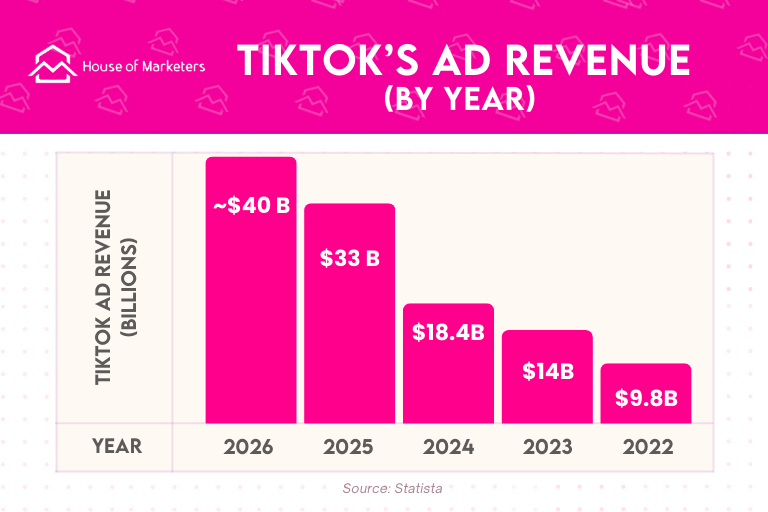
TikTok is an audience-building machine first and a payout platform second. Per-view pay rewards posting consistently, and the bigger streams (deals, Shop, Series, products) all reward the audience that consistent posting builds. Stack them and the creators you see quitting day jobs are not making money on view counts alone, they are making it on how the 6 streams compound.
TikTok Creator Rewards Program: How Per-View Pay Actually Works
The Creator Rewards Program replaced the original Creator Fund in 2023, and the shift matters for the math. Creator Fund paid from a fixed annual pool (roughly $200M in the US), so every new creator who joined shrank everyone else's share. The program now pays from live advertiser spend, so the pool grows with platform revenue rather than diluting against it. Per-1,000-view rates climbed roughly 10x in the transition per Bluehost's 2026 earnings breakdown.
"Qualified view" is the word that moves the calculation. Minimum video length is 1 minute per TikTok's official Creator Rewards Program terms, watch time and originality both count, but audience geography moves the number more than anything else. A video with 1 million views from low-CPM regions will earn less than 200,000 views from the US.
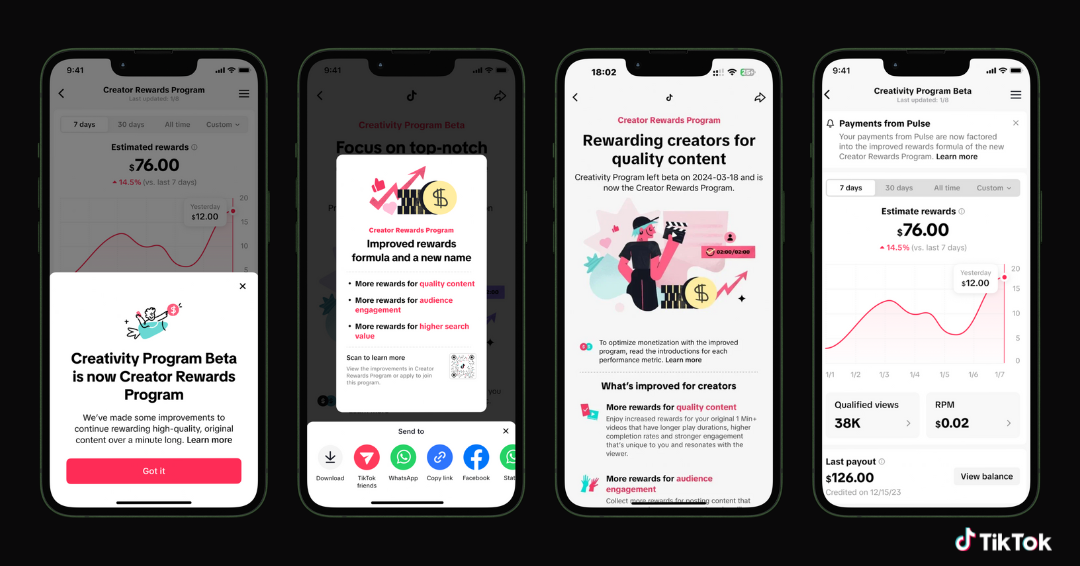
Minimum video length is 1 minute, and while watch time and originality matter, audience geography has the biggest impact on earnings. Image source: TikTok Newsroom
RPM ranges by niche, with current creator-reported data:
- Finance, investing, SaaS, B2B: $0.60 to $1.50 per 1,000 qualified views on the standard tier, higher with additional reward bonuses
- Lifestyle, fitness, health: $0.30 to $0.70
- Entertainment, comedy, dance: $0.15 to $0.40
- Gaming, memes, general: $0.10 to $0.35
These are creator-reported ranges. TikTok does not publish official RPMs, which is why every tool and blog you find will quote slightly different numbers. The shape of the ranges is consistent across sources.
Real math at mid-tier: a creator with 500,000 qualified views per month in a $0.50 RPM niche earns roughly $250 from Creator Rewards alone. That $250 is the baseline, and brand deals, Shop commissions, Series, and digital products are what take it from beer money to a real income.
Eligibility is the hard gate: 18+, 10,000 followers, 100,000 qualified video views in the last 30 days, account in good standing, based in the US, UK, France, Germany, Japan, South Korea, Mexico, or Brazil per TikTok's Creator Academy eligibility documentation.
Creator Rewards vs Creator Fund: What Changed and Why It Matters
Creator Fund had a structural problem. The pool was fixed at roughly $200M a year while the creator base kept growing, so every payout cycle shrank everyone's slice. Creators who earned $300 a month in 2021 were earning $30 by 2023 from the same view counts. Creator Rewards moved everyone off that fixed pool and onto an ad-revenue model where payouts grow with platform revenue, which is why per-view rates jumped roughly 10x in the transition.
Creator Fund is fully discontinued in most markets in 2026. If you are still seeing old dashboard data, check your Creator Rewards eligibility inside TikTok Studio and migrate. The qualification bar is slightly higher but the per-view payout is materially different.
Which Niches Pay the Most Per View on TikTok
Top-earning niches rank by advertiser CPM, which passes through to RPM:
- Personal finance and investing, where audiences have purchase intent and advertisers pay premium for qualified impressions
- SaaS and tech reviews, because B2B advertisers pay the highest CPMs on any platform
- Business education and coaching, same reasoning
- Health and fitness, mid to upper tier depending on product intent in audience
- Parenting and home improvement, mid tier with reliable brand deal interest
- Entertainment, dance, memes, pure reach, which gets huge view counts but low advertiser value per view
A nuance most creators miss: a lower-RPM niche with a purchase-intent audience can out-earn a higher-RPM niche on the back end. Finance creators win on per-view RPM, but beauty and fashion creators often win on total income because brands pay top of the range when audiences actually convert. If you are still deciding where to build, our breakdown of what counts as a digital creator in 2026 walks through how niche choice feeds every downstream revenue stream.
Brand Deals and Sponsorships: Where TikTok Creators Earn Real Money
Brand sponsorships are the primary income source for most professional TikTok creators. A single deal for a mid-size creator (100K to 500K followers) typically pays more than 3 to 6 months of Creator Rewards income combined. Brand income is what turns a side-hustle creator into a full-time creator.
Rate benchmarks by follower tier, based on Influencer Marketing Hub's 2026 TikTok rate guide:
- Nano (1K to 10K): $50 to $300 per sponsored post
- Micro (10K to 100K): $300 to $2,000
- Mid-tier (100K to 500K): $2,000 to $8,000
- Macro (500K to 1M): $8,000 to $20,000
- Mega (1M+): $20,000 to $100,000+
These are starting ranges. Numbers push higher when the niche is hot, engagement is strong, and the brand wants exclusive usage rights. Finance and crypto creators typically command 50 to 100 percent premiums over the ranges above because their audiences convert at higher rates, while health and wellness creators usually pull around 30 percent premiums and pure entertainment creators sit at or below the baseline.
What brand partnerships teams pay for is reliable distribution inside a defined niche. A creator with 150,000 followers posting 5 times a week in a tight niche will out-earn a creator with 400,000 followers posting twice a week in a broad lane, because a calendar that can promise 4 sponsored slots a quarter is worth roughly 4x a calendar that can only promise one.
Finding deals proactively matters more than waiting for inbound. TikTok's Creator Marketplace surfaces opportunities but tends to cap deal sizes, while direct outreach to brand partnerships teams opens up the higher end of the ranges above. If you need a primer on positioning yourself for these conversations, our guide to personal brand examples that drive business shows what positioning gets brands to pay top of the range.
How Posting Frequency Affects Brand Deal Rates
Brands pay for distribution windows. A creator posting 5 times per week gives a brand 5 potential viral moments per sponsored campaign, while a creator posting once a week gives them one, which is why the same follower count can produce very different annual income.
Run the numbers at a $1,000 per-video rate. A creator posting daily and selling one sponsored slot a week brings in roughly $52,000 annually from brand deals; selling two sponsored slots a week takes that to $104,000. A creator posting 3 times a week and selling one slot still ends up at $52,000, but with much less room to add more. Output sets the ceiling on how many sponsored slots you can sell before organic posts start feeling saturated with ads.
The content bottleneck is the block most creators hit. You can study brand-deal pricing, negotiation, and pitching for months. None of it converts to income if you can't reliably produce 4 to 7 sponsored-quality videos a week. Output is the gating constraint, and it applies across every revenue stream in this guide.
TikTok Shop, Affiliate Marketing, and Selling Your Own Products
TikTok Shop is the most underused stream on this list. There is no minimum follower count to join, and creators earn a commission on every sale driven by a tagged product in their videos. Commission rates typically land between 5 and 30 percent depending on category per Calculate Creator's benchmark dataset, with beauty, supplements, and fashion at the high end and electronics near the low end.
The in-platform attribution is what makes TikTok Shop different. External affiliate programs like Amazon Associates or ShareASale require link-in-bio traffic, which converts at 1 to 3 percent on a good day. TikTok Shop links directly in the video, the cart is native, and conversion rates on shoppable TikTok videos regularly land 3 to 10x higher than external affiliate clicks. The cut per sale is lower on some product categories than external programs, but the conversion lift usually makes the math work.
Selling your own digital products off TikTok (courses, templates, ebooks, coaching, newsletters, paid communities) is the highest-margin stream in this guide. A creator with 50,000 followers in a specific niche can out-earn a 500,000 general lifestyle creator by selling a $97 product to a small but highly qualified audience. Margin per sale is 80 to 95 percent after platform fees, compared with 5 to 30 percent on TikTok Shop.
Digital products keep earning long after the upload, in a way deal-based income doesn't. A product video uploaded today can drive sales 3 months later when it surfaces again on the For You page, while a brand deal stops earning the moment the campaign ends. The same content volume that grows Creator Rewards also multiplies digital product discovery moments. If you're stuck on what to film, our guide to side hustles using AI video walks through the product angles creators are monetizing right now.
TikTok LIVE Gifting and Series: Platform-Native Revenue
TikTok LIVE mechanics are simple: viewers buy Coins, send virtual Gifts during the broadcast, and the creator receives Diamonds at roughly 50 percent of Coin value, withdrawable as cash. Top LIVE creators report $500 to $5,000 per strong session, but most weeks return nothing, which is why most creators treat LIVE as situational rather than core.
TikTok Series is the gated content stream. Creators package long-form content into paid Series (up to 80 videos per Series, priced from $0.99 to $189.99), and keep roughly 80 percent of revenue. The fit is tight: educational, tutorial-heavy, or expertise-led content where viewers will pay for structured learning. A creator running a Series on "how to read financial statements" can earn more from 500 buyers at $49 than from 5 million organic views at baseline RPM.
How Much TikTok Creators Actually Earn: Real Benchmarks by Follower Count
Earnings stack across streams at predictable tiers. These are ranges based on creators running most streams simultaneously:
- 10,000 followers: $0 to $200 per month. Mostly LIVE gifts and small TikTok Shop commissions, no Creator Rewards eligibility yet
- 50,000 followers: $200 to $1,500 per month. Creator Rewards kicks in, micro brand deals begin, TikTok Shop commissions compound
- 100,000 followers: $1,500 to $5,000 per month. Brand deals become reliable, Shop sales start scaling, Creator Rewards settles into a predictable baseline
- 500,000 followers: $5,000 to $25,000 per month. Multiple brand deals per month, all streams active, digital products become realistic
- 1,000,000+ followers: $25,000 to $100,000+ per month. Sponsored slots priced at premium, Series viable, product ecosystems reliable
The niche multiplier is stronger than the follower multiplier. A 100,000-follower finance creator and a 100,000-follower dance creator are not on the same income trajectory. Same follower count, very different income potential, driven mostly by advertiser CPM in the niche and how reliably the audience converts on brand deals.
The output multiplier is stronger still. Two creators at 200,000 followers, one posting 5 times a week and one posting once: the first creator pulls roughly 5x the Creator Rewards income, 3 to 5x more brand deal pitches, and 4x more TikTok Shop discovery moments, plus compounding follower growth. Output is the biggest lever in this entire guide and the one most creators leave untouched.
TikTok vs YouTube Shorts vs Instagram Reels: Platform Pay Comparison
Side-by-side per-view comparison:
- TikTok Creator Rewards: $0.40 to $1.00 per 1,000 qualified views, standard
- YouTube Shorts: $0.04 to $0.06 per 1,000 views per Mediacube's 2026 creator data
- Instagram Reels: no direct per-view pay program in 2026, revenue driven by brand deals and bonus programs
TikTok's per-view rate is 10x higher than YouTube Shorts at the baseline, and Shorts trails badly for most niches. Where YouTube Shorts wins is when a Shorts viewer clicks into a long-form video, because long-form pays $2 to $10+ RPM. The pipe from Shorts to long-form is the YouTube strategy.
The move most high-output creators make: post the same video to all three platforms and stack monetization from each. Creators running this strategy report 2 to 3x total income from the same content output. Reels doesn't pay per view directly but it builds brand-deal pipeline; Shorts funnels traffic into long-form ad revenue, while TikTok pays Creator Rewards and drives Shop and brand deals. The catch: multi-platform distribution multiplies income on the same content, which is exactly why production volume becomes the constraint that decides everything else.
How to Post More Without Filming More: AI Video Creation for TikTok
The production bottleneck is the constraint that caps income for most creators. Filming, editing, captioning, rendering, scheduling, then posting and doing it again the next day, that's a second job stacked on top of everything else. It's why the average TikTok creator posts 1 to 3 times a week even though every number in this guide says daily is where the money lives.
Argil is built for this bottleneck. Upload a 2-minute video of yourself once and Argil trains a personal AI clone that matches your face, voice, and delivery. Write scripts and the clone turns them into fully-edited short-form videos with captions, cuts, and b-roll. There is no filming setup or editing software to manage, and the output looks like you recording, because the avatar is trained on you.
Argil runs $39 per month on the Classic plan with annual billing dropping it to $27 per month per the Argil pricing page. The Classic plan carries 1,600 credits per month and 10 avatar styles, enough for a creator producing 4 to 7 short-form videos per week. Compared with tools like HeyGen at $29 per month for the Creator plan, Synthesia at $29 per month for Starter, Revid at $39 per month for Hobby, or Creatify at $33 per month for Starter, Argil sits in the same price band but optimizes for short-form creator workflows rather than corporate explainer video or performance ad creative.
What changes in the income equation when the production bottleneck goes: a creator who was posting 3 times a week can comfortably output 14 to 21 videos a week. That output feeds Creator Rewards, sponsored slots, TikTok Shop discovery, digital product visibility, and follower growth all at once. Every income stream above scales with how many videos go up, and how many videos go up depends on whether the creator can produce them without burning out.
Who Benefits Most from AI Video Creation on TikTok
Best fit: creators whose face and expertise are the content. The strongest niches for this format are finance, business coaching, SaaS, health advice, legal education, tech reviews, and productivity, all of which happen to carry the highest RPMs and the strongest brand-deal rates. AI video works best when the creator is the product, and that creator-as-product model is exactly what advertisers pay top dollar for.
Not a fit: anything where the camera needs to capture physical action or environment. Cooking demos where technique drives the watch, fitness where form has to show, travel content where the environment is the hook, product unboxings, and physical-performance comedy all need real footage. AI video doesn't replace content that depends on the real world; it replaces the production grind around talking-head content, which happens to be most creator content by volume. For a deeper look at the creator-as-product model, our guide to branding an AI avatar that actually builds an audience covers the positioning that gets the model to scale.
FAQ
How much does TikTok pay per 1,000 views?
Standard Creator Rewards pays $0.40 to $1.00 per 1,000 qualified views, and niche high-retention content can reach $6.00 per 1,000 views. The per-view rate is one component. The creators earning real money combine Creator Rewards with several other streams: brand deals, TikTok Shop commissions, Series, LIVE, and off-platform product sales.
How many views do you need to make money on TikTok?
Creator Rewards requires 100,000 qualified views in the last 30 days. Brand deals and TikTok Shop can start earning at 1,000 to 10,000 followers with no view threshold. Views alone do not determine income: a creator with 10,000 engaged followers in a tight niche can out-earn a creator with 500,000 general lifestyle followers.
Can you make a full-time income on TikTok?
Yes, but rarely from Creator Rewards alone. A realistic $5,000 per month at 100,000 followers typically combines Creator Rewards ($200 to $600), two brand deals ($2,000 to $5,000), TikTok Shop commissions ($500 to $1,500), and often a digital product funnel ($1,000 to $3,000). The stream mix matters more than any single number.
How long does it take to start earning on TikTok?
Affiliate and LIVE gifts are possible at 1,000 to 5,000 followers. TikTok Shop works at any follower count if approved. Creator Rewards kicks in at 10,000 followers plus 100,000 monthly views, which typically takes 3 to 12 months of consistent posting. First brand deals usually land at 10,000 to 50,000 followers depending on niche.
Do you pay taxes on TikTok earnings?
All TikTok income is taxable as self-employment income in the US and most countries. TikTok issues a 1099 to US creators earning $600+ in a year. Most creators should plan for quarterly estimated tax payments. Tracking equipment, software, and content production expenses reduces taxable income materially.
Is TikTok pay per view worth it as a standalone income strategy?
No. Creator Rewards alone will not replace a full-time job for 95 percent of creators. As one stream in a multi-stream TikTok income stack, it becomes real money. The value of Creator Rewards is that it rewards exactly the behavior that grows every other stream: consistent, high-quality output at volume.
Related Articles
- How Do Leading AI Avatar Services Compare on Pricing in 2026
- What's the Best UGC Video Production Tool in 2025
- What's Happening in the Creator Economy in 2025
Complete TikTok pay per view and creator revenue guide for 2026, every income stream benchmarked
Editor notes from qa-articles - final score 98/100, 1 iteration: triplet density at 39.1% (above 30% threshold) but driven mostly by factual inline lists (geography, pricing tiers, ICP examples) rather than parallel rule-of-three device. Two genuine parallel-anaphora paragraphs (P34 no-X chain, P36 more-X chain) were tightened during the rewrite. No blockers. Status flipped to Ready to publish.