The Best Time to Post on YouTube: A Data Backed Guide
Buffer, SocialPilot and Metricool each ran a 2026 YouTube timing study and got different hours. See where they agree, and what to post today.
Article Highlights
- Best time to post on YouTube: 8am to 4pm for long form
- Shorts peak in the afternoon and evening, not the morning
- The 3 biggest 2026 studies land on different hours, side by side below
- YouTube says publish time will not change long term views
- Your Studio Audience report beats every published chart
- Argil removes the filming step so you can hold your slot
The Best Time to Post on YouTube: A Data Backed Guide
The best time to post on YouTube is between 8am and 4pm local time for long form videos, and early afternoon to 9pm for Shorts. The three largest public studies disagree on the exact hour, and YouTube itself says publish time does not affect a video's long term performance.
The short answer: best times to post on YouTube
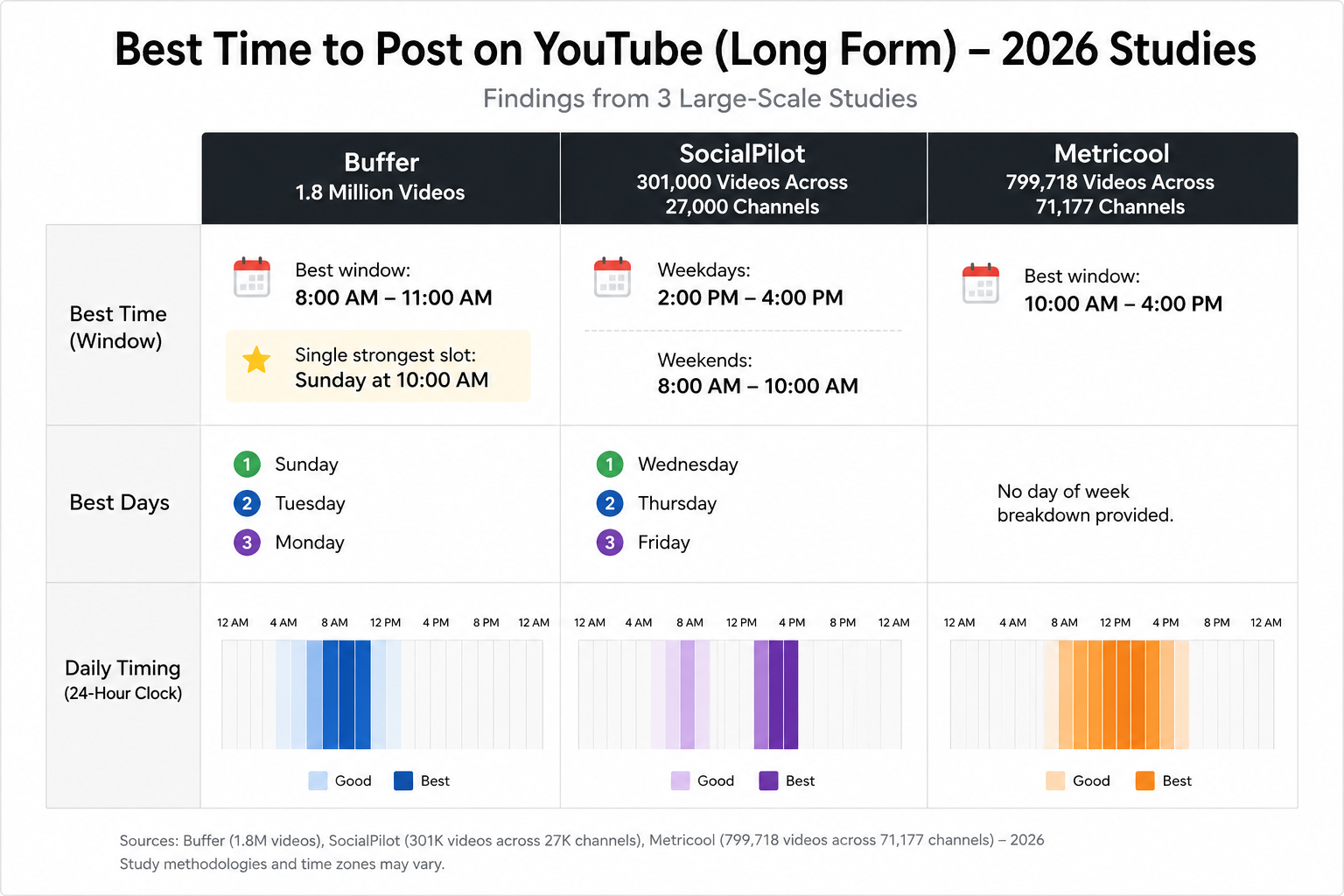
Three companies have published large scale timing studies in 2026. Here is what each one found, side by side.
| Study | Sample | Best long form window | Best Shorts window |
|---|---|---|---|
| Buffer | 1.8 million videos | Sunday 10am (best days: Sun, Tue, Mon) | Friday 4pm, with 6pm to 11pm strong overall (best days: Fri, Sat, Thu) |
| SocialPilot | 301,000 videos, 27,000+ channels | 2pm to 5pm weekdays, 8am to 10am weekends (best days: Wed, Thu, Fri) | 12pm to 3pm and 7pm to 9pm (best days: Fri, Sat, Thu) |
| Metricool | 799,718 videos, 71,177 channels | 10am to 4pm, no day breakdown published | 2pm to 6pm, no day breakdown published |
- Buffer, 1.8 million videos - Sunday at 10am is the single strongest slot, and the best overall window runs from roughly 8am to 11am. Best days are Sunday, then Tuesday, then Monday.
- SocialPilot, 301,000 videos across 27,000 channels - weekday uploads run 2pm to 5pm, narrowing to 1pm to 3pm on Friday, with weekends at 8am to 10am. Best days are Wednesday, Thursday and Friday.
- Metricool, 799,718 videos across 71,177 channels - One wide band from 10am to 4pm, with no day of week breakdown.
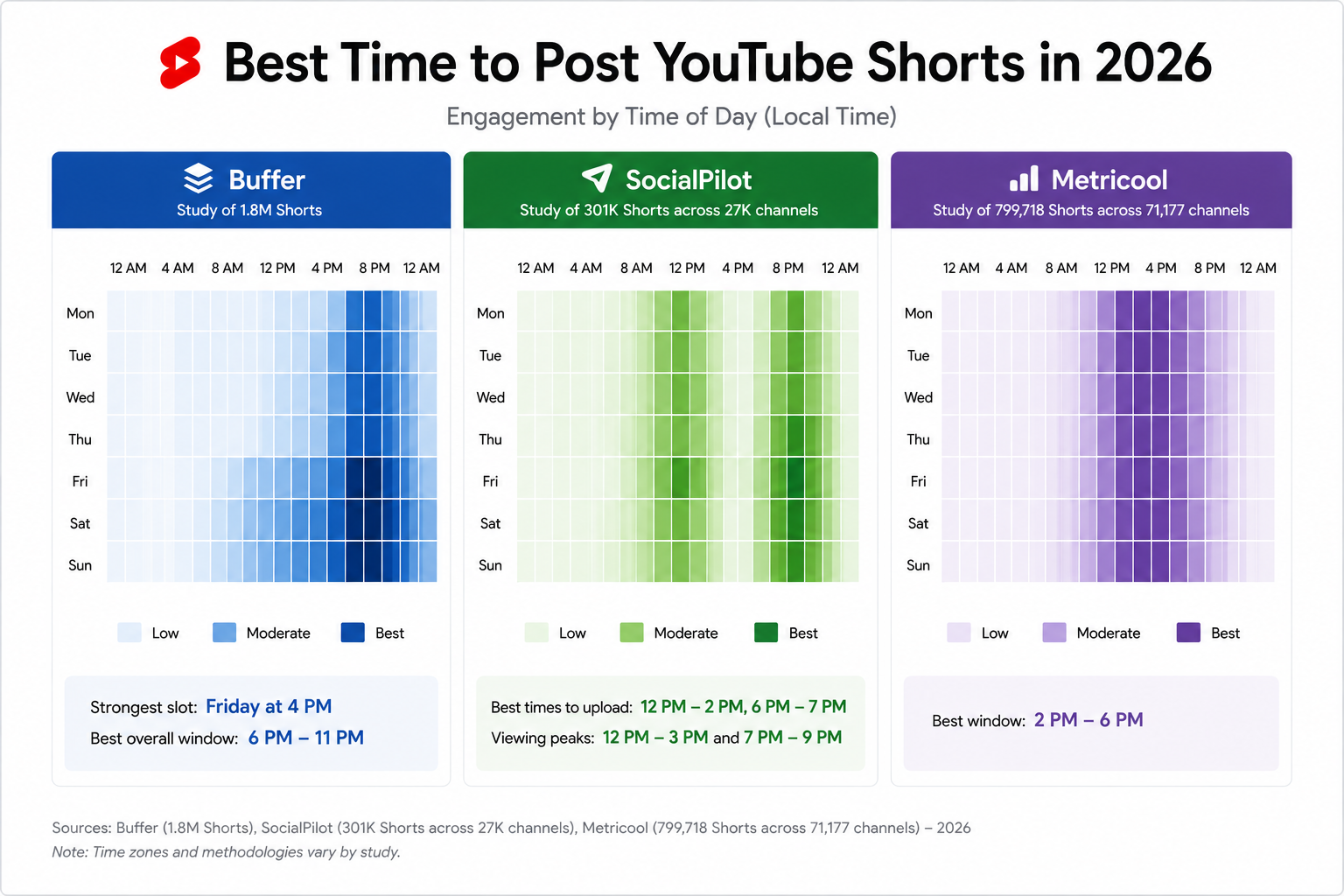
And for Shorts.
- Buffer - Friday at 4pm is the strongest slot, and evenings from 6pm to 11pm perform best overall. Best days are Friday, then Saturday, then Thursday.
- SocialPilot - Upload between 12pm and 2pm, or between 6pm and 7pm. Viewing peaks land at 12pm to 3pm and again at 7pm to 9pm.
- Metricool - 2pm to 6pm, with no day of week breakdown.
If you want one starting answer for long form, take a weekday early afternoon slot or a weekend mid morning slot, in your audience's local time. For Shorts, take early afternoon or the 6pm to 9pm block.
Both are starting hypotheses. The rest of this guide covers why those three studies point in different directions, and how to replace all of them with a number that comes from your own channel.
Why the published best times contradict each other
The long form numbers make the problem obvious. Buffer says Sunday morning. SocialPilot says Wednesday to Friday afternoon. Metricool gives a six hour band that swallows both. These are all large, honest datasets, and they cannot all be describing the same peak.
Most guides quietly pick whichever study supports the chart they want to publish. The disagreement is the more useful thing, because the cause of it tells you how much weight any single number deserves.
Upload time and viewing peak are two different numbers
SocialPilot's data separates the moment you hit publish from the moment your audience shows up, and recommends uploading roughly 2 to 3 hours before the peak. YouTube needs that window to index the video, test thumbnails against early traffic, and push subscriber notifications before the crowd arrives.
That gap is where half the confusion on this topic comes from. A study reporting a 6pm to 9pm viewing peak and a study recommending a 2pm to 4pm upload are describing two different fields, and they line up perfectly once you label them. Once those numbers get copied into a listicle the labels fall off, and readers end up scheduling for the wrong one.
Every dataset is one scheduling tool's customer base
Buffer, SocialPilot and Metricool each analyzed videos scheduled through their own product. That sample is made of creators organized enough to plan uploads in advance, paying for software to do it, and clustered in whatever regions and niches that company sells into, which is not what YouTube at large looks like.
A gaming channel scheduling through one tool and a B2B channel scheduling through another will produce different peaks. Sample size does not fix that.
The studies do not measure the same metric
Buffer ranked slots by median engagement across its 1.8 million videos. SocialPilot ranked by engagement rate normalized per view, a deliberate choice so that findings apply whether a channel has 500 subscribers or 500,000. Those two methods can rank the same hour differently even on identical data, because one is shaped by audience size and the other strips audience size out.
Every published best time to post on YouTube chart, including the table at the top of this page, is a starting hypothesis for your first test. Treating one as a finished answer is where the mistake happens.
What YouTube actually says about publish time
The platform itself has published a position on this, and few of the timing guides quote it. From YouTube's own performance FAQ:
"Publish time is not known to impact a video's long-term performance."
The same page adds that YouTube's recommendation system aims to deliver the right videos to the right viewers regardless of when a video was uploaded. It also carves out one exception, and that exception is Live and Premiere formats, where the whole event depends on people being there at a set time.
That line looks like it demolishes every timing study on this page, and the reason it does not is that the two are answering different questions.
The studies measure what happens in the first hours after publishing. YouTube is describing the lifetime of a video. A well timed upload gets a better first audience, which gives the recommendation system a cleaner early signal to work with. A badly timed one starts slower and then, on YouTube more than on any other platform, often catches up weeks later through search and suggested traffic anyway.
Spend real effort on timing where the opening window is the entire event: Shorts, Premieres and live streams. If you have moved your upload slot three times this quarter and never redesigned a thumbnail on an evergreen long form video, you are optimizing the wrong variable.
Best time to post long form YouTube videos
For long form, two windows appear in more than one dataset, which makes them the safest places to start.
- Weekend mornings, roughly 8am to 10am. Buffer's top three slots include Sunday 10am and Sunday 9am. SocialPilot recommends 8am to 10am at weekends. Two independent samples landing in the same two hour band is the strongest agreement anywhere in this data.
- Weekday early to mid afternoon, roughly 12pm to 5pm. SocialPilot puts the weekday upload window at 2pm to 5pm, narrowing to 1pm to 3pm on Friday. Buffer's third strongest slot overall is Friday 12pm, and Metricool's 10am to 4pm band covers the same ground.
Where the datasets split, they split on days. The split itself tells you more than any average of it would.
- Buffer's best days are Sunday, then Tuesday, then Monday, with Sunday clearly ahead.
- SocialPilot's best days are Wednesday, Thursday and Friday, with weekend performance concentrated in the morning.
Averaging those into a single recommended day would produce a number that neither study supports, so pick one and test it.
On the worst times, SocialPilot is the only one of the three to publish an explicit avoid list, and it flags weekday uploads before 9am, anything after 10pm, and early Saturday mornings. Its stated reasons are practical. Before 9am the audience is commuting or starting work, and after 10pm the active audience is smaller and notification delivery drops off. If you are publishing at 3am because that is when the render finished, use YouTube's scheduling feature and set it for the morning instead.
Whatever window you start with, make it one that fits a day you can reliably publish. Consistency is what trains both the recommendation system and your subscribers, and holding a Wednesday 2pm slot for 12 straight weeks is what that looks like in practice. That kind of consistency is also the foundation of a personal brand an audience remembers. The more common and more expensive failure is getting the hour right while the cadence slips. If you are still working out what to publish in that slot, our list of YouTube video ideas is the place to start, and how much YouTube pays per view will tell you what those early views are actually worth to you.
Best time to post YouTube Shorts, and why it runs opposite
Shorts and long form video peak in almost opposite windows.
Buffer puts Shorts at Friday 4pm with evenings from 6pm to 11pm performing best, against long form's Sunday 8am to 11am. SocialPilot puts Shorts at midday and early evening, against long form's mid afternoon. The hours differ but the direction is the same. Shorts skew later in the day, long form skews earlier.
Shorts sit in a browse feed that can keep surfacing a video for days, so a Short that lands flat on Tuesday can still find its audience on Friday, and the opening hour carries less weight. Long form leans much harder on subscriber notifications and suggested placements, which cluster around the moments people sit down to watch something instead of scrolling.
Side by side, the practical difference looks like this.
- Long form - Strongest earlier in the day, morning through mid afternoon. The first 24 hours carry real weight because notifications and suggested traffic fire early.
- Shorts - Strongest from early afternoon into the evening. The first 24 hours matter less, because the feed keeps re testing the video for days.
Run one upload schedule across both formats and one of them is always posting at the wrong time. If you publish both, they need separate slots, and the Shorts slot should sit later in the day than the long form one.
Shorts timing deserves a full treatment of its own, including the day by day breakdown and how the feed's testing cycle changes what a flop actually means. In the meantime, our YouTube Shorts hub collects everything on the format, including how long a YouTube Short can be and how Shorts compare to TikTok, both of which will shape your schedule.
How to find your own best time to post on YouTube
Every study on this page ends with the same recommendation, which is to use your own channel's data. Here is how.
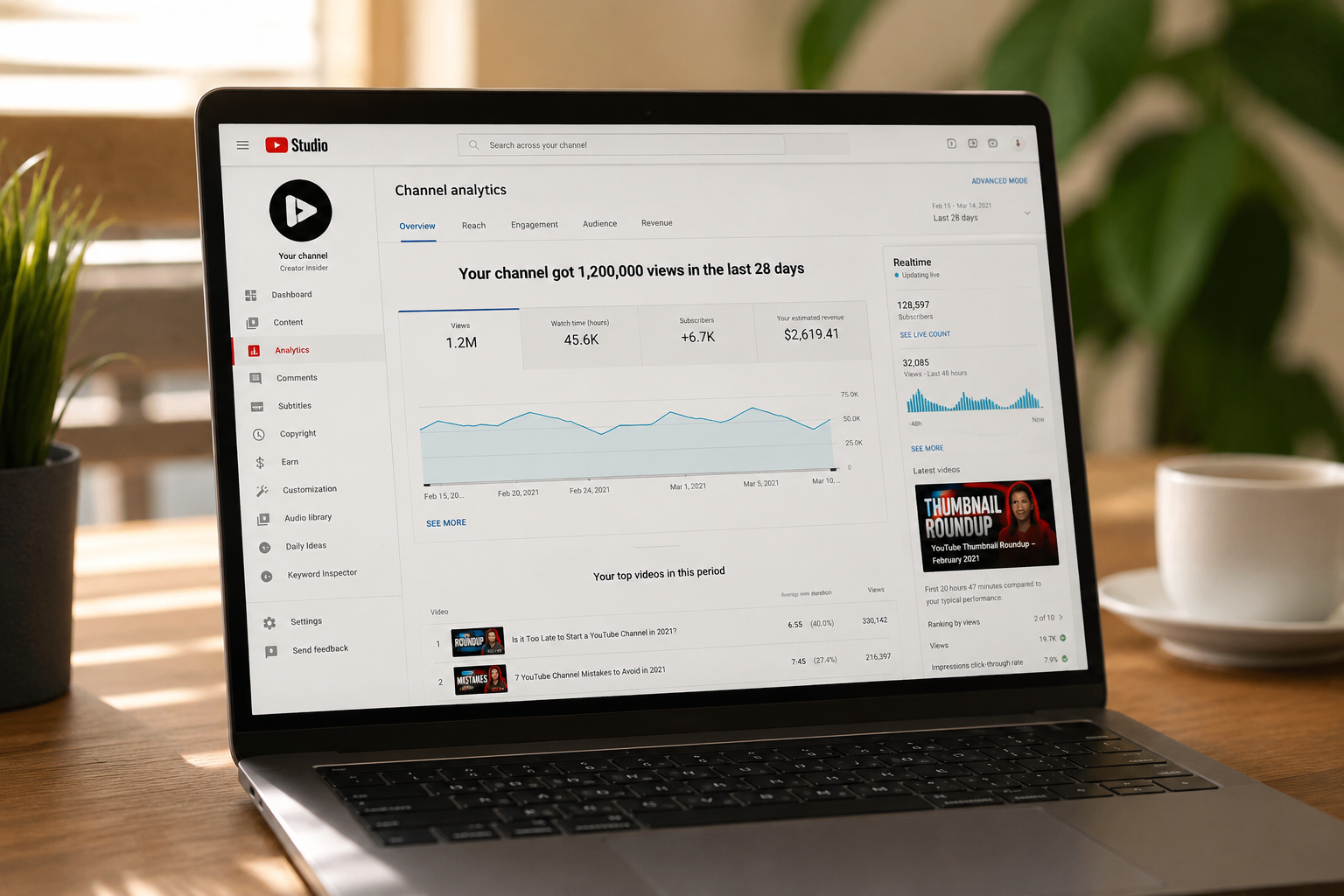
- Open YouTube Studio and select Analytics in the left menu.
- Open the Audience tab across the top.
- Find the report called "When your viewers are on YouTube".
- Read the last 28 days. The darker bars are the hours your audience is online.
- Set your upload 2 to 3 hours before the densest band.
Per YouTube's own documentation, that report shows when your viewers are online across YouTube in the last 28 days, and YouTube frames it as a tool for building community, scheduling a Premiere, and planning a live stream. It does not show when they watch you specifically.
The people in it are your audience, counted in their own time zones, which is what makes it usable. If you have a global audience, optimize for your single largest geography instead of hunting for a compromise hour that serves nobody well.
Then run an actual test. Everything except the slot stays fixed, so the topic, format, title style and thumbnail style all hold steady while you move the hour. Give it 6 to 8 uploads before you read anything into the result. Fewer than that and you are reading noise, because a single strong video will swamp the signal.
Finishing that test is harder than it sounds. If you publish weekly, 6 to 8 uploads is roughly two months. It is easy to change your thumbnail approach, topic mix and title style inside that window, and end up with a result that cannot be attributed to anything. So if you post once a week, timing is genuinely the wrong experiment to be running, and those two months are better spent testing thumbnails. Timing earns its place once you are publishing several times a week, and not really before. If you are starting from scratch, begin with setting the channel up properly.
The constraint the timing charts leave out
Follow the advice in every study above and you arrive at the same two instructions. Be consistent, and test across 6 to 8 uploads. Both are questions about how much video you can actually make.
If one video takes you a full day to film and edit, you cannot hold a Tuesday 2pm slot for 12 weeks running, and you can never complete a clean timing test. For a lot of channels, publishing capacity is what decides whether any of this is reachable.
That is the gap Argil closes. You upload a 2 minute recording of yourself once, which is enough to train the model, and after that the videos come from a script rather than a shoot. Posting a Short every weekday at 6pm is hard to sustain on a filming schedule, and only becomes practical when production is not the bottleneck. Holding a slot turns into a calendar decision, and the timing test above turns into something you can finish. The mechanics of uploading a Short take about a minute once the video exists, and our AI video creation library covers the rest of that workflow.
Timing mistakes that cost views
Four errors come up over and over.
Copying a US benchmark for a non US audience
A published benchmark is always somebody else's audience, measured in their time zones. Your Audience report is already reported in your viewers' own, so use it and ignore the benchmark entirely.
Publishing at the peak instead of ahead of it
If your audience peaks at 7pm and you publish at 7pm, the peak passes while the platform is still doing its opening work on the video. Move the upload 2 to 3 hours earlier and the crowd arrives to something already live and already surfaced.
Moving the slot every upload
Every change resets the experiment, so the data never accumulates and every conclusion drawn from it is noise. A slot needs 6 to 8 uploads behind it before the number means anything.
Optimizing the hour when packaging is the real bottleneck
YouTube's own impressions and click through rate documentation puts half of all channels and videos between 2 percent and 10 percent. Below 2 percent puts you underneath that band entirely, which means the thumbnail and title are losing the video before posting time gets a vote. Fix the packaging first, then come back to the hour.
FAQ
Does the time you post on YouTube actually matter?
It matters for the first 24 hours, not for the lifetime of the video. YouTube states that publish time is not known to affect long term performance, while timing studies consistently show it affects early engagement. It counts for most on the formats with a fixed opening window, which means live streams and Premieres above all.
What is the best day to post on YouTube?
The studies disagree. Buffer's data ranks Sunday highest for long form and Friday highest for Shorts. SocialPilot ranks Wednesday, Thursday and Friday highest for long form. Pick one and test it against your own Audience report. A blended day matches nobody's data.
What is the best time to post YouTube Shorts?
Early afternoon or evening, roughly 12pm to 3pm or 6pm to 9pm depending on the study. Shorts run later in the day than long form video, so if you publish both they need separate upload slots.
Is it bad to upload YouTube videos late at night?
SocialPilot's avoid list says yes, flagging anything after 10pm along with weekday uploads before 9am. The reasons given are a smaller active audience and weaker notification delivery. If your video is ready at 3am, schedule it for the morning instead of publishing immediately.
Should I post Shorts and long form videos at the same time?
No. The two formats peak in near opposite windows, so a single schedule will always be wrong for one of them. Give Shorts a later slot than your long form uploads.
How long before my audience peak should I upload?
Roughly 2 to 3 hours. Publish at the exact moment your audience arrives and the head start is gone before anyone sees the video.
How often should I post on YouTube?
Often enough that a schedule means something, which in practice means at least weekly for long form and several times a week for Shorts. Consistency is also the only way to gather enough data to test a slot properly.
Related Articles
Best time to post on YouTube, what the published data shows, and where it stops being useful.